
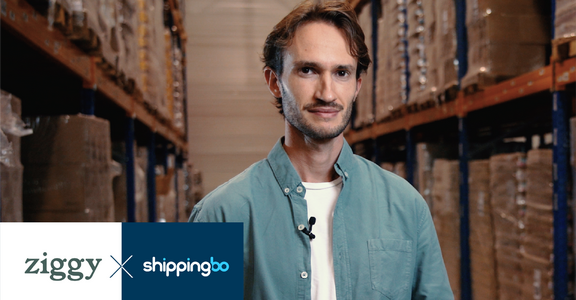
Does doubling order volume require doubling the size of the logistics team? For Ziggy, the answer is no. The brand, which specializes in cat nutrition, has made its in-house logistics a key driver to support its growth while maintaining control over its operations.
With Shippingbo, Ziggy organizes its various workflows, optimizes order fulfillment, and enhances inventory traceability. The goal is clear: to handle increases of 20,000, 30,000, or 35,000 orders without having to scale resources at the same rate.
“Being able to work with tools and solutions like Shippingbo—which are agile and flexible—allows us to fully align with our expectations and our DNA of strong growth.”
Logistics Case Study: Turning the Warehouse into a Growth Driver
At Ziggy, e-commerce logistics plays a direct role in the customer experience. The challenge, therefore, is not just to ship more, but to maintain reliable fulfillment as volumes and channels multiply.
A B2C Business That Has Become More Complex
Ziggy initially grew as a B2C e-commerce retailer. Today, the brand also distributes its products through more than 200 partners, including veterinary clinics and specialty retailers. It also operates three brick-and-mortar stores in Bordeaux and Paris.
Its warehouse must therefore accommodate several operational realities:
- subscriber orders, which are largely predictable
- traditional B2C orders
- B2B orders
- food products requiring tracking of lots and expiration dates
- Volume growth that requires regular adjustments to work methods
A single order-fulfillment method cannot effectively handle all of these order flows.
In-source to maintain control over operations
Ziggy has chosen to keep its logistics in-house in order to maintain control over its operations and to be able to adapt its processes as the company grows. This in-house logistics setup allows the company to directly influence warehouse zoning, picking routes, order-fulfillment methods, and the tools made available to its teams.
“In-sourcing logistics is clearly a key driver—a real strength—in hypergrowth because it allows us to constantly refine our processes.”
The goal, therefore, is not simply to keep the warehouse in-house. It is to be able to scale it quickly enough so that it does not become a barrier to growth.
Challenges faced: handling more orders without disrupting warehouse operations
As volumes increase, small inefficiencies quickly become significant. Unnecessary trips, poorly organized order picking, or a lack of visibility into inventory can gradually limit processing capacity.
Organize subscriptions, B2C, and B2B differently
At Ziggy, about 80% of customers are subscribers. A significant portion of orders can therefore be anticipated. Traditional B2C orders follow a different logic. Their preparation varies depending on the type of products and boxes. B2B orders impose yet other constraints. Combining these orders into a single process would have quickly disrupted the workflow in the warehouse.
So Ziggy needed to segment his order fulfillment process based on the operational realities of each workflow.
“Thanks to Shippingbo, we were able to create three main categories of preparation sessions: subscribers, B2C orders, and B2B orders.”
Ensuring the traceability of perishable products
The food products sold by Ziggy are subject to best-by dates.
Inventory inventory management cannot, therefore, be limited to simply knowing how many units are on hand. Teams must also track the lot numbers and dates associated with the products from the time they enter the warehouse until they are shipped.
“We’re making a significant effort to track pallets from the time they are received through their entire life cycle in the warehouse, all the way to when they are shipped out.”
Growth must not compromise this level of control. Performance therefore depends both on the speed of execution and on sufficiently accurate inventory traceability.
Solutions offered by Shippingbo: Structuring Execution Based on Actual Workflows
To address these challenges, Ziggy uses Shippingbo to streamline operations in its warehouse. The organization was built gradually around the actual workflows handled by the teams.
Three preparation sessions for three streams
With Shippingbo, Ziggy organizes his day into three main blocks:
- The first session focuses on subscribers. Since these orders are predictable, the packages can be prepared in advance. The teams then trigger the printing of the necessary labels at the appropriate time.
- The second session is dedicated to B2C, with different sessions based on the type of orders and boxes.
- Finally, a last session is dedicated to B2B.
This organizational structure ensures that tasks remain consistent and streamlines both picking and packaging.
“These sessions help ensure that everyone works efficiently and effectively, whether in picking or packaging.”
Improving Picking with PDAs and Zoning
Ziggy has gradually transformed its work processes. In particular, the company has transitioned from paper-based planning to the integration of PDAs.
At the same time, zoning makes it possibleto adapt the physical layout of the warehouse to different routing patterns. As volume increases, this structuring becomes increasingly important. Every unnecessary movement or handling task, repeated several thousand times, ultimately takes a toll on productivity.
“We took full ownership of the tool from start to finish to understand how we could optimize every route, every process, and every area in the warehouse.”
The WMS and field tools thus help make methods more reproducible and reduce reliance on individual habits.
Support that evolves with the organization
Ziggy’s transformation wasn’t limited to simply deploying software. The Shippingbo teams first worked on understanding how the warehouse operated, then onevolving order-picking methods andintegrating new practices.
“Shippingbo’s support is very hands-on right from day one, when they come in to conduct this comprehensive audit and consultation to understand how we operate.”
This support continues as new milestones are reached.
“As we reached various growth milestones—from 10,000 to 20,000 and up to 30,000 orders—we had constant interactions with our contacts.”
The logic is important: an organizational structure designed for 10,000 orders isn’t necessarily the one that will allow us to manage 30,000 efficiently.
Results: doubling volumes without doubling the workforce
The goal of an effective logistics organization is not to ask workers to work twice as fast. It is to create enough capacity to handle more orders through a more efficient organizational structure.
Growth that does not automatically translate into new hires
That’s the most compelling part of Ziggy’s testimony.
“Given that we’re operating at 20% capacity, we’re fortunate that we don’t have to double our staff after all.”
This sentence sums up the challenge of logistics scalability.
By streamlining its processes and leveraging the data provided by Shippingbo, Ziggy can handle more orders without having to increase its workforce by the same proportion.
“We didn’t feel the need to ultimately double our workforce, even though our order volume has doubled.”
The challenge, therefore, is not to cut back on resources. It is to maintain operating flexibility before each new phase of growth immediately requires new hires.
A logistics system capable of handling the next phase
For Ziggy, bringing operations in-house does not mean maintaining a small-scale, artisanal structure.
In-house logistics, on the other hand, becomes a driver of growth when it is based on structured processes, reliable inventory management, handheld devices, tailored order-picking procedures, and an organization capable of adapting. This approach already enables the company to look beyond its current volumes.
“Today we’re at 20,000 orders, but tomorrow we could easily reach 30,000, 35,000, or even more.”
Can your logistics handle twice as many orders?
Ziggy’s story ultimately raises a simple question: If your volume doubled tomorrow, could your warehouse keep up without doubling its resources?
The Ziggy case shows that before adding staff, it may be worthwhile to review the segmentation of material flows, picking routes, order fulfillment, zoning, traceability, and the tools used by operators.
Shippingbo enables e-commerce businesses to streamline these operations using its OMS, WMS, and TMS modules, allowing for better coordination of orders and their fulfillment within the warehouse.
Are you looking to scale up for your next phase of growth without overwhelming your warehouse with complexity? Request a Shippingbo demo:

FAQ
What is in-house logistics?
In-house logistics means that the e-retailer manages its inventory, order fulfillment, and shipping within its own organization. This model allows the company to maintain control over these processes and adapt them quickly as volumes, sales channels, or operational constraints change.
How can we handle more orders without doubling our staff?
The challenge is to increase processing capacity without increasing resources at the same rate. This involves, in particular, better organization of workflows, tailored preparation sessions, the use of PDAs, optimized picking, and the automation of repetitive tasks. At Ziggy, this approach makes it possible to double order volumes without having to double the workforce.
Why Use a WMS in an E-commerce Warehouse?
A WMS helps structure and manage warehouse operations. In particular, it helps organize storage locations, guide order fulfillment, track inventory movements, and improve inventory traceability. For a growing e-commerce business, it is especially valuable for making processes more reliable and repeatable as volumes increase.
How does Shippingbo support Ziggy’s logistics growth?
Shippingbo enables Ziggy to organize its subscription, B2C, and B2B workflows into different preparation sessions. The solution also supports the use of PDAs, warehouse zoning, and the tracking of batches and expiration dates. This support evolves in line with the company’s growth stages to adapt processes to new volumes.
Glossary
In-House Logistics
An arrangement in which a company directly manages its logistics operations—including warehousing, order fulfillment, and shipping—rather than outsourcing them entirely to a third-party provider.
WMS
The Warehouse Management System(WMS) is software used to manage the physical operations of a warehouse, including inventory, storage locations, order fulfillment, movements, and traceability.
PDA
A PDA is a mobile device used by warehouse operators. Among other things, it can guide them during order picking, allow them to scan products, and ensure the security of certain steps in the order preparation process.
Picking
Picking refers to the process of gathering products from the warehouse to prepare an order. Optimizing picking routes helps reduce unnecessary movement and improve productivity.
Zoning
Zoning involves organizing the warehouse into different zones based on products, material flows, or order-picking methods. It allows operators’ routes to be tailored to the actual workflow.
Batch Processing
A preparation session groups together several orders based on common criteria in order to process them more efficiently.
Inventory Traceability
Inventory traceability involves tracking products and their movements as they pass through the warehouse.
Logistics Scalability
Logistics scalability refers to an organization’s ability to handle an increase in volume without proportionally increasing its costs, workforce, or complexity.