
Understanding a logistics platform means understanding how a company actually organizes its workflow between receiving, storage, order fulfillment, and shipping. This guide explains how it works, the main types of platforms, how they differ from a warehouse, and the criteria to consider when choosing, organizing, and effectively managing logistics operations.
- What is a logistics platform?
- How does a logistics hub work?
- What are the different types of logistics hubs?
- How do you choose and organize a logistics hub?
- How does Shippingbo help manage a logistics hub?
A logistics hub is a facility where goods are received, inspected, stored if necessary, prepared, and then redistributed to customers, stores, or other locations. It manages both the physical flow of products and the information needed to process them.
In e-commerce, a platform can receive products from multiple suppliers, process orders from an online store, marketplaces, or physical stores, and then manage their fulfillment and shipping.
In fact, the volume of sales continues to grow. In 2025, French e-commerce reached 196.4 billion euros in revenue, including 76.1 billion euros in product sales, up 4% year-over-year, according to Fevad’s 2025 annual report.
Its performance, therefore, does not depend solely on the building. It relies on the ability to coordinate orders, inventory, warehouse operations, and transportation.
What is a logistics hub?
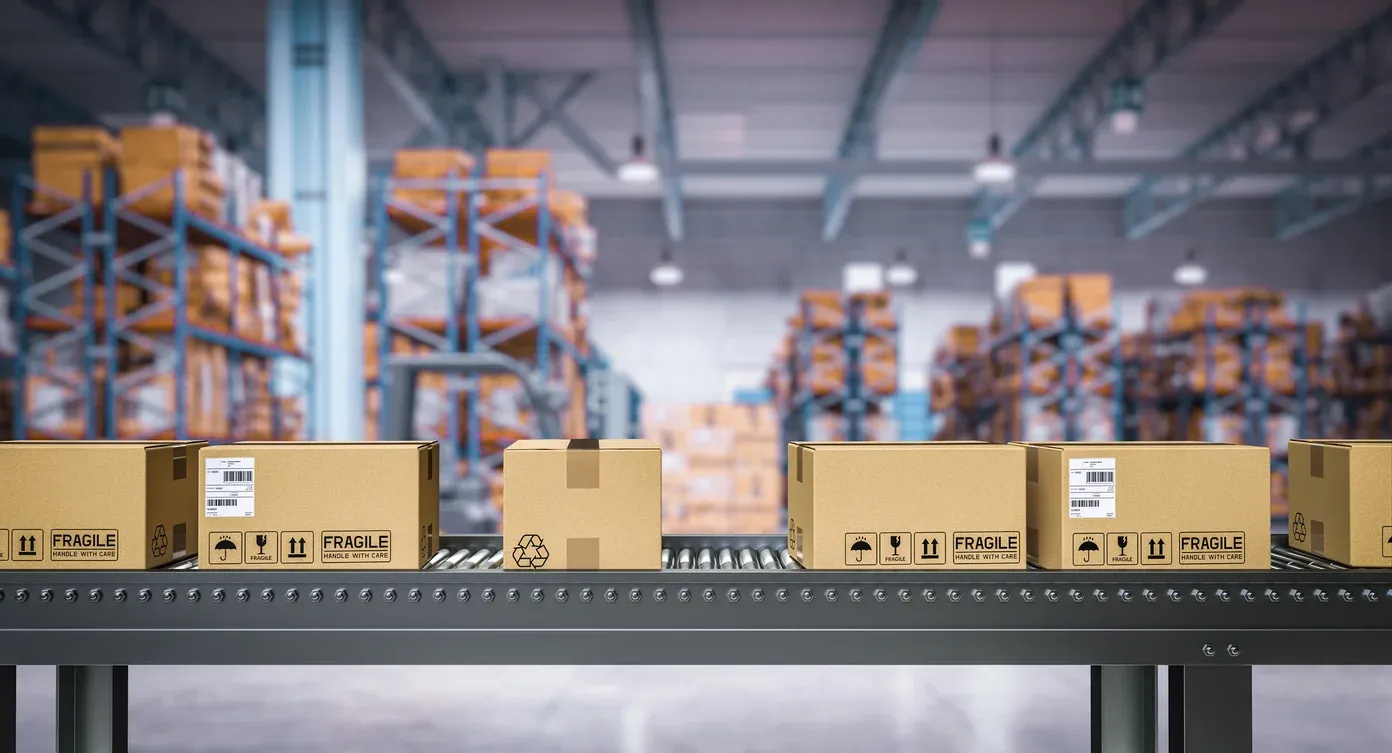
A logistics hub is, above all, a processing point between the arrival of goods and their next destination. Its function is to receive, process, route, and redistribute products.
Unlike a storage-centric approach, a platform can hold goods for several weeks or operate with very little intermediate inventory.
Definition and Practical Example
To provide an operational definition of a logistics hub: it is a facility organized to receive goods, carry out the necessary operations to process them, and prepare them for redistribution to a customer, a store, a partner, or another logistics site.
Let’s take the example of an e-commerce logistics hub. A brand sells on Shopify, Amazon, and in several physical stores. Its suppliers deliver their products to a central hub.
Upon arrival, the goods are inspected and logged. Some are sent to a storage area. Others are already needed for orders and may follow a shorter route.
When an order arrives, the products are located, picked, inspected, packed, and then handed over to the appropriate carrier.
The hub thus connects four flows: goods, orders, inventory, and transportation. If information doesn’t flow smoothly between these flows, the physical fulfillment process suffers as well.
What is the difference between a logistics hub and a warehouse?
The difference between a warehouse and a logistics hub lies primarily in their primary function. Historically, warehouses have been organized around storage. Logistics hubs, on the other hand, are more focused on processing and redistribution.
| Organization | Primary Function | Storage | Destination |
| Warehouse | Store goods | Generally important | Future orders or other locations |
| Logistics hub | Receive, process, and redistribute | Variable | Customers, stores, or locations |
| Distribution center | Store, prepare, and distribute | Often present | Network of stores or customers |
| Cross-docking | Sort and reship quickly | Very limited | Next destination |
| Logistics hub | Concentrate and redirect flows | Secondary | Multiple destinations |
These categories are not mutually exclusive. A single platform can store certain items and handle other products via cross-docking.
This infrastructure represents a significant number of facilities in France. As of December 31, 2024, metropolitan France had 3,900 warehouses or logistics hubs measuring 10,000 m² or more, with a total area of 93 million m², according to the“ ” (National Inventory of Logistics Infrastructure), published by the Ministry of Ecological Transition’s Data and Statistical Studies Service. Their total floor area increased by 2.3% over the past year.
A distribution center can also combine storage, order fulfillment, and redistribution. The term “logistics hub” places greater emphasis on the consolidation and subsequent redistribution of goods within a network.
How does a logistics platform work?
The operation of a logistics platform follows a simple process: receiving goods, recording their status, directing them to the correct location or order, and then organizing their shipment.
The challenge arises when volumes, sales channels, SKUs, or processing rules increase.
From Goods Receipt to Shipping
Ideally, the process begins before the truck arrives. The hub must know which products are expected, their quantities, and their supplier.
Upon receipt, operators verify the SKUs and quantities delivered. Depending on the business, they may also check the condition of the goods, the lots, or the serial numbers.
The products are then routed. Those intended for storage are sent to a storage location. Those already assigned to orders may take a shorter route. In cross-docking, the goods move almost directly from receiving to shipping.
When an order needs to be fulfilled, teams must know where the product is located, how much is available, and what priority to apply.
After picking, the items are inspected, packed, and accompanied by the necessary documents. The packages are then handed over to the selected carrier.
Key Operations Performed
The activities at a logistics hub vary depending on the company’s model, but the journey of a shipment generally includes:
- receiving, inspecting, and recording products;
- storing and organizing inventory;
- internal transfers and restocking for order picking;
- preparing and checking orders;
- packaging and assembling shipments;
- Generating shipping labels and documents;
- handing over to the carrier and tracking shipment status;
- processing returns and restocking items as needed.
The role of a logistics platform is therefore to ensure continuity between these operations.
This challenge is particularly significant in an e-commerce logistics hub, where B2C, B2B, marketplace, and retail orders can all coexist, each with different priorities, fulfillment methods, and shipping solutions.
What are the different types of logistics hubs?
Logistics platforms can be categorized based on two simple criteria: how goods move through them and the organization that operates the facility.
This overview is more useful for a logistics manager than a lengthy classification of buildings.
Storage, Distribution, or Cross-Docking Centers
A storage-oriented hub stores goods until they are picked for an order. The organization of storage locations, inventory, and restocking plays a central role here.
A distribution hub combines storage and order fulfillment to supply multiple recipients: consumers, stores, distributors, or other sites.
Cross-docking follows a different approach. Incoming goods are sorted and then quickly shipped out. Interim storage is kept to a minimum.
No single model is universally superior. A company handling several thousand SKUs with irregular demand does not have the same needs as an organization capable of precisely synchronizing its supplier deliveries with its shipments.
In fact, a single distribution center can combine these approaches depending on the products and orders.
In-house, outsourced, or 3PL-operated platform
A company can operate its distribution center in-house. In this case, it retains direct control over teams, inventory, and processes. In return, it is responsible for the facilities, equipment, and day-to-day operations.
It can also outsource all or part of its operations. In that case, the service provider handles the actual execution, but the company must maintain sufficient oversight of its orders, inventory, and service quality.
A 3PL logistics platform is operated by a logistics provider for multiple clients. It must manage different product catalogs, inventories, order-fulfillment rules, and service levels while sharing teams and equipment.
The decision between in-house operations and outsourcing therefore depends on volume, variability, the desired level of control, available expertise, and the ability to manage a service provider.
How do you choose and organize a logistics hub?

The choice of a platform should be based on the order volumes to be processed, not just on its capacity. It’s important to understand what comes in, what goes out, at what rate, and under what constraints.
For example, a platform designed for average business volume can become a bottleneck when an event like Black Friday or a sales campaign concentrates several days’ worth of orders into a short period of time.
Location, Capacity, and Nature of the Workflow
Location influences access to suppliers, carriers, customers, and labor pools. It must be evaluated within the context of the overall logistics network.
Capacity is not limited to the number of square meters available. A distribution center may have sufficient storage space but lack loading docks, order-picking stations, or packing areas during peak periods.
The nature of the products also matters. Dimensions, weight, fragility, packaging, batches, or serial numbers can affect organizational requirements.
When choosing or evaluating a platform, several criteria must be considered together:
- location relative to suppliers, customers, and carriers;
- average and peak volumes;
- number of SKUs and physical characteristics of the products;
- expected lead times between receipt and shipment;
- number of channels and types of orders;
- available human, technological, and financial resources.
A dedicated platform is therefore not suitable for all companies. With low volumes and simple workflows, a leaner organizational structure or outsourcing may be a better option.
Organization of Inventory, Teams, and Loading Docks
Effective logistics hub organization aims to reduce movement, unnecessary handling, and cross-flow.
Frequently ordered items can be placed closer to the order-picking areas. The reserve stock then replenishes the picking locations as needed.
Processing rules must also be clear. Teams must know which orders to prioritize, how to handle an urgent receipt, or what to do when a stock discrepancy arises.
Technology, Connectivity, and Traceability
Logistics hub management relies as much on data as it does on the physical layout.
The tools must make it possible to determine which order needs to be fulfilled, where the inventory is located, which operation is in progress, and how the merchandise should be shipped.
A logistics platform software cannot compensate for poor on-site organization. It must translate processes into executable rules: receiving, movements, priorities, checks, and shipments.
Data quality is critical. An incorrect theoretical inventory level can result in an order that cannot be fulfilled. An incorrect product SKU can cause an error to be passed on to the customer.
Traceability, on the other hand, allows you to track the key stages: receipt, storage, movement, fulfillment, and shipping. It becomes critical in omnichannel, multi-warehouse, or multi-client environments.
How does Shippingbo help manage a logistics platform?
Shippingbo does not provide the building, loading docks, or material-handling equipment.
The solution operates at the logistics execution level. It helps connect information across orders, inventory, warehouse operations, and shipments through three complementary components: OMS, WMS, and TMS.
Orchestrating orders and workflows with an OMS
An OMS, or Order Management System, centralizes orders and manages their fulfillment.
When a company sells through multiple channels or has multiple inventory sources, displaying orders in a single interface is no longer enough. It’s also necessary to determine where and how each order should be processed.
OMS Shippingbo allows you to centralize workflows and route them according to defined operational rules.
It primarily answers one question: Which order should be fulfilled, where, and according to which rules?
Manage inventory and operations with a WMS
The WMS, or Warehouse Management System, manages the physical operations in the warehouse.
With Shippingbo, it handles tasks such as receiving, bin assignments, inventory movements, order picking, and inspections. Operations performed on the PDA allow actions to be recorded directly on the shop floor.
The WMS answers a second question: where are the goods located, and how should they be handled to fulfill the order?
As volume increases, scanning, picking routes, and traceability also help standardize methods and reduce reliance on individual warehouse staff knowledge.
Automate shipments with a TMS
The TMS is activated at the time of shipment.
It allows you to connect operations to carriers, apply shipping rules, and generate the labels or documents needed for shipment.
It answers a third question: How should the prepared order be shipped?
The benefit of combining OMS, WMS, and TMS is to ensure continuity between the received order, available inventory, the warehouse operation, and the final shipment.
A high-performance logistics hub bridges the physical and digital worlds
A logistics platform is not simply a building designed to store or handle products in transit. It is an execution system that manages the flow of products from receipt through shipment. Its performance depends not only on the physical layout but also on the quality of the data used to manage orders, inventory, and transportation.
As the number of channels, volumes, warehouses, or customers grows, it becomes difficult to maintain this coordination using isolated tools and manual processes. Shippingbo helps structure this operational layer through its OMS, WMS, and TMS modules, without providing or replacing the platform’s physical infrastructure.
Are you looking to streamline, modernize, or better manage your logistics platform? Talk to a Shippingbo expert to analyze your organization and identify the workflows that need to be made more reliable.

FAQ
A logistics hub receives, processes, and redistributes goods. Depending on how it’s organized, it may also handle storage, order fulfillment, packaging, shipping, and returns management.
A warehouse is primarily focused on storage. A logistics hub places greater emphasis on receiving, processing, and redistribution. In practice, a single facility can fulfill both functions.
No. Some hubs store products for several weeks. Others operate on a just-in-time basis. In cross-docking, goods are received, sorted, and then quickly shipped out.
A 3PL hub is operated by a logistics provider on behalf of one or more companies. The 3PL handles the physical operations while adhering to each client’s specific guidelines.
An OMS coordinates orders, a WMS manages inventory and warehouse operations, and a TMS handles shipments and transportation. Integrating these systems minimizes information gaps between ordering, fulfillment, and delivery.
There is no universal threshold. A dedicated logistics platform becomes necessary when volumes, the number of SKUs, peak periods, sales channels, or fulfillment constraints make it difficult to manage the workflow with a simpler setup.
Glossary
3PL
A logistics provider that handles all or part of a company’s physical operations, such as warehousing, order fulfillment, or shipping.
Cross-docking
A system in which goods are received, sorted, and then quickly shipped out, with very little interim storage.
Logistics hub
A central hub in a network where multiple cargo flows are consolidated before being rerouted to different destinations.
OMS (Order Management System)
Software that centralizes orders from multiple channels and organizes their fulfillment according to defined rules.
PDA
A mobile device used by warehouse operators to scan products and record transactions directly on the floor.
Picking
The process of removing the products needed to fulfill an order from inventory.
TMS (Transport Management System)
Software used to manage shipments, apply shipping rules, and generate the documents required for shipping.
WMS (Warehouse Management System)
Software that manages inventory and physical operations carried out in the warehouse, such as receiving, transfers, order picking, and inspection.