
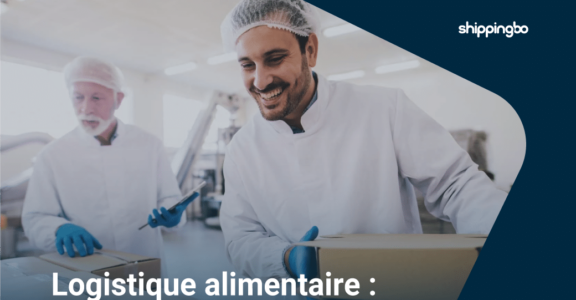
Discover the crucial issues in food logistics. From the cold chain to inventory management and traceability, explore with us the challenges of food logistics management.

Navigating the complex and demanding world of food distribution is a bit like juggling eggs. Every detail counts to ensure the quality of the products delivered. So there’s an essential question: how can you ensure this quality when shipping products that are often perishable?
Food logistics is a special discipline that covers all aspects of the delivery of food products from producer to consumer. Our mission? To ensure that your food products arrive at their destination on time, safe and of impeccable quality.
This is where food logistics differs from more general logistics. Due to the perishable nature of food products, time is a critical factor. Any slowdown or delay in the distribution chain can shorten the product’s shelf-life, affect its quality and, in the worst case, render it unfit for consumption. What’s more, the preservation and transportation of food products require specific conditions, such as controlled temperatures, which are not always required in other types of logistics.
And to understand food logistics management, it’s essential to optimize the entire supply chain. Ready to learn more? We’ll tell you all about it!
The cold chain
The cold chain plays a key role in the success of your food logistics. It’s the set of actions and procedures designed to ensure a constant temperature, from production to delivery, for products that require it. These include fresh produce, frozen foods, sensitive foods and certain grocery products, which require specific temperature conditions to maintain their quality, flavor and safety.
It’s a crucial link that must not be overlooked. The slightest failure can have unfortunate consequences, such as thedeterioration of your products or even their total loss, with a direct impact on customer satisfaction and your company’s reputation. Not to mention the health risks involved in consuming food that has suffered a break in the cold chain.
The complexity of cold chain management lies in its multidimensional nature. It begins at the production stage, with the harvesting of fresh produce or the removal of processed products from production lines. Products are then stored in refrigerated warehouses or cold rooms, before being transported in refrigerated vehicles. Finally, they are stored under suitable conditions at the point of sale until they are purchased by consumers, or in your customers’ refrigerators in the case of home delivery.
Ensuring an uninterrupted cold chain throughout the supply chain requires rigorous management, constant monitoring and high-quality equipment. Control is needed at every stage, from product temperature at harvest or production, to storage and transport.
It may seem daunting, but don’t worry. With the right tools, and careful planning, it’s entirely possible to control the cold chain to guarantee product quality during shipment.
Inventory management and perishables
When it comes to food logistics, inventory management is not a task to be taken lightly. You’re faced with a major challenge: how to perfectly balance supply and stock rotation to avoid overstocking or out-of-stock situations?
Understanding inventory dynamics is essential to maintaining a constant and steady flow of products. It’s a balancing act where every decision counts. Overstocking can lead to expired products, financial losses, and a larger carbon footprint due to food waste. Conversely, an out-of-stock situation can lead to customer dissatisfaction, lost sales and a poor image for your company.
But that’s not all. In the agri-food sector, products have a limited lifespan. Perishable foodstuffs add a further layer of complexity to inventory management. A precise, efficient tracking system is essential to guarantee product freshness, from receipt to sale.
Managing stocks of perishable products means you have to take many factors into account, such as expiration dates, stock rotation, cold chain compliance and product traceability. Speed and precision are essential. An error or delay can compromise product quality and even safety.
So how do you meet this challenge? How can you ensure that your inventory is optimally managed to guarantee product quality at the time of shipment? The key lies in the use of appropriate and efficientinventory management tools, as well as the implementation of precise procedures for managing perishable products.
Product traceability
Product traceability is not just an option in food logistics, it’s an imperative. Tracking every product along the supply chain, from the producer’s field to the consumer’s plate, is a complex but crucial task.
Why is traceability so important? It plays a major role for several reasons. Firstly, it guarantees product quality and safety. In the event of a problem, such as contamination or a quality defect, traceability makes it possible toquickly identify the source of the problem and intervene effectively. This avoids or minimizes risks to consumer health and impacts on your business.
Secondly, traceability meets a growing consumer demand for greater transparency. Consumers want to know where their food comes from, how it was produced, and how it was transported to them. Especially since the Covid-19 crisis, 72% of consumers want to know the place of origin of what they eat, according to LSA. Efficient traceability makes it possible to provide this information, which strengthens consumer confidence in your products and your brand.
What’s more, traceability is often a legal requirement. Food regulations often require detailed information to be kept on the origin and whereabouts of food products. Failure to comply with these requirements can result in legal penalties, costly product recalls, and damage to your company’s reputation.
Finally, traceability enables more efficient supply chain management. With a clear view of each product’s journey, you can identify inefficiencies, improve processes, and optimize food logistics.
But how do you ensure effective traceability? It’s a complex challenge that requires specific tools and systems. Inventory management and product tracking systems, combined with technologies such as barcodes, RFID tags and geographic information systems, can play a key role in ensuring accurate, real-time traceability.
Time management
Time management in food logistics is a race against time. Every food product has a specific shelf-life, and every minute counts to ensure that it reaches the consumer before that fateful date. But that’s not all: any inefficiency in the distribution process can reduce this shelf life even further. Delays in product delivery, receipt or storage can lead to premature deterioration. Time management therefore concerns the entire logistics process, from procurement to distribution.
Why is this so important? By optimizing the food supply chain, you minimize delays and ensure fast, efficient delivery. In this way, you maximize the shelf life of products for the consumer, guaranteeing freshness and quality. This optimization requires careful planning, good coordination between the various stakeholders, and the use of advanced tools and technologies to monitor and control processes.
But beyond the question of shelf life, time management is also a question of efficiency and customer satisfaction. Fast delivery means a happy customer, who is more likely to return for future purchases. What’s more, by avoiding delays, you avoid the additional costs associated with product deterioration or the need to make emergency deliveries.
In a world where consumers increasingly expect speed and efficiency, time management in food logistics is more than just a challenge: it’s a necessity. And with the right tools and processes, you can be sure of staying ahead of the game.
Solutions to meet the challenges of food logistics
In the world of food logistics, the challenges are many, which is why Shippingbo provides you with the software you need to meet them!
OMS for improved order management
The Shippingbo solution offers an Order Management System (OMS) to facilitate order processing and real-time tracking. Thanks to this tool, you can optimize your order management, save time and ensure better coordination between your sales channels and warehouses.
A WMS to optimize your inventory management
When it comes to inventory management, Shippingbo’s Warehouse Management System (WMS) gives you real-time control over your stock levels, optimizes your picking sessions, and enables you to set up a “one-stop shop”. efficient stock rotation system. This ensures efficient management of your warehouse, helping to reduce product loss and increase customer satisfaction.
A TMS to maximize your shipments
Shipping is the final link in your logistics chain. Shippingbo’s Transport Management System (TMS) enables you tooptimize your shipments by simply connecting you to all carriers, automating order allocation and tracking your products in real time.
The right transport partner for reliable delivery
Finally, it’s essential to choose your transport partners carefully. This choice will determine the quality of the delivery service, and consequently the overall customer experience. That’s why Shippingbo gives you access to over 40 carriers and freight forwarders, so you can choose the one (or ones) that suits you best!
Conclusion
At the end of the day, dealing with the complexity of food logistics can seem a daunting task. However, understanding the multi-dimensional nature of this discipline is essential to guaranteeing the quality and safety of our products. The challenge is daunting, as every aspect of routing is crucial to ensuring that food products reach the consumer in impeccable condition.
But in a world where technology is advancing at a hundred miles an hour, new tools are being made available to you to become indispensable allies. The tools offered by companies like Shippingbo provide concrete, reliable solutions. They enable you to meet these challenges efficiently and accurately. Thanks to these tools, you can optimize the entire logistics chain, guaranteeing fast, efficient distribution, without sacrificing the quality of your food products.
In short, food logistics, though demanding, is not an insoluble enigma. Thanks to rigorous management, the adoption of appropriate technological tools and close collaboration with trusted partners, it is possible to overcome these challenges. Are you ready to embark on this adventure? The future of food distribution awaits you.
Find out more about Shippingbo from a certified logistics expert
