
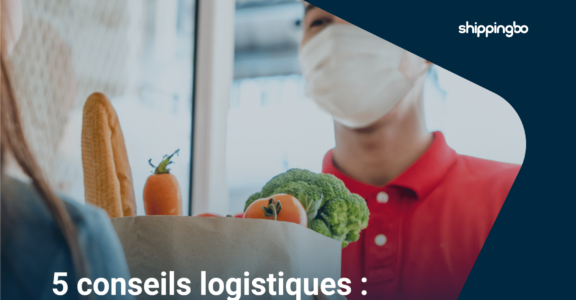
The health crisis has brought about a significant change in French consumer habits: dark stores, home delivery of food products, drive-throughs, online purchase of local produce…. Food e-commerce is experiencing unprecedented growth. As proof, according to FEVAD, food e-commerce climbed 42% in 2020 compared to 2019. This growth is set to continue in 2021, with an increase of 13% on 2020.

But how do you keep up logistically and meet this new consumer demand when you’re a food specialist?
Selling food products online poses a number of logistical challenges: how do you handle frozen products? Products with expiration dates?
In this article, we’ll give you 5 logistics tips for success in food e-commerce.
First and foremost, of course, you need a logistics technology, preferably an agile and robust one that can easily adapt to the constraints of food e-commerce. At Shippingbo, our SaaS technology consists of three building blocks:
- an OMS (Order Management System), dedicated to order management
- a WMS (Warehouse Management System), dedicated to warehouse management and order preparation,
- a TMS (Transport Management System), dedicated to parcel shipping.
Three tools in one to facilitate the processing of your e-commerce food orders: from receipt to dispatch.
Optimal warehouse management
Managing food products in a warehouse differs from “conventional” product management. Food e-commerce involves a number of constraints: the heterogeneity of products (dry, frozen, fresh, etc.), packaging, wedging, different picking methods, etc. This means that warehouse management needs to be adapted.
The first challenge is to always have a reliable, up-to-date view of stock levels, especially for perishable products. The Shippingbo WMS is your ally!
In particular, it allows you to :
- Precise real-time stock status (availability date, quantities, sell-by dates, suppliers, batches, replenishment requirements, etc.).
- Automatically activate/deactivate your online offers. The aim of automated stock management is to activate and deactivate offers instantly in the event of a product being out of stock.
Just like your products, your warehouse management software should also enable you to keep an inventory of your packaging, with part numbers, dimensions, weights and, of course, stock quantities. For example, in the case of Shippingbo WMS, when you process an order, you’ll be able to enter the carton you want to use for the packaging! The stock of this reference will then be automatically decremented. Thanks to this feature, you can keep your packaging stock up to date and optimize your packaging costs!
In general, other functions such as intelligent picking, PDA use, prioritization of picking sessions and picking control will enable you to greatly improve your warehouse management.
Finally, by using a back-office to centralize receipts, restocking, replenishment and returns, you can ensure that your logistics are optimized and adapted to the requirements of food e-commerce, so that you can offer consumers the best possible customer experience.
Order splitting for easier picking
Shippingbo’s OMS, the first building block in the technology, allows you to split orders according to predefined criteria:
- Or warehouse-related criteria, if you have one warehouse dedicated to dry goods, and another to refrigerated products,
- Or criteria linked to the product category itself, if you need to divide up orders in the same warehouse according to product: dry, positive cold, negative cold…
The “food drive” preparation process replicated in the warehouse
The Shippingbo WMS has created order-picking processes inspired by food drives, to enable its customers specializing in food e-commerce to prepare their orders more efficiently.
This preparation process, widely used by the giants of the agri-food industry, involves picking all the products and placing them directly into bags or bins to make up the order. It’s fast, efficient and saves time, particularly as it limits the need to move around the warehouse. Equipment required: a PDA/tablet, a mobile beehive and off you go!
A wide range of transport options
One of the other challenges of e-commerce, whether food or non-food, lies in merchants’ ability to offer consumers a variety of delivery options (standard, express, click and collect, point of collection) while keeping transport costs under control. There’s only one way to do this: with a TMS (Transport Management System).
If you want to optimize your shipments as much as possible, in terms of time, customer satisfaction and money, this tool has many advantages that are impossible to do without.
With Shippingbo TMS, you can :
- Be connected to all carriers on the market, including those specialized in food delivery such as Chronofresh,
- Create shipping rules to automate your shipments (e.g.: I decide to systematically assign carrier 1 to orders consisting of dry goods, and carrier 2 to orders consisting of fresh and frozen goods). This allows you to always allocate the right carrier to the right order, and thus control the associated costs.
- Save time printing your parcel labels: from a single interface, you can easily edit and print your labels,
- Enable your after-sales teams to track shipments in real time,
- Inform consumers automatically and in real time that their order has been dispatched,
- …. and much more!
Centralized ordering and stock synchronization
Omnichannelity (selling on several sales channels simultaneously) can be seen as an additional constraint for food e-commerce specialists, given the constraints that food itself already entails.
However, with the right technology, you can simply decide to sell on other sales channels: marketplaces (Greenweez, Amazon…), e-commerce sites(Prestashop, Shopify, Magento…), or via a food distributor…
Shippingbo connects your warehouse(s) to your sales channels, centralizing all your orders in real time on a single interface. This makes order processing easier and faster. You no longer need to go to the back-office of each sales channel to process your orders: everything is centralized! So an order received at 8.00am can already start being prepared at 8.02am. A must for food sales!
What’s more, your inventory is synchronized in real time across all your sales channels. In concrete terms, this means that if a sale is made on one of your sales channels, your stock is automatically updated on the others! You can avoid out-of-stock sales and offer 100% of your products for sale!

Everything you need to know about delivery for an e-commerce business selling food products
When it comes tofood e-commerce, delivery is of crucial importance to guarantee the freshness and quality of products right to the consumer’s door. Unlike other types of merchandise, food products require specific transport conditions, such as temperature control, fast delivery times and appropriate packaging to preserve their integrity.
What’s more, current regulations must be complied with to ensure food safety. So selecting a reliable logistics partner is not only good for your brand image, it’s also essential for customer satisfaction. Opting for flexible, environmentally-friendly delivery solutions can also give you a competitive edge in an increasingly saturated market.
Improve your e-commerce food logistics with Shippingbo
The food sector is certainly a more difficult one in which to apply the e-commerce model, but we’ve seen that, with the right technology, it’s far from impossible! On the contrary, you can take full advantage of the opportunities offered by food e-commerce!
Want to find out more? Read our white paper on Order Management Systems
