
A WMS and SAP connection may suffice to link sales management to the warehouse in a simple environment. But as soon as flows become more complex, inventories need to be more finely synchronized, or logistics becomes a performance issue, an ERP + OMS + WMS architecture often proves more robust than a direct connection.
The connection between SAP and a WMS answers a question frequently asked by growing companies: how can data be better circulated between sales management, inventory and logistics execution?
- SAP and WMS: what are the differences and why combine them?
- Why ERP alone reaches its limits in logistics
- Why connecting SAP to a WMS and OMS is often the best option
- Shippingbo: a solution to complement SAP
But the real issue is not just technical. It’s organizational. As long as flows remain simple, SAP may be sufficient to manage part of the operations. As soon as volumes increase, references multiply or the business becomes omnichannel, a direct connection between management and logistics often becomes necessary.
SAP structures the management, the WMS executes the logistics, but neither of them alone controls all the operational complexity. When orders, stocks and shipments become more demanding, an SAP + OMS + WMS architecture is often more reliable than a simple ERP ↔ warehouse synchro.
SAP et WMS : quelles différences et pourquoi les associer ?
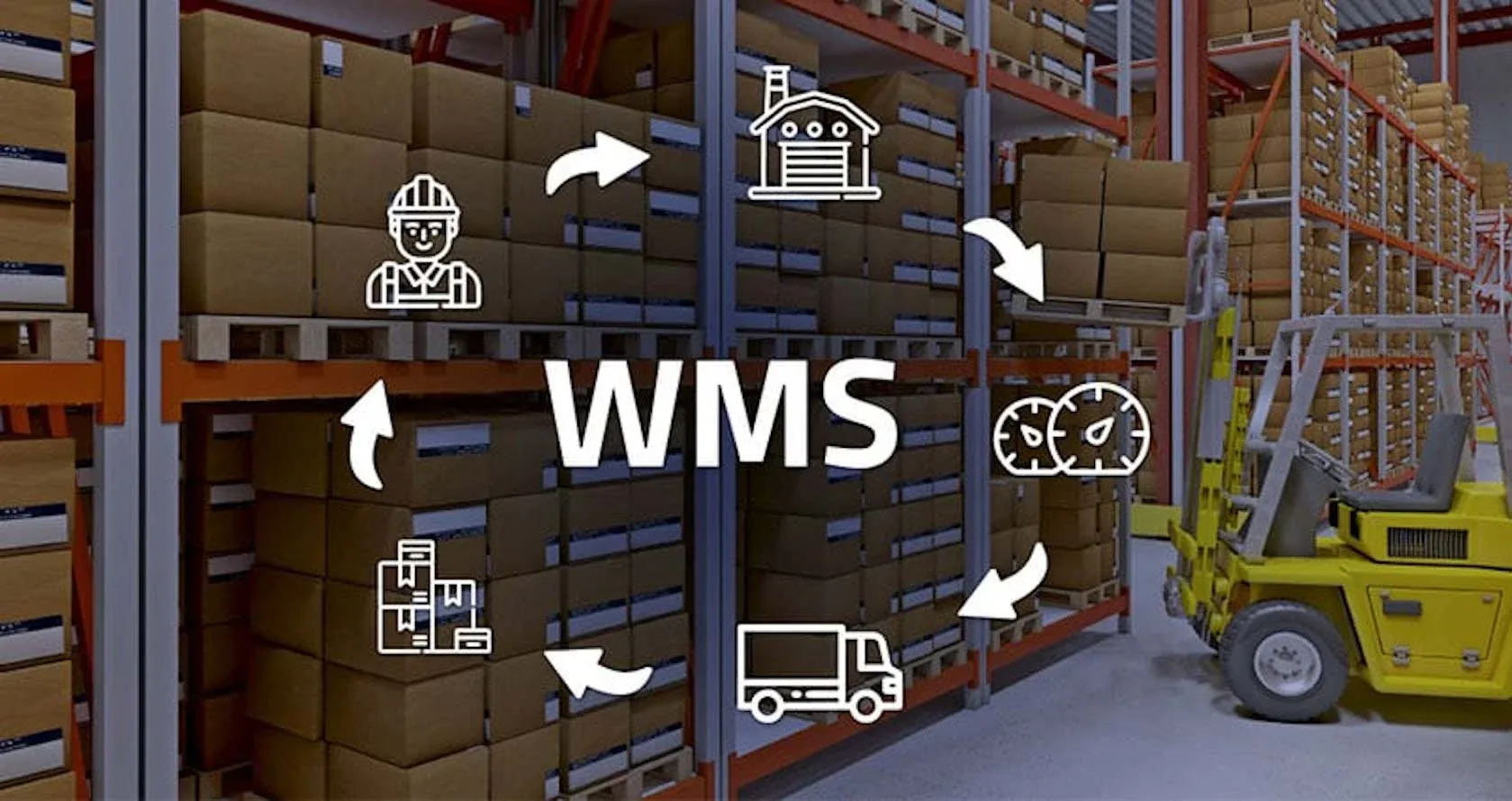
Avant de parler de connexion entre SAP et un WMS, il faut repartir des rôles réels de chaque brique. Beaucoup d’entreprises cherchent à “brancher” un outil supplémentaire quand les flux se tendent. En pratique, la question la plus utile est plutôt : quel système doit piloter quoi ?
SAP et un WMS ne couvrent pas le même périmètre. L’un structure la gestion commerciale et financière de l’entreprise. L’autre pilote l’exécution logistique dans l’entrepôt. C’est précisément parce qu’ils répondent à deux besoins différents qu’ils deviennent complémentaires.
What SAP can manage
SAP is first and foremost used to structure the company’s back office and some of its most critical operational processes. ERP helps manage purchasing, procurement, sales, reference systems, planning and part of inventory management. For a company that is already structured, it is a useful foundation for making data more reliable, harmonizing processes and linking several business functions within a single framework.
In an e-commerce or omnichannel organization, SAP plays the role of repository and structuring base. It consolidates information, frames flows and helps maintain a global vision of operations.
On the other hand, just because an ERP system knows how to pilot supply chain processes or track inventory, it doesn’t automatically become the most suitable tool for orchestrating every detail of logistics execution in the field.
What a WMS brings to the field
A WMS, or Warehouse Management System, is software designed to manage the warehouse on a day-to-day basis. Its role is not simply to know how many units exist. It’s about knowing where they are, in what condition, in what zone, according to what priority and with what picking method.
In concrete terms, a WMS can manage locations, stock movements, receipts, internal replenishments, picking sessions, preparation controls, PDA scans, batches, bundles, returns and field execution rules.
In other words, where ERP provides a useful vision for management, the WMS provides an exploitable vision for logistics action.
Why these two tools become complementary as logistics become more complex
As long as a company processes few orders, from a single site, with few part numbers and few exceptions, ERP can sometimes suffice. But when volumes increase, operational density changes.
Teams no longer just manage documents, supplies or stock levels. They manage priorities, location constraints, partial shortages, incomplete deliveries, urgent orders, carrier rules and sometimes several types of flow in parallel.
At this stage, associating SAP with a WMS clarifies roles. ERP structures data and processes. The WMS executes the actual logistics. And if the business becomes truly omnichannel or multi-site, a WMS additionally orchestrates orders between channels, inventories and fulfillment points. SAP itself emphasizes that ERP and specialized supply chain management solutions can play different but complementary roles within the same company.
Why ERP alone reaches its limits in logistics

It’s not a question of saying that an ERP is insufficient in principle. The point is to recognize that it was not designed to absorb all the logistical complexity of a growing business.
The more diversified the flows, the more limits appear. They are not always visible at first, as the team compensates with files, routines, manual arbitration and workarounds. It’s precisely this mode of operation that ends up costing the company dearly.
A vision of stock that is often too theoretical for field implementation
In many companies, the first weak signal concerns inventories. On paper, stock levels seem consistent. In the field, actual availability is more nuanced.
Stock “as seen by the ERP” does not always reflect logistics reality with sufficient precision: empty picking location, stock in reserve not replenished, article blocked in inspection, batch not usable, partial reception not finalized, return not handed over for sale, order already being prepared or assigned to another channel.
The result: the company believes it has reliable information, but the operational teams are working with data that is only partially usable. This is where discrepancies, delays and manual arbitration arise.
Order picking, shipping and traceability: operations that are difficult to industrialize
The second limitation concerns execution. Managing sales documents or stock movements is not the same thing as managing efficient order preparation.
When it comes to organizing picking sessions, guiding pickers, controlling scanned items and label printing, distinguishing between B2B and B2C flows, tracking parcels, processing returns or applying carrier rules, ERP often reaches its operational limits.
It’s not a question of software quality. It’s a question of specialization. A WMS is designed to reduce errors in the field, streamline operations and industrialize logistics processes. An ERP, on the other hand, remains focused on management.
As flows multiply, coordination becomes more complex
Complexity increases sharply as soon as a company sells through several channels, manages several warehouses, serves several types of customer or has to apply different rules to different orders.
The same order may have to be routed according to available stock, location, service level, customer type, delivery promise or transport cost. Without a suitable orchestration tool, this coordination becomes fragile.
The challenge is no longer simply to circulate information. It’s also about making the right decision, at the right time, with reliable data and consistent execution.
Signs that we need to go further
There are certain signs that ERP alone is reaching its limits. Unreliable inventories between channels or warehouses, frequent re-entries between teams and tools, or blocked orders with no clear visibility are typical indicators.
Added to this is the fact that order preparation is still very manual, despite the rise in volumes, difficulties in managing multiple carriers or shipping methods, and increasing time spent handling exceptions rather than standard flows.
Finally, the absence of precise logistics performance management limits optimization possibilities.
When these problems become recurrent, the issue is no longer just the ERP, but the overall architecture of the tools.
Why connecting SAP to a WMS and OMS is often the best option
When logistics become denser, adding a tool only makes sense if it really improves the organization. The aim is not to pile on software. The aim is to better distribute responsibilities, to make flows more reliable, easier to read and more scalable.
This is why an SAP + OMS + WMS architecture often makes sense.
A better division of roles between sales management, orchestration and logistics execution
Dans une architecture robuste, chaque outil intervient sur la couche qu’il maîtrise le mieux. SAP structure la gestion commerciale, les devis, la facturation, la relation client et une partie du référentiel stock. Le WMS pilote l’exécution terrain dans l’entrepôt : réceptions, emplacements, mouvements de stock, picking, contrôle, expédition et retours. L’OMS, lui, orchestre les commandes entre les canaux, les stocks disponibles et les points d’exécution.
The difference between a simpler connection and a more robust architecture becomes clear when the two approaches are compared:
In other words, a direct connection between SAP and a WMS may be appropriate as long as the environment remains relatively simple. But as soon as flows multiply, and you need to arbitrate between several channels, several stocks or several preparation sites, the addition of a WMS makes it possible to better coordinate the whole.
Synchronize orders, inventory and shipments more efficiently
Good architecture doesn’t just move data up and down. It makes information more useful.
Orders are centralized in theWMS, routed according to configurable rules, then forwarded to the right preparation site. The WMS then executes logistics operations in real time. Stock movements and shipping statuses can then be synchronized more reliably with ERP and sales channels.
This logic improves overall consistency between the commercial promise, actual availability and quality of execution.
Reduce errors, re-keying and information gaps
When roles are poorly distributed, teams compensate with manual manipulations. They copy information, check several screens, correct discrepancies and deal with anomalies without always knowing where they come from.
ERP + OMS + WMS architecture limits these information gaps. It reduces double entries, makes inter-departmental exchanges more reliable, and prevents logistics decisions from being based on incomplete data.
This is particularly important when several teams are involved in the same chain: customer service, sales, e-commerce, warehouse, purchasing and transport.
Improve fluidity, visibility and management capacity
The benefits are not just operational. It’s also managerial.
When flows are better structured, the company can see more clearly where blockages, inventory discrepancies, preparation anomalies, shipment delays and costly arbitrages are located. It can then more accurately manage its priorities, routing rules and logistics capacities.
This visibility becomes a real lever when you need to absorb a peak in activity, open a new channel, reorganize a warehouse or improve service quality without massive recruitment.
Building a more robust organization to support growth
Growth doesn’t just create more volume. It creates more exceptions, more dependencies between teams, and more operational risk.
A well-thought-out architecture makes it possible to grow without piling on patches. It makes the organization more robust, based as it is on clear roles, better-tooled workflows and more usable data.
It’s also what enables us to maintain service quality when business becomes more complex: more orders, more references, more channels, more customer demands.
Shippingbo: a solution to complement SAP
Once the architecture requirements have been defined, Shippingbo’s role becomes clearer. The challenge is not to replace SAP, but to complement the existing solution with a suite designed for e-commerce logistics orchestration and execution.
Why add Shippingbo to your environment
Shippingbo associe un OMS, un WMS et un TMS dans une même suite SaaS. Cette logique permet de connecter les canaux de vente, de centraliser les commandes, de synchroniser les stocks en temps réel, d’aiguiller les flux selon des règles métier, de piloter les préparations et d’automatiser les expéditions.
Dans une architecture avec SAP, Shippingbo vient donc couvrir les besoins logistiques les plus sensibles : centralisation omnicanale, exécution terrain, mapping transporteurs, gestion multi-entrepôts, préparation avancée, retours, traçabilité et suivi des expéditions.
It’s not just the connection between tools that’s important. It’s the ability to bring together sales management, order orchestration and field logistics within a coherent framework.
When is this connection relevant?
Connecting SAP to Shippingbo becomes particularly relevant when a company enters a more demanding phase of logistics structuring.
This is often the case when volumes increase, when the business opens up to several channels, when several carriers need to be managed, when preparation becomes more industrial or when stock reliability becomes a direct business issue.
This architecture is also relevant for companies that already have a useful ERP to manage their business, but no longer want to rely on workarounds, ancillary files or manual handling for their logistics performance.
SAP can structure your business, but it can’t handle all your logistics.
SAP is a useful foundation for sales management. But as soon as logistics becomes a performance issue in its own right, the challenge is no longer simply to centralize data. We need to orchestrate orders, ensure inventory reliability and execute field operations with precision.
This is where a more robust architecture comes into its own. In addition to SAP, Shippingbo adds an OMS, WMS and TMS layer designed to centralize orders, synchronize inventories in real time, optimize preparation and better manage shipments. You keep your ERP, while strengthening the most sensitive part of your operational chain.
Request a demo to find out how you can reinforce SAP with a WMS / OMS architecture better adapted to your logistics challenges, without unnecessarily replacing existing systems:
FAQ
Connecter SAP à un WMS permet de conserver un ERP pour la gestion commerciale, tout en ajoutant un outil spécialisé pour l’exécution logistique. Le WMS pilote les réceptions, les emplacements, le picking, le contrôle, l’expédition, les retours et la traçabilité.
Oui, dans des environnements simples. Mais dès que les volumes augmentent, que les règles logistiques se complexifient ou que le stock doit être piloté plus finement, une connexion directe montre souvent ses limites.
Parce qu’un OMS orchestre les commandes entre les canaux de vente, les stocks et les points d’exécution. Il apporte une couche de pilotage et d’aiguillage que l’ERP et le WMS ne couvrent pas toujours seuls.
Quand les écarts de stock se multiplient, que les ressaisies deviennent fréquentes, que les expéditions sont gérées dans plusieurs outils ou que le manque de visibilité commence à freiner l’activité. À ce stade, connecter SAP à un WMS, et souvent à un OMS, devient plus pertinent.
Cette architecture permet de mieux répartir les rôles entre gestion commerciale, orchestration des commandes et exécution logistique. Elle améliore la fiabilité des stocks, réduit les erreurs, limite les manipulations manuelles et renforce la capacité de pilotage.
Glossary
API
Interface that enables two software programs to exchange data automatically.
ERP
Management software that centralizes key company data, such as purchasing, sales, invoicing and inventory.
WHO
Order Management System. A tool that centralizes and orchestrates orders between sales channels, inventories and fulfillment points.
WMS
Warehouse Management System. Software that controls warehouse operations: reception, location, preparation and stock movements.
TMS
Transport Management System. A tool for managing shipments, selecting carriers and tracking deliveries.
Omnichannel
Organization in which several sales or distribution channels operate in a connected fashion.
Multi-warehouse
Operation in which stocks and orders are distributed over several logistics sites.