
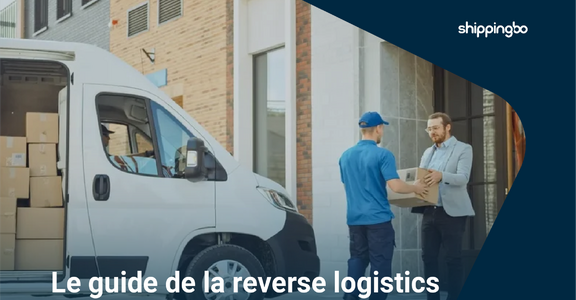
Parcel returns are often perceived as a negative aspect of e-commerce. But what if you could turn them into a competitive advantage? Find out how well-orchestrated reverse logistics can transform these returns, boost your brand image and contribute to your CSR strategy.

In the world of e-commerce, efficient and optimized returns management is a major challenge for your company. Not only is it a crucial aspect of the customer experience, it’s also an opportunity to demonstrate your commitment to quality service.
So it’s important to understand that returns management isn’t just about receiving returned goods – it’s about the whole process.
Whereas traditional logistics focuses on the flow of products from producer to consumer, reverse logistics looks at the reverse path, from consumer to producer. And while it may not be the most obvious way to benefit your business, reverse logistics is a real opportunity to optimize your costs, improve customer satisfaction and reduce your environmental footprint.
Why are reverse logistics becoming so important?
The challenge of reverse logistics is twofold. On the one hand, it has a direct influence on your brand image. A customer who makes a return can judge your ability to manage this situation effectively. If the return is well managed, your brand image will be strengthened.
On the other hand, today’s environmental challenges mean that reverse logistics is becoming an important component of your sustainable development strategy. So you could make a real impact on your CSR strategy, thanks to reverse logistics. And if so, simply offer returns, so that the product isn’t thrown away, and the customer doesn’t suffer any prejudice, as laid down in the Consumer Code.
How can you limit customer returns?
Reducing customer returns requires careful analysis to target areas for improvement. Two aspects are key to this approach:
Product life management : Each phase (introduction, growth, maturity and decline) requires specific attention. Understanding these stages helps to anticipate and minimize returns.
The use of information technologies: These enable real-time tracking of products and automate the collection of data on the flow of returns. This information is essential for efficient reverse logistics management. That’s why Shippingbo offers you a WMS capable of efficiently managing your stocks and their movements.
Despite these efforts, returns are inevitable, and can be reduced but not eliminated. But what if logistics could become an opportunity for your CSR approach?
Customer feedback: an opportunity to seize
Managing customer returns can seem like an extra workload. But with the right strategy, you can turn this constraint into a genuine CSR opportunity .
Indeed, implementing a CSR approach is now a crucial issue for your company, not only to comply with government regulations, but also to increase your sales. And why? Because 42% of the image consumers have of your company comes from your CSR approach, according to the Reputation Institute.
So let’s see how you can improve your reverse logistics to make it a lever for customer satisfaction and one of your CSR actions.
How can you optimize your reverse logistics?
Facilitating customer returns
For your returns logistics to be effective, it’s crucial to make the process as easy as possible for your customers. Offer a transparent, easy-to-understand returns policy. They need to know exactly under what conditions and within what timeframe they can make a return.
And don’t forget to simplify access to return labels. Shippingbo provides you with these logistical tools to help you do just that:
- collect the return label from the carrier who delivered the order,
- to generate this label
It’s up to you to decide whether you want to send a pre-printed return label in your customer’s parcel before it’s dispatched, or send it to them by e-mail when they wish to return their parcel.
Finally, you can provide more eco-responsible packaging, without having to invest in new packaging. In fact, as a first step in your customer returns process, think of return packaging. In addition to simplifying the procedure for your customers, allowing them to reuse the original packaging reduces the amount of cardboard or plastic needed for returns.
Collecting and sorting returned products
Once the customer has made the return, efficient management of returned products in the warehouse is essential. Products must be quickly sorted to determine whether they can be returned to stock as is, or whether they require special handling.
To begin with, we need toidentify the various possiblereasons for a return , and see why a product can be returned:
- Customers return their purchases for a variety of reasons:
- The product doesn’t meet their expectations.
- The product is defective or has a defect.
- The article has become obsolete.
- There is excess stock that needs to be returned to the warehouse.
- Inventory is seasonal, like seasonal clothing or toys during the Christmas holidays, which only sell on specific dates and have to be stored for the rest of the year.
Whether the product is returned because of a defect, a picking error, dissatisfaction or seasonal inventory, managing these returns requires a decision to be made: whether the product can be put back into stock for sale or not.
The Shippingbo solution offers efficient returns processing:
when the product is returned and collected by your team, you can :
- define which elements of the order have been returned,
- give the reason for their return according to the information sent to your after-sales service by the customer,
- choose from the same interface whether the product can be restocked or not,
Your stocks are then updated on all your sales channels as soon as the product is restocked by your teams.
In this way, the process is optimized, and all you have to do is decide what to do with products that can’t be put back into stock – a new route to eco-responsible reverse logistics.
To optimize your logistics even further, you can also use a PDA for this stage of your returns management. Would you like to find out more about PDA returns management?
Reuse or recycle damaged products
In reverse logistics, each returned product represents a CSR opportunity, but also an economic one. Here are a few ways to add value to these products:
- Repair : You can put a damaged product back into working order. This is the first step towards optimizing your customer returns.
- Restoration: You can restore a used product to a certain level of quality. These levels will generally be lower than those of the original product, but it can still be put back on the market. This is the principle of reconditioned products, and you could, for example, sell them on a marketplace like Back Market, which differentiates itself by its catalog of reconditioned high-tech products.
- New manufacture : Consider offering the used product the same high quality standards as the original, but at a lower cost. It’s a great way to optimize your returns management.
- Cannibalism : Don’t hesitate to salvage a small portion of reusable components for use in repairing, restoring or remanufacturing other items. In this way, you demonstrate your efficiency in managing reverse logistics.
- Recycling: Take advantage of the opportunity to recycle. Use the materials or components of returned products to make new items, which don’t have to be identical to the originals. This step is not only economical but also environmentally friendly.
These methods give a second life to returned products and limit the environmental impact of your business. And by opting for the Shippingbo solution, you gain access not only to software enabling you to optimize your reverse logistics, but also to over 200 connectors, including more than 100 marketplaces.
The importance of customer communication
The returns process doesn’t stop when the product arrives at the warehouse. It’s essential to communicate with the customer throughout the process. Keep them informed of the progress of their return, and be sure to offer them different options: exchange, refund, or possibly a discount on a future purchase.
This proactive communication can greatly improve customer satisfaction and help build customer loyalty. Would you like to optimize your reverse logistics and turn it into a lever for customer satisfaction? Find out all our tips: La Gestion Des Retours Comme Levier De Satisfaction Client – Shippingbo.
This is not the only communication you need to optimize! Communicate about your CSR commitment and share your customers’ experiences. That’s how you’ ll build trust between you and your customers, whether it’s for feedback or for your business as a whole.
Conclusion
As you can see, reverse logistics can no longer be neglected. It represents a major opportunity to strengthen your brand image, improve customer satisfaction and significantly integrate the principles of Corporate Social Responsibility (CSR) into your business model.
Properly implemented, reverse logistics can turn what seems like a workload and a loss of profit into a competitive advantage. By choosing the right tools and implementing all the solutions available to you: customer returns can become a sustainable growth driver for your company.
Ready to turn your returns management into a strategic opportunity?
