
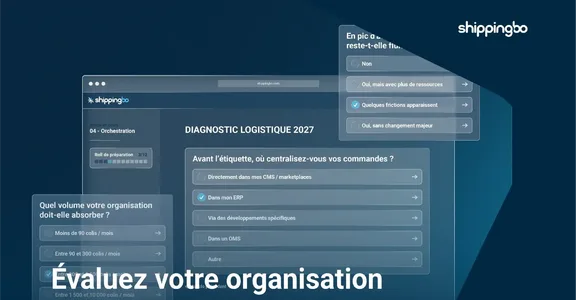
The Shippingbo Logistics Assessment allows you to evaluate your organization’s maturity, the consistency of your tools, and the robustness of your workflows before committing to new investments. It highlights pain points, scalability risks, and priority areas for improvement across OMS, WMS, ERP, transportation, inventory, warehousing, and outsourcing. The goal: to help you make more informed decisions and build a logistics organization capable of supporting your long-term growth.
Your organization is running smoothly today. But will it be able to handle a new warehouse, more marketplaces, a growing B2B business, or a few thousand additional orders per month?
- A logistics operation can function even after it has already reached its limits
- Before investing, identify the project that will actually make a difference
- Your next logistics project might start with 10 questions
That’s often where the next stage of growth is determined. Not in the ability to process orders today, but in the ability to handle greater volume and complexity tomorrow without increasing errors, costs, and workarounds.
The Shippingbo Logistics Assessment was designed to answer this question: through about ten targeted questions, it evaluates your organization’s maturity and highlights the areas for improvement that truly deserve your attention.
A logistics operation can function even after it has already reached its limits

Logistics organizations rarely become inefficient overnight. They make up for it.
A rule is managed manually. A file supplements the ERP system. A team monitors inventory levels before a peak. A new channel requires custom development. One person is familiar with the exceptions that the tools cannot handle.
Taken separately, these adjustments seem manageable. However, when they accumulate, they often reveal an operational bottleneck.
Weaknesses often become apparent before actual incidents occur
For an e-commerce business, the question is no longer just about how to fulfill an order.
They must coordinate multiple channels, different types of order flows, sometimes multiple warehouses, an ERP system, a WMS, marketplaces, carriers, and varying customer requirements.
Certain warning signs should therefore be noted:
- inventory levels that are difficult to track accurately across different channels;
- exceptions that are still handled manually by teams;
- order fulfillment that becomes less efficient during peak periods;
- information scattered across multiple systems;
- a growing reliance on a few individuals who know the workarounds;
- Every new channel, warehouse, or data stream that further complicates the architecture.
The problem is that it remains difficult to determine whether these issues require minor adjustments or a more structural transformation.
That’s exactly what the assessment helps you examine.
Test your organization before growth does it for you
Imagine that your volume increases sharply tomorrow.
Can your current organization handle this increase? Add a new channel without rebuilding workflows? Open a warehouse without complicating your IT system? Maintain reliable inventory levels everywhere? Evolve your business model without losing visibility? If the answer isn’t obvious, it’s probably a good idea to assess your organization before deciding on your next project.
The Shippingbo Logistics Assessment reviews your architecture, tools, and operational model to identify any weaknesses that could hinder your future growth.
The goal is not to compile a generic list of best practices. It is to understand what truly deserves attention in your specific context.
Before investing, identify the project that will truly make a difference
A logistical challenge can lead to very different responses.
Should we switch to a different WMS? Add an OMS? Upgradethe ERP? Improve transportation management? Automate certain workflows? Outsource all or part of our logistics operations? Rethink our multi-warehouse organization?
The wrong approach is to start by choosing a solution. The right approach is to first make a diagnosis.
Walk away with priorities, not just a score
Diagnosis is more than just a series of questions. It should enable you to turn operational observations into concrete decisions.
Based on your answers, you’ll leave with:
- a customized report highlighting your main pain points;
- recommendations tailored to your organization and your logistics model;
- ideas for areas to explore: internal stack, transportation, outsourcing, e-commerce OMS/WMS architecture;
- resources selected based on the identified issues;
- the opportunity to consult with a Shippingbo representative to explore a result or decision in greater depth.
The goal is simple: to come away not with more questions, but with a clearer understanding of which projects to tackle first.
The best assessment doesn’t necessarily lead to changing tools
That is precisely what makes this exercise worthwhile.
Your priority might be to better connect existing solutions , review certain warehouse processes, better orchestrate your flows, challenge your outsourcing model, or indeed evolve your OMS / WMS / TMS architecture.
The value of the assessment lies in prioritizing decisions.
Before committing budget, teams, and several months to a project, you’ll have a clearer understanding of your situation and a roadmap to focus your efforts where they’ll have the greatest impact.
Your next logistics project might start with 12 questions
The more mature your organization is, the more critical logistics decisions become.
A poor choice doesn’t just cost you a software subscription. It can create technical debt, slow down your warehouse, make switching providers difficult, or complicate every new stage of growth.
That’s why we designed the Shippingbo Logistics Assessment: to help you take a step back before making a decision.
In just a few minutes, assess your organization, identify its main weaknesses, and get recommendations tailored to your business model.
Shippingbo supports e-commerce organizations in orchestrating and executing their operations with its OMS, WMS, and TMS modules. But before we talk about solutions, we first need to know which problem truly deserves to be solved.
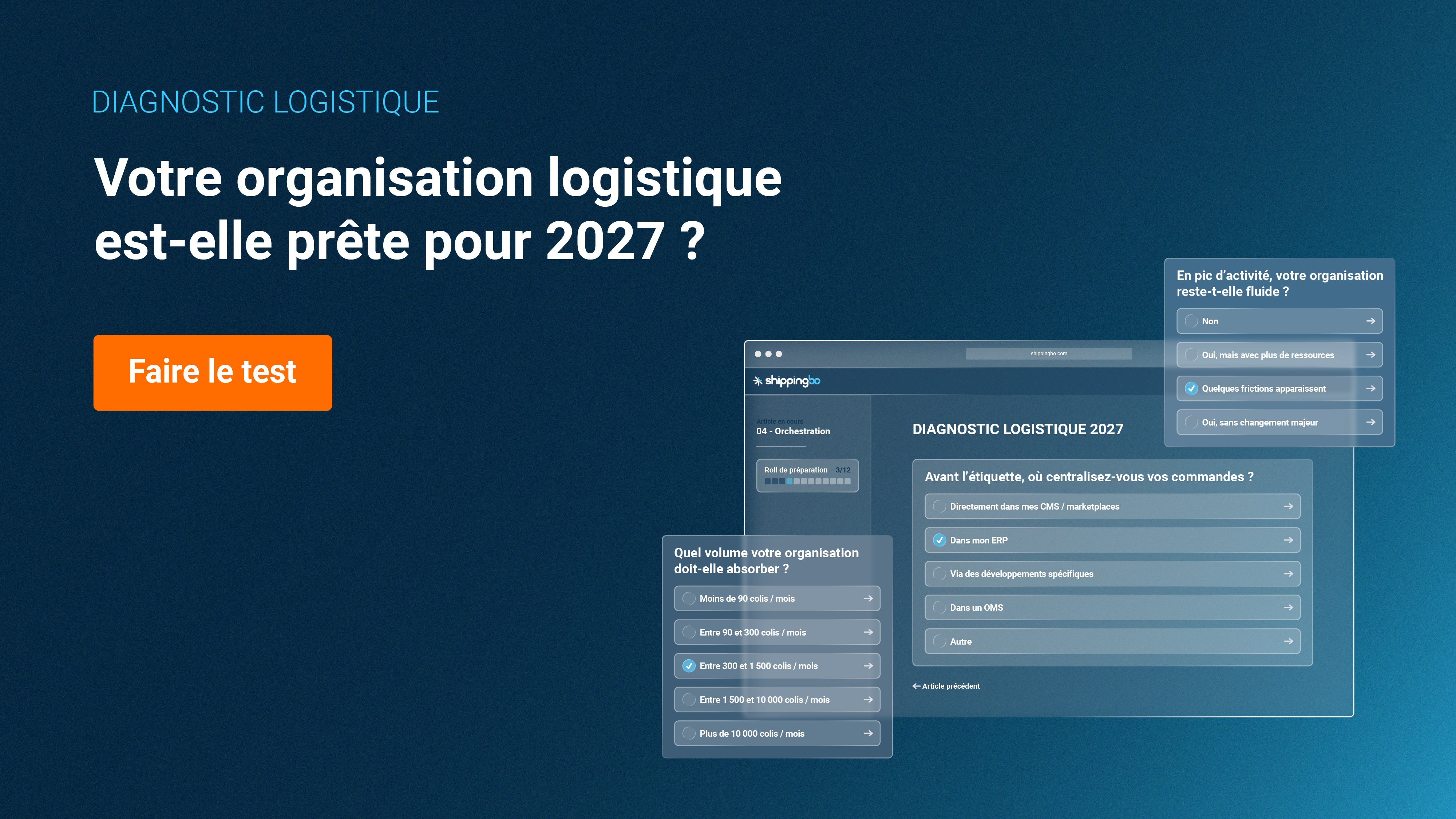
Assess your logistics organization and identify the changes you should prioritize for your next phase of growth:
FAQ
The Shippingbo Logistics Assessment helps you evaluate the maturity of your organization, your tools, and your workflows. It helps identify weaknesses that could hinder your growth and highlights the issues that need to be addressed first, whether they relate to your architecture, your warehouse, transportation, or your outsourcing model.
The assessment is based on about ten targeted questions regarding your organization, your tools, and your key operational challenges. Based on your answers, you’ll receive a personalized report, recommendations tailored to your model, and a selection of resources related to the issues identified.
No. The primary goal is to identify which area is the true priority. Depending on your situation, the recommendations may pertain to your internal tech stack, your transportation management, your outsourcing model, your current organizational structure, or an e-commerce OMS/WMS architecture. The assessment is primarily intended to help you make more informed decisions.
The results will help you better prioritize the changes you need to implement. You can explore the identified areas in greater depth using the resources provided and communicate directly with a Shippingbo representative through the assessment interface to ask questions about your organization or your upcoming decisions.
Glossary
OMS
An Order Management System is a system for managing and coordinating orders. It centralizes orders from various channels and organizes their processing according to rules defined by the company.
WMS
A Warehouse Management System is warehouse management software. It is used, in particular, to manage inventory, storage locations, order fulfillment, and warehouse operations.
TMS
A Transport Management System is a tool dedicated to managing transportation. It enables the structuring and oversight of operations related to shipments and carriers.
ERP
An Enterprise Resource Planning system, or integrated management software, centralizes various business management functions. Within a logistics architecture, it can exchange data with the OMS, the WMS, or other operational tools.
Scalability
Scalability refers to the ability of an organization, process, or system to accommodate increased volume and complexity without requiring a complete overhaul.
Logistics Architecture
Logistics architecture refers to how tools, workflows, warehouses, sales channels, and partners are organized and connected to execute operations.
Omnichannel
An omnichannel organization coordinates multiple sales and distribution channels under a single operational framework: e-commerce sites, marketplaces, brick-and-mortar stores, B2B, or other channels.
Logistics Outsourcing
Logistics outsourcing involves entrusting all or part of logistics operations to an external service provider. This may include, in particular, warehousing, order fulfillment, or shipping.
Logistics Stack
The logistics stack refers to the set of tools used to manage and execute operations: ERP, OMS, WMS, TMS, CMS, marketplaces, and other connected systems.