

Understanding the different types of inventory helps provide a clearer picture of inventory management in logistics. Safety stock, alert stock, available stock, physical stock, and stock in transit —each concept addresses a specific need. In this article, you’ll learn why there are several types of inventory, how to easily distinguish between them, and in which cases these differences become critical in e-commerce.
In logistics, inventory refers to all the goods held by a company to meet demand, secure supply, and ensure the continuity of operations.
This definition seems simple. However, in reality, inventory can never be interpreted in just one way. An item may be physically present in the warehouse, already reserved for an order, in transit between two locations, nearing its expiration date, or simply not selling well. This is precisely why there are several types of inventory.
- What is inventory in logistics?
- Why are there different types of inventory?
- What are the main types of inventory you should know about?
- What are the key differences between the types of inventory that should not be confused?
- In what situations do the different types of inventory become a challenge?
- Why does visibility into inventory quickly become essential?
- How can you make inventory more transparent and reliable with Shippingbo?
Understanding the different types of inventory helps you better understand what’s actually happening in a logistics warehouse. For a logistics manager, an e-commerce manager, or an executive, this is what helps distinguish what is actually sellable, what protects against stockouts, what needs to be restocked, and what unnecessarily ties up space and cash flow.
The purpose of this article is not to provide a comprehensive overview of a management method. The goal is to clarify the concepts: what is logistics inventory, why do several categories coexist, what are the different types of inventory, what differences should not be confused, and in what cases do these distinctions become relevant in e-commerce.
What Is Inventory in Logistics?

Before going into detail about the categories, we need to start with a clear foundation. In logistics, inventory is not just a quantity of stored products. It is an operational resource that enables us to meet demand, absorb variances, and ensure the smooth flow of goods.
A Simple Definition of Inventory
The definition logistics inventory is as follows: inventory refers to all goods held by a company at a given time to fulfill its sales, customer commitments, or operational needs.
In other words, inventory refers to what a company has available to sell, prepare, ship, or use to supply its operations. This may include finished products, items in stock, goods in transit, or units already allocated to orders.
Why Inventory Is Essential in the Supply Chain
In a theoretical world, a company would receive a product at the exact moment a customer orders it. In reality, this approach would be too fragile. Demand fluctuates, supplier lead times change, carriers experience delays, and certain sales channels suddenly see a surge in outbound shipments.
Inventory therefore acts as a buffer. It prevents an unforeseen event from immediately leading to a stockout. It also helps ensure consistent fulfillment of customer promises, especially in e-commerce, where fast order fulfillment and reliable shipping have a direct impact on customer satisfaction.
Stock, Inventory, and Procurement: What Are the Differences?
Stock refers to what the company holds.Stock inventory involves counting and verifying what is actually present to compare the physical count with the system data.Procurement refers to the process of bringing in new goods to maintain a consistent level.
In other words, stock is the available inventory; inventory counting is used to verify its accuracy; andprocurement or restocking is used to prevent stock levels from becoming insufficient.
Why are there different types of inventory?
If we were to talk about “inventory” as a single, undifferentiated concept, the interpretation would quickly become misleading. A given product may be physically present but already reserved. It may be in the process of being transferred between two locations. It may also be available in limited quantities due to an approaching expiration date or pending quality control.
The various types of inventory therefore exist to better describe the reality of the flow of goods.
Specifically, these distinctions serve to:
- better anticipate fluctuations in demand;
- ensure reliable lead times;
- adapt inventory counts to the nature of the products;
- know what is actually available for sale.
Responding to Fluctuations in Demand
Demand is never perfectly stable. A promotional event, a peak sales season, a marketplace feature, or a marketing campaign can very quickly drive up sales. Certain types of inventory exist specifically to absorb this variability, such as safety stock or seasonal inventory.
Securing Supply
The second factor is lead times. A supplier may deliver late, a shipment may be partial, and an imported item may take longer than expected to return to stock. This is why we distinguish between concepts such as alert stock, minimum stock, and maximum stock.
Adapting Storage to the Nature of the Products
Not all products come with the same constraints. A cosmetic product, a spare part, an older clothing collection, or a best-seller produced daily do not follow the same logic. This is why there are categories such as perishable inventory and dormant inventory or non-perishable inventory.
Gain a better understanding of what is actually available
Between the physical inventory and the theoretical inventory, allocated inventory, and available inventory—a single SKU can have multiple realities depending on the perspective. The more channels a company sells through, the more critical this distinction becomes. Just because a product exists somewhere in the warehouse doesn’t mean it’s actually ready to be sold immediately.
What are the main types of inventory you should know about?
There are many different classifications depending on the industry and organization. For the purposes of understanding logistics, the following are the most useful categories.
| Stock Type | Primary Role | E-commerce example |
| Safety stock | Coping with the Unexpected | Avoiding a Shortage After a Stronger-than-Expected Campaign |
| Safety stock | Trigger a restock | Follow up with a supplier before a stockout |
| Minimum inventory | Set a minimum threshold | Ensure a minimum level for a strategic SKU |
| Maximum stock | Limit excess inventory | Avoid tying up too much cash |
| Seasonal inventory | Anticipating a Foreseeable Peak | Build inventory before Christmas or Black Friday |
| In-Transit Inventory | Track goods in transit | View a replenishment shipment that has already been dispatched |
| Dormant inventory | Identify slow-moving SKUs | Identify products that have been in stock for months |
| Perishable inventory | Take the product’s shelf life into account | Prioritize the sale of cosmetics or supplements |
| Physical inventory | Check what’s actually on hand | Verify the quantities actually counted |
| Available stock | Knowing What Is Actually Sellable | Display the quantities still available for sale on the website |
Safety Stock
Safety stock is a buffer quantity intended to account for unforeseen circumstances. It is used to cover supplier delays, unexpected spikes in demand, or temporary discrepancies between forecasts and actual demand. In e-commerce, it can prevent a stockout on a product featured in a campaign that outperforms forecasts.
Alert inventory
The alert stock level is the threshold at which it becomes necessary to trigger a restocking. This is not yet the critical level, but rather a signal that action is needed. In a marketplace context, for example, it allows you to follow up with a supplier before an item becomes unavailable.
Minimum Inventory
The minimum inventory level represents the lowest level below which the company does not wish to go. When this level is reached, the safety margin becomes small and the risk of stockouts increases.
Maximum inventory
Maximum inventory sets the upper limit that must not be exceeded. It helps prevent overstocking, unnecessary clutter, tied-up cash, and a decline in inventory turnover.
Seasonal inventory
Seasonal inventory is built up in advance of a predictable peak. This could be Christmas, sales, Black Friday, or a busy period specific to a particular industry. It is not intended to absorb unforeseen events but to prepare for an expected increase in demand.
In-transit inventory
In-transit inventory refers to goods that have already been shipped from one location to another but have not yet been received at the destination. They exist within the supply chain but are not yet available for order fulfillment.
Dormant inventory
Dormant inventory consists of items that have little or no turnover during a given period. It isn’t necessarily dead stock, but it’s already a warning sign. It’s often found in older collections, low-demand variants, or SKUs that were launched on too large a scale.
Perishable inventory
Perishable inventory refers to products with a limited shelf life. Quantity alone is not enough; inventory must also be tracked over time, considering factors such as expiration dates, lot numbers, or sales priority.
Physical inventory
Physical inventory refers to what is actually present in the warehouse. It is the on-the-ground view—what is observed during a count or inventory. However, a product that is physically present is not always immediately saleable.
Available inventory
Available inventory refers to the quantity that can actually be made available for sale or order fulfillment at a given moment. It may be less than the physical inventory, since quantities that have already been reserved, blocked, or allocated to orders must be subtracted. This data must be accurately reported to the website and marketplaces to prevent overselling.
What are the differences between the various types of inventory—and how can you avoid confusing them?

Knowing the definitions is helpful. Understanding the differences between similar concepts is even more so.
Safety Stock vs. Alert Stock
The difference between safety stock and alert stock lies in their function. Alert stock is a trigger threshold. Safety stock is a protective reserve. The former is used to take action in a timely manner. The latter is used to weather situations when reality deviates from the plan.
Physical Inventory vs. Available Inventory
The difference between physical inventory and available inventory is one of the most important in e-commerce. Physical inventory refers to what is actually present in the warehouse. Available stock refers to what can actually be sold or prepared. Between the two, there may be allocated stock, reserved quantities, or inventory discrepancies.
Dormant inventory vs. excess inventory
Slow-moving inventory refers to turnover rate. Excess inventory refers to excessive quantities. A product can therefore be in excess inventory while still moving quickly. Conversely, a product can become slow-moving even in small quantities.
Perishable Inventory vs. Non-Perishable Inventory
Perishable inventory must be analyzed in terms of shelf life. Non-perishable inventory does not face this immediate constraint, but it can still become obsolete, move more slowly than expected, or lead to excess inventory.
In what situations do the different types of inventory become an issue?
These distinctions become very real as soon as volumes increase, channels multiply, or the organization becomes more complex.
They become particularly useful when the company needs to:
- sell through multiple channels at the same time;
- manage multiple locations or storage areas;
- handle seasonal spikes in activity;
- keep up with a rapidly expanding product catalog.
The Case of an E-Commerce Warehouse
In an e-commerce inventory environment, inventory tracking must keep up with a fast pace. Orders come in all day long, order fulfillment moves quickly, and sales channels must consistently show availability. In this context, the difference between physical inventory and available inventory isn’t just a detail—it’s essential for reliability.
The Case of a Seasonal Business
When a business relies heavily on peak sales periods, inventory counting errors are costly. Too little inventory means lost sales. Too much inventory ties up cash unnecessarily after the peak. The concepts of seasonal inventory, maximum inventory, and safety stock then become very real.
The Case of a Multichannel Business
As soon as a company sells on its website, on a marketplace, sometimes in a physical store, or through multiple warehouses, the situation becomes more complex. The same product may be available on one channel, on hold on another, or distributed across multiple locations. It is precisely in this type of environment that omnichannel inventory and multi-warehouse inventory require a more structured approach.
The Case of Rapid Catalog Growth
When the number of SKUs increases rapidly, slow-moving products tend to accumulate more easily, and trade-offs become more difficult. In this context, concepts such as dormant inventory, dead stock, or reserve stock become more meaningful for accurately assessing the reality on the ground.
Why does inventory visibility quickly become essential?
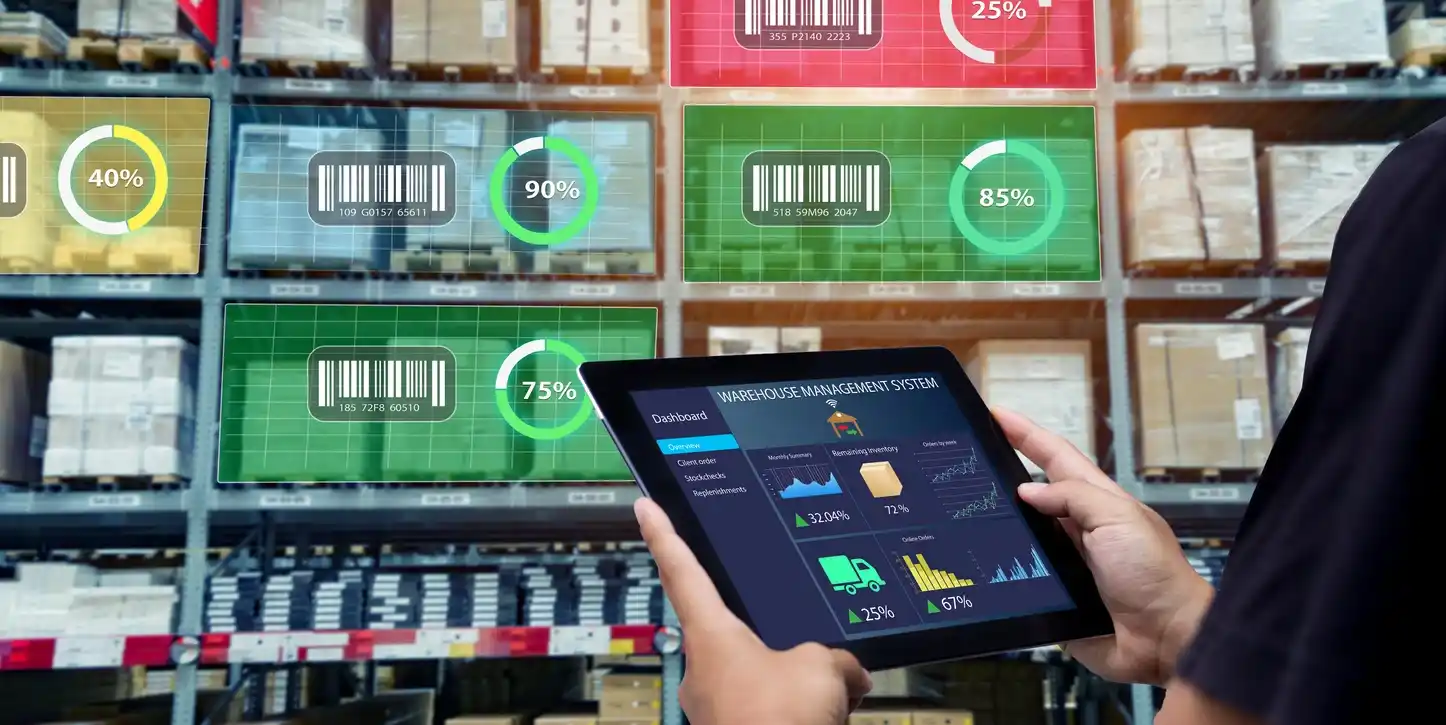
Understanding inventory types is the first step. But very quickly, the real issue becomes visibility. As the business grows, the question is no longer just about how much is left, but about which inventory is actually available for use, where it is located, and what it has already been allocated to.
When Manual Spreadsheets Reach Their Limits
At first, a single spreadsheet may be enough to track a few SKUs. But as soon as orders increase, returns are added, or multiple people are working on the same data, reliability declines. It’s no longer always clear whether the figure shown corresponds to the theoretical inventory, the actual counted inventory, or the inventory that’s actually available for sale.
Why Tracking Inventory Becomes More Complex Across Multiple Channels
In an omnichannel environment, inventory doesn’t move at the same pace everywhere. A marketplace, an e-commerce site, a physical store, or an outsourced site don’t consume inventory data in the same way. It’s therefore necessary to distinguish between the quantity on hand, the reserved quantity, and the available inventory.
How a tool can help clarify this
Good inventory software does more than just provide more accurate numbers. It helps distinguish between different inventory counts, track movements, ensure the reliability of inventory variances, and make the data usable on a daily basis. In a e-commerce WMS or e-commerce OMS environment, this clarity becomes crucial.
How can you make inventory more transparent and reliable with Shippingbo?
As shipment volumes increase, it’s no longer just a matter of having accurate inventory on paper. You need to quickly understand which inventory is available, which is reserved, which is moving between multiple locations, and how the various channels interpret this reality.
It is in this type of context that inventory tracking must become more reliable without adding to the teams’ daily workload. The transition to a new tool is not primarily about sophistication; it addresses a need for operational clarity.
A unified view of inventory across all channels
Shippingbo helps e-commerce businesses and logistics teams centralize inventory management in an omnichannel environment. This helps minimize discrepancies between online stores, marketplaces, and field operations.
A Clearer View of Available Inventory
Between physical inventory, reservations, pending orders, and logistics movements, inventory data can quickly become difficult to interpret. Shippingbo helps make this data clearer so you can better identify what’s actually usable on a day-to-day basis.
A solution designed for e-commerce logistics challenges
Shippingbo was designed for e-commerce operations that need to coordinate order orchestration, warehouse fulfillment, and shipping within a single environment. The goal is to make workflows more reliable, inventory more transparent, and operations more seamless as the business grows.
Gaining a better understanding of your inventory means gaining a better understanding of your logistics
Understanding the different types of inventory allows for a more nuanced understanding of what is actually happening within a logistics organization. This is what helps distinguish a safety stock from an alert threshold, current inventory from sellable inventory, or slow-moving inventory from excess inventory.
As soon as an e-commerce business grows, becomes omnichannel, or expands its product offerings, this insight becomes essential. Shippingbo helps make inventory data more transparent, reliable, and actionable on a daily basis by connecting the on-the-ground reality of the warehouse to the promises made across sales channels.
Download our white paper, “5 Tips to Avoid Inventory Errors,” to identify the most common pitfalls and make your daily inventory tracking more reliable.

FAQ
Answer: In logistics, inventory refers to all the goods held by a company to meet demand, secure supply, and ensure the continuity of operations.
Answer: There are several types of inventory because they do not all serve the same purpose. Some are used to anticipate a surge in demand, others to compensate for a delay in supply, to distinguish what is actually available, or to account for the nature of the products in stock.
Answer: The most common types of inventory are safety stock, alert stock, minimum stock, maximum stock, seasonal stock, in-transit stock, dormant stock, perishable stock, physical stock, and available stock.
Answer: Physical inventory refers to the quantity actually present in the warehouse. Available inventory refers to the quantity that can still be sold or allocated, after taking into account reservations and pending transactions.
Answer: Safety stock is a buffer intended to absorb unforeseen events. Alert stock is the threshold that signals the need to initiate a restocking process before reaching that buffer.
Answer: The more channels, warehouses, or marketplaces a company sells through, the harder it becomes to know what’s actually available. Good visibility reduces errors, stockouts, and discrepancies between on-the-ground reality and the data displayed.
Glossary
Best-by Date / Use-by Date
The date indicating how long a product will retain its optimal quality. This is important for certain food products or sensitive items.
Lot
A group of units of the same product grouped under a single manufacturing or receiving reference number.
WHO E-commerce
Order management tool. It centralizes orders from multiple channels and helps coordinate them.
Omnichannel
An organizational model in which a company sells through multiple interconnected channels, offering a more unified customer experience.
SKU
Internal code used to uniquely identify a product SKU.
Excess inventory
Inventory levels are too high relative to actual demand, tying up space and cash.
Overselling
A situation in which a product is sold even though it is no longer actually available.
E-commerce WMS
Warehouse management tool. It helps organize on-site operations such as receiving, putaway, picking, and order fulfillment.