
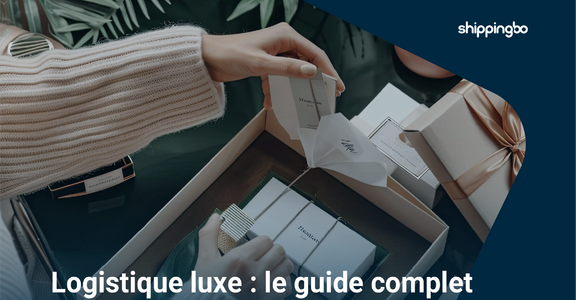
Visit luxury logistics is today a strategic pillar for high-end brands: it refers to all logistics processes designed to meet the specific requirements of high-value products, in terms of security, traceability and customer experience. At a time when e-commerce is becoming a major sales channel, logistics is no longer just about getting products from point A to point B. It’s also about protecting high-value goods. It must protect high-value goods, guarantee flawless execution and extend the in-store experience.
- The specific challenges of logistics in the luxury sector
- The role of the WMS in ensuring flawless warehouse operations
- Transport and delivery: ensuring the last mile
- How Shippingbo supports luxury brands
For premium ready-to-wear, leather goods, jewelry and cosmetics brands, logistics are now an integral part of the brand promise. Every parcel delivered reflects on the image, trust and loyalty of the end customer. Luxury e-commerce logistics must therefore combine security, traceability, omnichannelity and attention to detail, while remaining capable of absorbing growth and peaks in activity.
The specific challenges of logistics in the luxury sector

The luxury supply chain is characterized by a much higher level of demand than traditional e-commerce standards. The products transported have a high financial value, but also a strong emotional value for the customer. Even a minor logistical error can permanently damage the relationship with the brand.
The luxury goods sector represents almost 3% of French GDP and generates around one million direct and indirect jobs in the fashion, leather goods, jewelry and premium beauty industries, confirming the economic impact of this market on local supply chains, according to Forbes.
Haute couture logistics, leather goods logistics and cosmetics logistics share common constraints: secure flows, absolute precision and the ability to offer a consistent experience across all channels. These challenges need to be addressed comprehensively, from the warehouse right through to the last kilometer.
In luxury logistics, three pillars structure operational excellence:
- Safety, to protect products with very high financial and symbolic value
- Traceability, so that each item can be tracked individually and seamlessly
- The customer experience, which extends the brand’s universe well beyond the point of purchase
Flow security and anti-shrinkage measures
In luxury logistics, security is a non-negotiable prerequisite. The risks of theft, loss or substitution concern both thesecure warehouse and transport. Shrinkage represents not only a direct cost, but also a major reputational risk.
Security requires strict processes and restricted access, as well as tools capable of ensuring the precise traceability of movements. The masking of sensitive information on labels, the use of secure messaging and the separation of product and customer data greatly reduce exposure to risk.
The customer experience: an extension of the physical store
In luxury goods, buying doesn’t stop with payment. Theunboxing experience is a key moment, often shared and remembered. It must reflect the brand’s codes and extend the emotion felt in the boutique.
Meticulous order preparation enables the integration of elements with high perceived value: premium packaging, tissue paper, discreet fragrances, personalized messages. This requirement implies a logistics organization capable of reconciling personalization and operational efficiency, without compromising on quality.
Omnichannel and unified inventory management
Luxury customers are naturally omnichannel. They expect total freedom in their journey: purchase online, return in-store, exchange via another channel. This fluidity relies on perfectly orchestrated luxury omnichannel logistics.
Unified premium inventory management is at the heart of this system. It guarantees consistent product availability across all channels, prevents overselling and secures the promise made to the customer. Without this global vision, the experience becomes fragmented and inconsistent.
The role of the WMS in ensuring flawless warehouse operations
In high-performance luxury logistics, the WMS does more than just manage the warehouse: it becomes a tool for orchestrating quality, safety and the customer experience.
The warehouse is the operational heart of luxury logistics. It is here that a large part of the customer experience takes place, long before delivery. An e-commerce WMS adapted to the sector enables us to structure demanding processes while maintaining a high level of productivity. The scalability of logistics operations becomes a decisive criterion: it enables luxury brands to structure their growth while maintaining a constant level of excellence, even during peaks in activity or the deployment of new omnichannel channels.
Beyond warehouse management, the WMS becomes a tool for steering quality, personalization and security, while supporting thelogistics automation necessary for growth.
Quality control and customization
Logistics quality control is an essential step before each shipment. It allows us to check the condition of the product, the conformity of the order and the presence of all expected elements.
The WMS must also integrate order personalization rules: adding goodies, inserting a handwritten note, choosing specific packaging.
In a luxury e-commerce logistics context, these customization steps can include :
- Premium packaging in line with brand codes (tissue paper, ribbons, boxes)
- A scripted unboxing experience, identical across all sales channels
- Meticulous order preparation, including stringent quality controls
- Standardized order personalization without disrupting productivity These actions, when integrated natively into workflows, enhance the customer experience without degrading team performance.
Unit traceability: serial number and batch management
In the luxury goods industry, traceability of serial numbers is essential. For bags, watches or jewelry pieces, each unit must be individually identified and tracked. Serial number management in the WMS guarantees total traceability, from receipt to dispatch. It secures flows, facilitates audits and reinforces customer confidence, particularly during returns or after-sales service operations.
This unitary traceability also makes it possible to effectively combat counterfeiting, authenticate each product at all times, and ensure total consistency between physical stock, system data and omnichannel routes.
Perpetual inventory for high-value stocks
Luxury goods represent a major financial asset. An inaccurate inventory can quickly impact cash flow and the ability to serve customers.
Thanks to a perpetual inventory based on supply chain digitization, stock movements are recorded in real time. This approach reduces discrepancies, secures purchasing decisions and provides a reliable view of stock levels at all times.
Transport and delivery: ensuring the last mile

In luxury logistics, transport and delivery represent the final point of contact with the customer. This last mile determines the overall perception of the brand.
Delivery is the final point of contact between brand and customer. In luxury logistics, the last mile must live up to the promised experience, both operationally and in terms of customer relations.
Secure transport is not just about speed. It encompasses discretion, reliability and the ability to reassure customers every step of the way.
Choosing specialized carriers and Ad Valorem insurance
The use of a specialized luxury carrier is essential for high-value shipments. These partners master the specific requirements of the sector: delivery against signature, strict adherence to delivery deadlines, confidentiality of information and quality of the relationship when the parcel is handed over. In this way, every interaction becomes an extension of the brand universe, right up to the last mile.
Ad valorem insurance completes the package by covering the actual value of the goods transported. It secures logistics flows, protects both the brand and the end customer, and enables controlled risk management, particularly for international shipments or parts with very high unit values.
Post-purchase communication: reassuring VIP customers
Thepost-purchase customer experience is based on fluid, proactive communication. Shipping notifications, parcel parcel tracking and delivery confirmations reassure customers at every stage, creating a climate of trust and transparency. This communication also reduces the pressure on customer service, by limiting solicitations linked to uncertainty or lack of information.
For international sales, it is imperative that international express delivery be accompanied by clear, coherent information on delivery times, the carrier and the key stages of the journey. Controlled communication avoids frustration, reinforces the perception of service quality and contributes to a premium experience, in line with luxury standards.
Managing returns: a critical step in building loyalty
Visit returns management luxury goods is a particularly sensitive moment in the customer journey. A poorly orchestrated return can have a lasting impact on brand perception, whereas a smooth, high-quality service can, on the contrary, strengthen the relationship of trust. In the luxury sector, returns should never be experienced as friction, but as a natural extension of the purchasing experience.
Efficient premium reverse logistics is based on rigorous controls on receipt, secure restocking and controlled reimbursement times. This organization preserves product value while reassuring customers of the brand’s reliability. Properly managed, this stage becomes a real loyalty-building lever.
How Shippingbo supports luxury brands
In modern luxury logistics, Shippingbo acts as an orchestra conductor. The platform coordinates flows, tools and partners to guarantee consistent, secure, omnichannel execution.
To structure this operational excellence, Shippingbo relies on three complementary building blocks, each playing a specific role in the luxury goods supply chain.
| Software brick | Role in luxury logistics | Impact on customer experience | Impact on safety |
| WHO | Orchestrating the omnichannel sales promise and intelligent order routing | Smooth flow between e-commerce and store, consistent product availability | Reducing inventory errors and overselling |
| WMS | Guarantee perfect execution in the warehouse with processes adapted to luxury goods | Meticulous order preparation, customization and enhanced quality control | Unit traceability, serial number management, shrinkage reduction |
| TMS | Secure and customize transport and delivery | Reliable delivery, controlled post-purchase communication, quality discount | Ad valorem insurance, signature on delivery, secure transport |
This integrated approach enables brands to manage seamless luxury omnichannel logistics, while maintaining high standards at every point of contact.
In modern luxury logistics, Shippingbo acts as an orchestra conductor. The platform coordinates flows, tools and partners to guarantee consistent, secure, omnichannel execution.
Shippingbo positions itself as the conductor of luxury logistics, orchestrating all flows, tools and partners. The OMS orchestrates the omnichannel sales promise, the WMS guarantees perfect execution in the warehouse, and the TMS secures and personalizes the last mile. The platform centralizes operations with an OMS, WMS and TMS suite designed for demanding environments.
Omnichannel order management, inventory synchronization, serial number traceability and advanced shipping rules enable brands to guarantee uncompromising fulfillment. Shippingbo also supports the management of luxury goods peaks, while maintaining a constant level of quality.
Logistics that live up to your brand promise
In luxury goods, logistics is not a cost center but a strategic differentiation lever.
In the luxury goods industry, logistics is a strategic lever for image, security and customer loyalty. High-performance luxury logistics is based on fine orchestration of operations, impeccable traceability and constant attention to the customer experience.
With Shippingbo, high-end brands have a solution capable of unifying their flows, securing their shipments and enhancing each order.
What if your supply chain became a true extension of your brand universe? Ask for a Shippingbo demo!

FAQ
Luxury logistics are subject to specific constraints linked to the financial and symbolic value of products. The main requirements concern the security of goods, in order to limit the risk of theft or loss, as well as total traceability, essential in the fight against counterfeiting and to guarantee the authenticity of items. Added to this are express delivery times, particularly for demanding international customers, and impeccable preparation quality, including careful packaging in line with the brand’s codes.
Shipping high-value products relies on precise transport management. It is essential to rely on a TMS capable of automatically selecting specialized carriers adapted to the requirements of luxury goods. These shipments must include Ad Valorem insurance, delivery against signature and real-time tracking, to secure the parcel throughout its journey and reassure the customer right through to final delivery.
A WMS is a central tool in luxury logistics, as it enables us to structure processes with high quality requirements. It manages serial numbers for complete unit traceability, imposes strict quality control stages before each shipment, and enables packaging instructions to be customized according to product or customer. The WMS thus becomes a key lever for guaranteeing perfect warehouse execution, without compromising on the customer experience.
Glossary
Ad Valorem
A type of transport insurance based on the actual value of the goods shipped, particularly used for luxury goods.
OMS (Order Management System)
Software that centralizes orders, orchestrates their routing and guarantees stock consistency across all channels.
WMS (Warehouse Management System)
Warehouse management system for inventory control, order preparation, traceability and quality control.
TMS (Transport Management System)
Transport management tool for selecting carriers, editing labels, managing insurance and tracking deliveries.
Unit traceability
Ability to track an individual product, often by serial number, throughout the supply chain.
Shrinkage
Difference between theoretical and actual stock, often due to theft, errors or losses.
Last kilometer
The last stage of transport, between the distribution point and the end customer, is particularly critical in luxury logistics.