
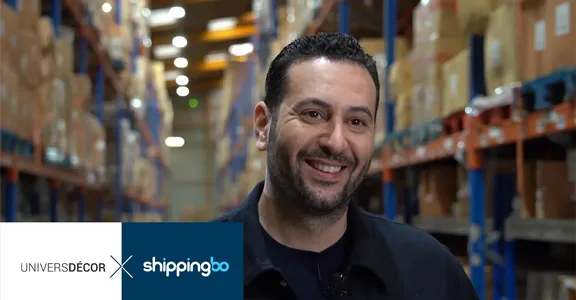
Univers Décor scaled up its operations without disrupting its logistics. In this Univers Décor customer testimonial, François Rabi explains how the company streamlined its workflows, met its deadlines, and handled high volumes with Shippingbo.
When an e-commerce brand grows rapidly, e-commerce logistics can either be a driving force or a breaking point. As long as volumes remain manageable, semi-manual processes can suffice. But when order volumes surge, sales channels multiply, and seasonal peaks come one after another, what worked yesterday quickly becomes a hindrance.
That’s exactly what Univers Décor went through. Starting out as a small, artisanal operation, the company had to restructure its operations to accommodate rapid growth, ensure the reliability of its workflows, and continue to ship quickly without compromising service quality. Its experience demonstrates one simple fact: growth does not disrupt logistics that are already industrialized. Rather, it disrupts organizations that have relied on manual processes for too long.
Logistics Case Study: When Growth Changes the Rules
Before we talk about tools, we need to talk about context. Univers Décor didn’t start out with an industrialized logistics operation. Like many growing e-commerce businesses, the company initially operated with a lean structure, workflows managed largely by hand, and a warehouse of about 500 m².
From a small operation to a major expansion
For several years, this model held up. Then COVID acted as a stress test. Suddenly, order volumes jumped from about 150 to 600 orders per day. At that level, it’s no longer just a matter of preparing orders faster. We have to prevent the entire supply chain from breaking down.
This is where many merchants realize a critical point: the real issue isn’t just volume. It’s the organization’s ability to maintain control as volume increases. More orders mean a higher risk of errors, more pressure on inventory, more strain on shipping, and greater reliance on field teams.
A Logistical Move During a Critical Period
The Univers Décor customer testimonial is even more telling because it goes beyond a simple increase in workload. The company also had to manage a massive relocation involving 100 trucks and 3,300 pallets in just 4 weeks, during the year-end peak season and Black Friday.
In other words: the worst possible time to improvise.
And yet, the teams continued to ship from both warehouses at the same time, while still meeting their commitment to customers.
“Without Shippingbo, it would have been impossible.”
This sentence sums up the challenge well. When business picks up, logistics must do more than just keep up. It must remain stable even as everything around it changes.
The Challenges Faced by Univers Décor
The Univers Décor case is interesting because it puts very concrete words to the problems that many e-commerce businesses face once their growth becomes significant.
Volumes that have become too large to manage manually
The first problem was managing volume. As long as business remains moderate, manual processes may suffice. But as soon as orders start to pile up, every manual task becomes a potential source of friction.
At Univers Décor, this resulted in several issues: preparation errors, shipping delays, inventory discrepancies, overselling, and an operational workload that was difficult to manage. At this point, logistics was no longer supporting growth; it was beginning to hinder it.
This sends a strong message to every e-commerce team: when teams spend their time correcting, verifying, and cleaning up, the issue is no longer the effort. The issue is the system.
Omnichannel complexity that is difficult to manage
Another challenge stems from the omnichannel strategy. Univers Décor currently sells through more than 20 distribution channels: marketplaces, private sales, dropshipping, direct fulfillment, and other related channels.
On paper, it’s a growth accelerator. In practice, it’s a major source of complexity. Each channel has its own constraints, rules, deadlines, inventory requirements, and sometimes its own documentation requirements.
Without a tool capable of centralizing orders, synchronizing inventory, and quickly executing operations, this diversity ultimately becomes costly. The risk isn’t just technical; it also affects customer satisfaction, the ability to deliver on promises, and profitability.
Logistics that threatened to slow growth
The most important point of the testimony is this: logistics was becoming a hindrance when it should have been supporting growth.
This is a common situation for rapidly growing companies. The brand knows how to sell. The channels are open. Demand is there. But execution is no longer up to par. And when execution falters, hidden costs pile up: disputes, re-captures, internal tensions, wasted time, cancellations, and a loss of trust.
Solutions Implemented with Shippingbo
What makes the Univers Décor case interesting is that it isn’t just about marginal optimization. It shows how a company transitions from a small-scale, artisanal approach to a structured one capable of supporting growth.
Structure processes to handle high volumes
Shippingbo was initially used to structure operations—not to add another layer of complexity, but to make workflows clear, executable, and repeatable.
When volumes increase, processes must hold up without relying on the heroism of the teams. We need rules, reliable procedures, clear coordination, and the ability to stay on track even during peak periods.
This is what has enabled Univers Décor to better accommodate growth and maintain a consistent level of service despite the pressure.
Improve the reliability of preparation with scanning and a PDA
With nearly 10,000 SKUs, the reliability of the picking process is a key challenge. Univers Décor clearly explains that using Shippingbo with a PDA has eliminated the main sources of error during order fulfillment.
This is a crucial point. In a warehouse that handles a large number of SKUs—with variations in size, color, or material—speed alone is not enough. Robust operational control is essential.
The PDA provides this framework. It guides, ensures safety, and makes the preparation process much clearer. The result: productivity increases without compromising quality.
Univers Décor reports that it can process 150,000 orders per year with just four employees, who are divided among order preparation, picking, and workflow management. The benefit is not merely quantitative; it stems from the fact that the company is scaling up with a stable team.
Centralize B2C, B2B, dropshipping, and direct fulfillment workflows
Another highlight of the Univers Décor customer testimonial is the ability to manage very different types of flows within a single logistics system.
Univers Décor uses advanced B2B functionality to manage packing lists by box and by pallet. This simplifies the receiving process for its business customers and streamlines order fulfillment.
But there’s more to it than that. The company also manages its e-commerce workflows, dropshipping activities, and direct fulfillment operations all within the same environment. This centralization simplifies organization, prevents silos, and makes operations more consistent.
This is precisely where a well-utilized combination of OMS and WMS makes all the difference: it’s not just about viewing orders, but about directing the right flows to the right place, according to the right rules.
Continue shipping during a dual-warehouse operation
The feedback on the move is probably the best indicator of the robustness of the system that was put in place.
Shipping from two warehouses simultaneously during Black Friday and the year-end peak season without compromising on customer service requires more than just a tracking tool. It demands true orchestration capabilities.
All orders placed before 1:00 p.m. could still be shipped that afternoon. For an e-retailer, maintaining this level of service during such a major logistical transition sends a very strong message. It shows that technology didn’t just help save time—it also helped maintain control.
The results obtained
The results shared by Univers Décor are consistent with what one would expect from a well-structured logistics system: fewer errors, greater speed, and increased capacity—all without a sharp rise in organizational costs.
More reliable, faster, and easier-to-read execution
The company highlights three key indicators:
- First, the error rate, reported at 0.3%, which remains very low given the volume of data processed.
- Next, shipping speed, with the ability to meet tight deadlines and maintain a high level of service.
- Finally, the ability to handle high volumes, to the point of being able to manage days with extremely heavy workloads without compromising quality and using the same team.
These results are important because they reflect not only an increase in productivity but also an increase in control.
Logistics as a Driver of Growth
What’s most interesting, really, is what this structure subsequently made possible.
Once its logistics operations were streamlined, Univers Décor was able to develop a 3PL business for other brands. The company didn’t just solve its own problems; it turned its operational expertise into a new business opportunity.
This is often the true hallmark of a mature logistics system: it is no longer just a means of preventing losses, but becomes an asset for growth.
Key Takeaways from This Case Study
The Univers Décor case study shows that strong e-commerce growth isn’t managed by putting in more effort, but by implementing better processes and using the right tools.
Signs That It’s Time to Scale Up
When errors increase as volumes rise, when inventory becomes difficult to manage reliably, when sales channels multiply, and when teams spend more time correcting mistakes than executing tasks, it’s time to get organized.
Waiting is costly. Because a makeshift logistics system doesn’t always break down right away. It deteriorates gradually, until a surge in demand, a relocation, or a new channel exposes all its limitations.
Why the Right Technology Changes Course
Shippingbo makes it possible to turn this weak spot into a solid foundation. By centralizing workflows, ensuring reliable order fulfillment, synchronizing inventory, and making the fulfillment process more transparent, the platform helps e-commerce businesses scale up without losing control.
In the case of Univers Décor, the result is clear: a logistics operation that has evolved from a small-scale, artisanal approach to an industrial-scale organization capable of supporting omnichannel operations, handling peaks in activity, and scaling up.
Growth isn’t something you just endure—it’s something you plan for
Univers Décor didn’t just increase its productivity. The company regained control of its logistics operations at a time when complexity could have become a major obstacle.
This is exactly where Shippingbo adds value: by helping e-commerce businesses make their operations more reliable, streamline them, and scale them up using a single OMS, WMS, and TMS platform.
Are you facing a surge in volume, omnichannel complexity, or logistics challenges that are starting to slow your growth? Request a Shippingbo demo to see how you can streamline your workflows without compromising your customer promise:

FAQ
At what volume should a company start to scale up its e-commerce logistics?
There is no universal threshold. However, certain signs are unmistakable: an increase in picking errors, overselling, shipping delays, a lack of visibility into inventory, difficulty handling peaks in demand, or an increase in the number of sales channels. In the case of Univers Décor, scaling up became critical when volumes increased sharply and logistics could no longer rely on manual processes.
How can you tell if logistics is holding back the growth of an e-commerce business?
When teams spend more time fixing problems than getting work done, when every new channel adds complexity, or when peaks in activity put the entire organization under strain, logistics becomes a bottleneck. It’s not just a matter of productivity. It’s also a matter of reliability, customer satisfaction, and profitability.
Why does omnichannel retailing make logistics so complicated?
Because each channel has its own constraints regarding inventory, processing, shipping, and customer commitments. The more a brand sells on marketplaces, through B2B, via dropshipping, or through direct fulfillment, the more it needs a system capable of centralizing these workflows and executing them according to clear rules.
What is the role of an OMS during a growth phase?
An OMS enables you to centralize orders from multiple channels, coordinate their processing, and route them to the appropriate site or fulfillment method. During a growth phase, it helps prevent silos, maintain a big-picture view, and make operations more consistent.
What role does a WMS play in improving warehouse reliability?
A WMS is used to better manage on-the-ground operations: inventory, storage locations, order fulfillment, movements, monitoring, and traceability. It makes the warehouse more reliable and easier to manage on a day-to-day basis. In the case of Univers Décor, this component helped ensure consistent order fulfillment despite a large product catalog and high volume demands.
Is a PDA really useful in an e-commerce warehouse?
Yes, especially as volume increases or the number of SKUs grows. The PDA guides operators, ensures secure scanning, reduces picking errors, and improves throughput without compromising quality. It is often a practical tool for streamlining operations without complicating on-the-floor work.
Can B2C, B2B, and dropshipping orders be managed using a single tool?
Yes, provided you have a system designed to centralize and separate workflows without disrupting operations. This is precisely what Univers Décor has implemented to manage its e-commerce, B2B workflows, dropshipping, and direct fulfillment all within a single environment.
Why does a surge in activity or a move reveal logistical weaknesses?
Because these moments put pressure on the entire chain: inventory, order fulfillment, shipping, coordination between teams, and customer service. An organization that relies too heavily on ad-hoc processes may function well under normal conditions, but can break down abruptly as soon as an exceptional event occurs. It is often during these phases that the need for structure becomes evident.
Glossary
OMS (Order Management System)
The OMS, or Order Management System, is the tool that centralizes orders from various sales channels and coordinates their processing. It plays a key role in omnichannel logistics by coordinating workflows between the sales front end and operational execution.
WMS (Warehouse Management System)
The WMS, or Warehouse Management System, is a system used to manage warehouses. It is used to manage inventory, storage locations, movements, order fulfillment, and on-site operations.
TMS (Transport Management System)
The TMS, or Transport Management System, is used to manage shipping, carrier selection, label printing, and shipment tracking. It is used in the final stage of the supply chain, when the order leaves the warehouse.
PDA
A PDA is a mobile device used in warehouses to guide operators through their tasks. In particular, it is used to scan products, confirm inventory movements, and ensure the security of order fulfillment.
Dropshipping
Dropshipping is a business model in which a merchant sells a product without stocking it themselves, and then has the order shipped by a supplier or partner. This process requires effective coordination of logistics and inventory.
Direct Fulfillment
Direct fulfillment involves making your inventory available to resellers or partners so they can sell all or part of your product catalog with instant visibility into availability. This requires highly reliable logistics to avoid inventory conflicts.
3PL
The term 3PL, which stands for Third-Party Logistics, refers to a logistics provider that manages all or part of the operations on behalf of brands or retailers. A well-structured logistics system can also enable an e-commerce business to expand this aspect of its operations.