

The ABC stock classification system allows you to categorize your SKUs based on their importance, enabling more effective management of inventory, order picking, and restocking. When used properly, it helps reduce stockouts, limit excess inventory, and focus efforts on the most strategic products.
ABC inventory classification involves categorizing SKUs based on their economic or operational importance in order to apply the appropriate level of control to each product. It helps reduce stockouts, limit excess inventory, and improve the organization of inventory, order picking, and replenishment.
- What is ABC inventory classification?
- What is the ABC method used for in inventory management?
- How do you perform an ABC inventory analysis?
- Which ABC classification methods should be used?
- How do you apply the ABC method in a warehouse?
- Common Mistakes to Avoid When Conducting an ABC Inventory Analysis
- Automated ABC Analysis: When Should You Switch from Excel to a Dedicated Tool?
- How Shippingbo Helps You Automate Your ABC Inventory Classification
The ABC method remains one of the simplest ways to regain control over inventory without overcomplicating the entire organization. In a well-structured e-commerce SME, it helps identify which SKUs to monitor first, which ones to count more frequently, and how to better allocate resources among inventory, the warehouse, and order fulfillment.
Its value is very practical: a good ABC inventory analysis isn’t just for sorting SKUs. It also helps determine inventory frequency, the ABC replenishment policy, warehouse location, and safety stock levels. That is what distinguishes a theoretical method from a real management tool.
What is ABC inventory classification?
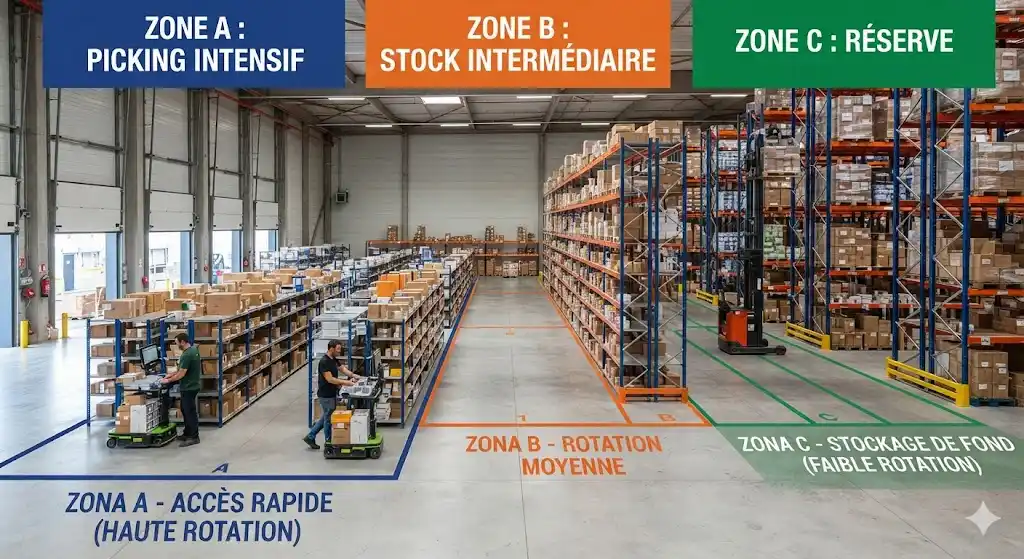
Before we talk about calculations, we need to clearly define the role of this method.
A Simple Definition of the ABC Method
La classification ABC inventaire segmente les références en trois groupes : A, B et C. La catégorie A regroupe les produits les plus stratégiques selon le critère retenu. La catégorie B correspond aux références intermédiaires. La catégorie C rassemble les produits les moins critiques.
Here’s the key point: a “stock” category isn’t necessarily the most expensive product. It’s the product that’s most important to your business based on the criteria you choose: value, turnover, margin, business criticality, or a combination of several factors.
Why is it called Pareto’s law?
Inventory Pareto analysis is often associated with the ABC method because, in many warehouses, a minority of SKUs account for the majority of value or movement. This is the logic behind the inventory Pareto principle: a small number of SKUs have a significant impact on logistics performance.
But we shouldn’t take this interpretation too literally. In e-commerce, seasonality, bundles, marketplaces, and omnichannel strategies can skew the distribution. The ABC method should therefore remain a decision-making tool, not a rigid rule.
Difference Between ABC Classification and Cycle Counting
The ABC inventory classification is used to prioritize SKUs.The ABC cycle count is used to schedule physical counts of these SKUs over time.
In practice, ABC answers the question: Which products deserve the most attention? Cycle counting answers another: How often should they be counted? The two are complementary. ABC structures the inventory-taking process rather than treating all inventory the same way.
What is the ABC method used for in inventory management?
La gestion des stocks ABC est utile parce qu’elle aide à arbitrer les ressources là où elles ont le plus d’effet terrain.
- Reduce stockouts on critical items
- Reduce excess inventory and storage costs
- Optimizing Product Placement in the Warehouse
- Prioriser les efforts d’inventaire et de réapprovisionnement
In an e-commerce warehouse, this translates into very specific decisions: best-selling items are placed in the most accessible areas, the most perishable SKUs are counted more frequently, and slow-moving products do not unnecessarily occupy the most efficient storage locations.
How do you perform an ABC inventory analysis?
The ABC classification calculation is easy to run. What matters most is the quality of the data and choosing the right criteria.
Data to Be Collected
For an ABC inventory analysis by value, you generally need to collect the following data: the product SKU, outbound shipments for the period, the unit cost or selected value, and the annual value consumed. For an execution-oriented analysis, you can also track inventory turnover, picking frequency, stockout rate, or business criticality.
The Step-by-Step Calculation
The most useful mini-process is as follows. First, extract the value or volume by SKU over a consistent time period. Next, sort the SKUs in descending order. Then calculate the cumulative percentage. After that, assign them to categories A, B, and C. Finally, define a stock, inventory, and replenishment policy for each category.
That is exactly the basis for an ABC analysis calculation in Excel. And that is also what a WMS can automate when the number of transactions becomes too high for reliable manual management.
A Simple Example of an ABC Table
| SKU | Annual Outings | Unit cost | Annual value | Cumulative % | Category |
| SKU-01 | 1200 | 50 € | 60,000 € | 57 % | A |
| SKU-02 | 1000 | 25 € | 25,000 € | 81 % | A |
| SKU-03 | 800 | 15 € | 12,000 € | 92 % | B |
| SKU-04 | 600 | 10 € | 6,000 € | 98 % | C |
| SKU-05 | 300 | 8 € | 2,400 € | 100 % | C |
This example shows why just two SKUs can account for the majority of the inventory. These are the ones that need to be prioritized for securing in stock a, b, and c.
Thresholds A, B, and C: Should the 80/15/5 ratio always be applied?
No. The 80/15/5 ratio is a guideline, not a requirement. Some companies prefer 70/20/10. Others narrow the scope of Category A to focus control on just a few SKUs. The right threshold is the one that actually helps manage the warehouse.
When the ABC Method Isn’t Enough A single classification system quickly becomes limiting if you manage highly seasonal products, multiple warehouses, or channels with different requirements. In such cases, you need to combine the ABC method with other factors, such as margin, supplier lead time, sensitivity to stockouts, or sales channel.
Which ABC classification methods should be used?
The choice of criterion affects how inventory is interpreted. It is therefore necessary to select an ABC that is useful for the intended decision.
The Main Variants of ABC Classification
- Rotational ABC is primarily used to improve picking and placement
- ABC classification by unit cost helps secure high-value items
- The ABC by Book Value Sheds Light on Financial Assets
- ABC classification based on usage and value is often the most useful in e-commerce logistics ABC classification, as it better reflects the reality on the ground.
When to combine multiple criteria
This is often the best approach. An inexpensive product that sells every day may be more strategic than a premium item with low sales volume. Conversely, an expensive, slow-moving item may require less picking space but more monitoring.
Let’s take an e-commerce example: a beauty brand sells a best-selling product with a low unit cost on its website, Amazon, and in retail stores. This product must be treated as critical, because stockouts directly impact revenue, the marketplace rating, and service levels. In this case, Category A depends more on turnover and omnichannel criticality than on unit price.
How do you apply the ABC method in a warehouse?

An ABC classification for a warehouse is only useful if it changes the fulfillment rules.
Where to place products A, B, and C
A-level products should be placed in areas that minimize movement and speed up order fulfillment. B-level products remain accessible but are lower priority. C-level products can be stored in secondary locations. This approach directly improvesABC picking and reduces unnecessary travel time.
How often should inventory be taken for each category?
A-category items should be counted more frequently than B- and C-category items. For example, a company might check A-category items weekly, B-category items monthly, and C-category items quarterly. This helps strengthenthe ABC inventory system without tying up the team in constant, exhaustive counts.
How to Link ABC to Picking and Replenishment
Inventory prioritization should also guide threshold alerts, safety stock levels, and replenishment rules. A-level items warrant tighter thresholds, more frequent checks, and more proactive monitoring. C-level items can be managed with a more flexible approach.
How to Adapt ABC for a Multi-Warehouse Environment
In an omnichannel environment, an item may be classified as A in a main warehouse and as B in a secondary location. It all depends on volume, the channel being served, and the delivery promise. A good logistics ABC classification must therefore be able to be reviewed by warehouse, by channel, and sometimes by time period.
Common Mistakes to Avoid When Conducting an ABC Inventory Analysis
Certain errors occur frequently and render the ABC useless.
- Sort by value only
- Ignore the actual rotation
- Never edit the categories
- Disconnect ABC from the field and the site
An ABC analysis of products must be based on actual inventory. Otherwise, it quickly becomes obsolete, especially during peak periods, when new sales channels are launched, or when there are significant fluctuations in demand.
Automated ABC Analysis: When Should You Switch from Excel to a Dedicated Tool?

The point isn’t to replace Excel just for the sake of it. The real question is: at what point does manual sorting become too slow or too unreliable?
The Limitations of a Manual Analysis
An Excel file may be sufficient at first. But as soon as the number of SKUs increases, sales channels multiply, or a multi-warehouse system is implemented, manual management becomes unreliable. Data quickly becomes outdated, multiple versions emerge, and decisions are made too late.
What a WMS/OMS Automates
A warehouse management system (WMS) helps ensure the reliability of inventory movements, available-to-sell inventory levels, alerts, storage locations, receiving, and inventory counts. An order management system (OMS), on the other hand, helps centralize orders and analyze demand by channel. Together, they makeautomated ABC analysis much more actionable.
The Benefits of Real-Time Updates
An automated ABC analysis becomes essential as soon as your categories need to adapt to sales, receipts, inventory discrepancies, and actual movements. This leads to improved inventory accuracy, faster restocking, increased picking productivity, and a higher level of service.
Key Performance Indicators to Track
At a minimum, track inventory reliability, out-of-stock rates, turnover by category, average picking time, order fulfillment error rates, and inventory coverage. These metrics show whether your real-time inventory management is having a tangible impact.
How Shippingbo Helps You Automate Your ABC Inventory Classification
The value of Shippingbo isn’t about adding yet another analytics tool to your stack. The value lies in linking your ABC inventory classification to the operations that truly make a difference: inventory reliability, inventory frequency, replenishment, picking, and multi-warehouse management.
Ensuring the reliability of real-time inventory data
An ABC classification is only useful if the data it is based on is reliable. If inventory movements are not properly reported, if inventory discrepancies accumulate, or if the available-for-sale inventory is not up to date, your A, B, and C categories quickly become theoretical.
With Shippingbo, inventory, movements, receipts, and alerts are all centralized in a single platform. This gives you a cleaner starting point for organizing your SKUs, tracking their performance, and preventing critical SKUs from being mismanaged due to inaccurate or outdated data.
Link ABC classification, inventory, picking, and replenishment
The real issue isn’t just figuring out which SKUs belong to Category A. The real issue is turning that information into an operational rule.
An A-tier item may require more frequent counting, a more accessible location, a stricter alert threshold, and more responsive restocking. A C-level SKU, on the other hand, can be managed with a more flexible approach. Shippingbo specifically bridges the gap between segmentation, inventory, order fulfillment, and restocking, ensuring that the ABC system is used to drive operations on the ground—not just to populate a spreadsheet.
Gain visibility across multiple warehouses and channels
As soon as you manage multiple logistics sites, multiple sales channels, or an omnichannel organization, a global ABC system is no longer sufficient. The same SKU may be a priority in one warehouse and a secondary item in another.
Shippingbo provides this visibility by centralizing inventory and order flows across multiple warehouses and channels. This allows you to reassess your priorities with a more nuanced approach that better reflects operational reality, and avoid making decisions in the dark when it comes to your e-commerce site, marketplaces, physical stores, or outsourced inventory.
Moving from static analysis to operational management
The switch to this tool becomes necessary when Excel is no longer sufficient to keep up with the actual pace of inventory flows. This is often the case as soon as the number of SKUs increases, sales become more volatile, or teams need to quickly balance stockouts, overstocking, and customer commitments.
Shippingbo allows you to move from one-time analysis to more continuous management. You no longer simply categorize your products once a quarter. You use the ABC method to better position your SKUs, ensure inventory accuracy, trigger the right restocking actions, and improve daily order fulfillment performance.
The ABC classification becomes useful when it guides action
ABC inventory classification is useful because it transforms a large number of SKUs into priorities for action. When done properly, it improves inventory reliability, reduces stockouts of best-selling items, limits overstocking, and shortens picking times.
Mais dès que les flux se complexifient, la méthode seule ne suffit plus. Il faut des données fiables, une mise à jour régulière et un lien direct avec l’inventaire, le réapprovisionnement, le picking et l’omnicanalité. C’est précisément l’apport de Shippingbo : relier OMS, WMS et TMS pour piloter vos opérations avec plus de visibilité, plus de fiabilité et moins d’arbitrages manuels.
Download the white paper “Inventory Management: 5 Tips to Avoid Inventory Errors and Maximize Your Sales.”

FAQ
ABC inventory classification is a method of segmenting items based on their economic or operational importance. It allows companies to focus their control, inventory, and replenishment efforts on the most strategic items.
You must list the SKUs, calculate their economic weight or turnover, sort the SKUs in descending order, calculate the total, and then assign them to categories A, B, and C before defining an appropriate inventory policy.
A ratio of approximately 80/15/5 is often used, but these thresholds are merely guidelines. Each company can adjust them based on its inventory flow, turnover, and warehouse constraints.
Automation prevents outdated classifications, reduces manual work, and allows categories to be updated based on actual movements, sales, receipts, and inventory variances.
The ABC method is used to prioritize items. Cyclical inventory is a physical inventory method. The two are complementary: the ABC method helps determine which items to count more frequently.
Glossary
ABC Inventory Analysis
A method for ranking items based on their economic or operational significance.
Category A
Group of the most strategic products to monitor as a priority.
ABC Inventory Classification
Segment inventory into categories A, B, and C to adjust the level of control.
Omnichannel
An organization in which sales and inventory are managed across multiple interconnected channels.
WHO
Software that centralizes and coordinates orders from various sales channels.
SKU
A unique code used to identify a product SKU.
TMS
Software that helps manage transportation, carriers, and shipments.
WMS
Warehouse management software that manages inventory, storage locations, movements, and order picking.