

The social commerce market (social shopping, s commerce and live commerce) is estimated at $931 billion in 2022 for China and the United States, representing 17% of e-commerce in 2022. These markets are growing steadily in these countries, and the trend is already beginning to emerge in Europe, with brands such as Darty, Boulanger and even Carrefour launching live shopping services. Meta is also planning to launch its payment service on Instagram and Facebook in Europe.
What is social commerce?
Social selling, s commerce, social shopping or social commerce, live commerce, livestreaming shopping: what are we really talking about?
Social commerce can be defined as the use of social networks to sell products or services. The purchase of a product is made indirectly. A publication is featured on the social network, and the merchant can insert a link in the post that redirects the consumer to his or her website, where the transaction takes place. Social commerce already exists in Europe. On instagram, there’s a “shop” tab that gives access to a marketplace in France, where merchants showcase their products and redirect the consumer to their website.
consumer on their site. The network serves as a showcase for the advertiser’s site. A similar tab exists with “Facebook marketplace”, which connects network users in the same way as Ebay. Individuals and companies showcase their products and then proceed to payment outside the social network.
What’s the difference between social commerce and social shopping?
Social shopping is defined as a type of sale made directly on the social network, without redirection to the advertiser’s site. Unlike social commerce, social shopping enables sales to be made directly on social networks, with a buy button and a native payment system. There is no redirection to the seller’s site. For the moment, Meta has launched social shopping in the United States with Facebook shop and Instagram shop, inspired by China, a pioneer in the field. Customers can view a company’s products on these networks, either via a post or a story, and can choose to pay and order on the network, or be redirected to the company’s site. Native payment functionalities are only available in the United States, but Meta is planning a rollout in Europe.
How do you define Live Shipping?
Live shopping or livestreaming shopping can be defined as a modern version of teleshopping. A network user, whether a brand, an individual or an influencer, films himself live to present his products, interact with the audience and propose a link to purchase the product in real time. The live shopping market will be worth $17 billion in the USA by 2022, and $503 billion in China. Today, many companies, including those in Europe, are looking to live shopping to boost their sales. Examples include Carrefour, which has teamed up with Brut, and Auchan, Leclerc and Orange, which are running Lives on Facebook, Youtube and specialized websites. Live shopping is already a reality in France and elsewhere in Europe, even if it is not as widespread as in Asia or America.
Social commerce: figures and statistics
Here are some key figures for social commerce (source: Statista):
- 931 billion: that’s the sales figure for all branches of social commerce (live commerce, social shopping, social commerce) in the USA and China by 2022.
- 1,314 billion: that’s the sales forecast for 2024 for all branches of social commerce worldwide, representing an estimated 30% increase in 2 years.
- 71% : this is the growth in social commerce sales between 2020 and 2022, against a backdrop of pandemics and a recovery in consumer spending.
- 17%: by 2022, social commerce in all categories will account for 17% of global e-commerce revenues.
- 19%: By 2024, social commerce will account for 19% of all e-commerce revenues worldwide.
Why does social commerce work so well?
Buying on a social network can activate several of these psychological mechanisms. For example, during a live session with an influencer, the buyer may be convinced to buy a product because he or she has a feeling of sympathy towards the influencer who will exchange and respond during the live session. Similarly, the exchange with an influencer during a live session can provoke a feeling of reciprocity, as the buyer can feel useful and indebted to the influencer, and will therefore want to buy to provoke a reaction and exchange with the influencer. But also, the opinion of other users will create social proof and encourage the decision to buy. What’s more, if the influencer himself provides feedback on his own purchases, his power of authority can be a factor of influence. What’s more, the influencer can play the rarity card to influence the act of buying. Finally, most lives are made on similar, coherent products. A beauty influencer will highlight a product for the complexion, then another complementary product for the eyes, for example.
Easy integration of social commerce with CMS
Shopify, the e-commerce behemoth, offers integration with most social networks, such as Facebook, Instagram, Tiktok, Pinterest, Snapchat and more. CMS integration enables you to link your social network to your online store, and to have automatic stock updates. Shopify also enables integration with instant messengers like Messenger or Whatsapp, with the possibility of creating chatbots with a “shop now” button that redirects to the store. Customers can also receive notifications on the progress of their orders directly on these instant messengers.
Social commerce popular with younger generations
Generation Z mainly uses Instagram (84%), Snapchat (76%) and Tiktok (52%). Millenials will prefer Facebook (55%), Instagram (45%) and Youtube (36%), while Boomers and Generation X will largely prefer Facebook (64%) and to a lesser extent Youtube (30%). According to the McKinsey study, Generation Z is the most likely to be influenced by social networks. 39% of them say that social networks are the channel that most influences them to recommend a brand or product. This makes social networks a preferred channel for Gen Z and Millenials in their purchasing decisions. For Gen Z, it’s the social proof that counts in triggering a purchase: 60% of them always look at reviews before buying a product, hence the importance of social networks in finding reviews. (Source: Digimind). 1 in 4 French people say they have already made a purchase via a social network, and this figure rises to 39% among 35-44 year-olds.
Social commerce: how to sell on social networks?
Selling products on social networks, often referred to as“social commerce“, is a vital strategic move for today’s businesses. Faced with an ever-changing digital landscape, a properly designed and implemented presence on these platforms can extend your reach to a diverse audience and significantly boost your sales.
The crucial first step is to select the platforms best suited to the nature of your product and your audience. Platforms like Facebook and Instagram have proven effective for products with strong visual appeal, such as fashion or home decor items. LinkedIn proves a wise choice for professional services, while up-and-coming platforms like TikTok captivate a younger audience.
Optimizing your presence on these platforms is just as essential. We recommend enriching titles and descriptions with relevant keywords, presenting high-resolution profile and cover images, and facilitating access to your website directly from your profile to ensure a smooth transition for potential customers.
Content remains the cornerstone of any social strategy. Providing high-quality images and videos can not only hold the audience’s attention, but also reinforce the perception of your brand. It’s essential that your product descriptions incorporate strategic keywords to maximize visibility.
What’s more, creating interactive content such as quizzes, polls or contests can serve to boost your audience’s engagement.
Integrating the e-commerce features specific to these platforms can transform your online presence into a veritable sales machine. Tools such as Instagram Shopping and Facebook Shop offer a simplified shopping experience, allowing customers to discover and purchase a product without leaving the platform.
To top it all off, a judicious investment in social network advertising can propel your product in front of a wider, relevant audience, optimizing the chances of conversion and increased sales.
Social commerce trends in 2025
Social commerce is constantly evolving, and by 2025 several key trends will reshape the sector:
- UGC (User Generated Content)
- Influencers
- Augmented reality (AR)
UGC (User Generated Content)
User Generated Content (UGC) will continue to play a fundamental role in social commerce. UGC, which includes customer reviews, posts on social networks and product unboxing videos, is a source of authenticity that consumers prefer. Unlike brand content or paid influencer campaigns, UGC relies on the spontaneity of consumers. This type of content enables brands to build a relationship of trust with their audience, while increasing engagement on social platforms.
Influencers: the new face of brands
By 2025, influencers will further strengthen their position as brand spokespeople on social networks. However, their role is evolving: rather than simple one-off collaborations, genuine long-term partnerships will emerge, where influencers will embody the brand in a more natural and ongoing way.
Augmented reality (AR) for an immersive experience
Augmented reality (AR) will revolutionize social commerce by offering an immersive user experience. By 2025, consumers will be able to virtually try on products, such as clothing or make-up, directly via social networking applications. This will reduce the barriers to purchase, increasing customers’ confidence in their choices, and consequently their conversion rates.
Which sectors to focus on?
According to a McKinsey study, the most streamed categories are :
- Clothing, accessories, fashion (35.6%)
- Beauty and cosmetics (7.6%)
- Food and nutrition (7.4%)
- Electronics, multimedia, high-tech (4.6%)
- Decoration and furnishings (3.6%)
- Automotive and local sales (0.2%)
Which social networks do social commerce?
Meta, the company that brings together Facebook, Instagram, Whatsapp and Messenger, is the forerunner in the West of social commerce in all its forms (s commerce, live commerce, social shopping). Meta is the first company to democratize social shopping in the West. For the moment, social shopping functionalities with a native payment system are only available in the United States, but a future roll-out to the rest of the world is one of the firm’s objectives. Today, it is still possible to do social commerce on Facebook or Instagram, as e-commerce platforms offer APIs to connect Facebook Marketplace to one’s e-commerce website.

In the US, Meta offers Facebook Shop and Instagram Shop, where an integrated payment system enables transactions to be carried out without leaving the social network. The e-tailer can even send order tracking notifications via Messenger or Whatsapp.
TikTok: the Chinese network used in Europe by Generation Z offers a mix of social shopping and live shopping in Asia. The trend, which originated in China, enables retailers and designers to film themselves and offer their products during the live session. Customers can then add items to their shopping baskets and pay directly on the application.
Pinterest lets users shop among their pinned ideas. A shop button lets users explore merchants’ virtual boutiques, and the shop button allows them to proceed to payment. However, Pinterest does not allow users to pay directly on the platform. Apple Pay handles the transaction.
Snapchat is a special case in social shopping. This is more social commerce, as it is not possible to pay or send orders from the platform. However, the app has developed a form of AR Shopping, or shopping in augmented reality. Lenses and filters enable products such as make-up or clothing to be tested in augmented reality. The customer is then redirected to the retailer’s website to continue shopping.
Advantages and disadvantages of social commerce
Social shopping, social commerce and live shopping offer a number of advantages, including :
- Engagement and high conversion rates
- Interactivity with customers
- Customer loyalty
- Benefit from a community of fans ready to support their favorite brands
- Opportunity to reach a young audience aged 18/25, GenZ and Millenials
- Increasing visibility for small brands
- Increase direct sales (DtoC)
However, there are also disadvantages:
- Technical and financial constraints for retailers
- Need to comply with platform rules
- Have a Key Opinion Leader (KOL) to boost sales and act as the face of the brand, in addition to engaging the audience and animating the live show.
- Anticipating and mastering emerging trends
Nano-influencers help improve brand image
Brands could bet more on micro and nano influencers who have a highly engaged community and a bond of trust with the influencer. This could generate better sales at lower costs, as very large influencers represent a significant cost for brands.
The new social commerce sectors
According to the McKinsey study, live and social shopping could extend beyond today’s sectors, touching on industries such ashealthcare, finance, BtoB and more.
The pandemic has democratized videoconferencing, which could push this sector towards live and social shopping, particularly in the United States.
Virtual reality and AI in social commerce
Virtual reality and augmented reality enable an even more immersive shopping experience, allowing consumers to replicate an in-store shopping experience while at home.
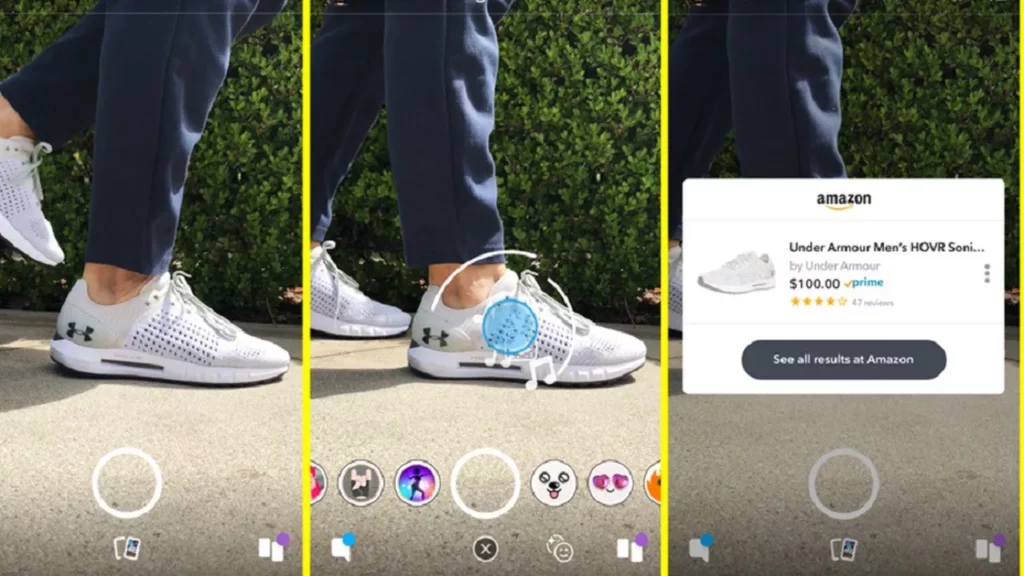
Snapchat is currently one of the only social networks to offer this type of experience in the West, combining shopping and augmented reality. Customers can use image recognition software to find an item on Amazon. Customers can also try on clothes using Snapchat lenses.
Social commerce and social shopping in France?
“In its study, Accenture reveals that 50% of respondents fear, in particular, a lack of buyer protection, as well as loopholes in refund policies for purchased goods.” (Fevad)
Trust is central to any transaction. Social networks that are destined to become marketplaces are no exception, and must offer users a safe and trustworthy environment.
However, in Europe and the United States, there is a real mistrust of social networks and the media in general. In a Washington Post survey in 2021, the majority of American users don’t trust Facebook, Instagram and Tiktok when it comes to protecting personal data. 72% of those polled said they didn’t trust Facebook’s personal data policy. The same applies to Tiktok (63%) and Instagram (60%).
Nevertheless, social commerce in all its forms (live shopping, social shopping) represents a considerable advantage for brands and social networks alike. It is therefore certain that these practices will arrive in Europe in the medium to long term. Today, some forms of social commerce and live shopping already exist, but it remains to be seen whether it will soon be possible to pay directly on social networks.
How about using social shopping to boost your e-commerce sales? Discover in our complete study how to take advantage of social commerce, social shopping and live shopping to stay one step ahead of your competitors and multiply your online sales:
