

PrestaShop enables you to manage your store and track orders, but it’s not always enough to manage demanding logistics preparation. As soon as volumes increase, several operators are involved or flows become omnichannel, the limits of native software quickly become apparent. Order-picking software or a WMS can make picking more reliable, reduce errors and better absorb growth.
If you’ve already read our article on Prestashop marketplaces order management, the next logical step is simple: once the orders have been centralized, they still need to be properly processed in the warehouse. This is precisely where the subject of order picking software for Prestashop becomes strategic.
Prestashop order-picking software is used to control the actual logistical execution after the order has been taken. It covers picking, checking, packing, prioritization, operator coordination and status feedback right through to dispatch.
Prestashop fulfills its role as an e-commerce foundation. However, as soon as logistics become more complex, the difference between order management and order picking becomes impossible to ignore. The aim here is to understand what PrestaShop does well, what it covers less well for the warehouse, and when a Prestashop WMS Shippingbo stack becomes more relevant.
La préparation de commande Prestashop regroupe les étapes nécessaires pour traiter une commande avant son expédition, notamment le picking, le contrôle et l’emballage. Lorsque les volumes augmentent, un logiciel de préparation de commandes connecté à PrestaShop permet de mieux structurer ces opérations et d’accompagner des processus logistiques plus complexes.
- What is order preparation on Prestashop?
- Prestashop’s native picking limitations
- When should I switch from Prestashop alone to Prestashop + WMS?
- Why the Prestashop + WMS combination is changing logistics performance
- Shippingbo, the solution for industrializing Prestashop order picking
This need for structuring is not without reason. According to Eurostat, 77% of European Internet users bought online in 2024, compared with 59% in 2014. In France,Arcep reports that in 2024, nearly 1.6 billion parcels were delivered in the country, up 3.4% year-on-year. As flows increase, the quality of preparation becomes an operational performance issue.
What is order preparation on Prestashop?

Before talking about tools, we need to clarify the scope. Prestashop order preparation begins where the validated order is actually executed in the warehouse.
Simple definition
Prestashop order preparation refers to all the logistical operations carried out between the validation of an order and its departure from the warehouse. We’re no longer just talking about order status in the back office, but physical execution: picking, checking, packing and delivery to the carrier.
A Prestashop order preparation tool therefore has a very different function from that of the CMS. It helps teams to prepare orders faster, reduce errors and keep an operational overview of what’s in progress, blocked or completed.
This definition is important, as many merchants still confuse Prestashop order processing with e-commerce order preparation. As long as volumes remain low, this confusion is tolerable. As soon as the load increases, it becomes a direct brake on logistics performance.
Operations involved: picking, checking, packing, prioritization
The first building block is Prestashop picking. You need to know what to pick, where to pick it, in what order, for what order and with what priority level. Without a picking logic, preparation is quickly based on individual habits rather than a reliable process.
Next comes the Prestashop picking control. This stage secures the conformity of items before packing. It’s this step that prevents SKU inversions, product omissions and errors, which in turn generate after-sales service, returns and reshipments.
Packing is also part of Prestashop parcel preparation. It’s not just a question of closing a box, but of attaching the right products to the right parcel, printing the right label at the right time, and feeding coherent information back into the system.
Finally, you have to prioritize. Not all orders can be prepared with the same logic. Some are urgent, others simple, and still others require several lines, several packages or specific processing. A good Prestashop logistics workflow helps to organize this reality.
What distinguishes order picking from simple order processing?
Order management covers the administrative and commercial life cycle of an order. It covers receipt, status, payment, modifications, refunds and customer service follow-up.
Visit order pickingconcerns warehouse execution. It’s the moment when we move from a registered order to one that’s physically ready for dispatch. It’s no longer a sales back-office issue, but a field issue.
This difference completely changes the choice of tool. Prestashop can be used to manage orders without being a true Prestashop warehouse software. As soon as the challenge becomes coordinating pickers, scanning, checking and picking sessions, you need a WMS layer.
Prestashop’s native picking limitations
Prestashop covers sales and order tracking very well. When logistics become more complex, however, the limitations of native software quickly become apparent.
Logic designed to manage orders, not warehouses
Prestashop is first and foremost an e-commerce CMS. It correctly manages the store, the catalog, orders and part of the stock management. stock management. For a start-up business, this is often sufficient.
The limit is reached when the warehouse becomes a subject in its own right. At this point, the merchant no longer just needs a good sales tool. He needs a tool capable of managing physical flows, operators, priorities and controls.
That’s why native Prestashop shouldn’t be denigrated, but repositioned. It does e-commerce well. It’s not so good at Prestashop warehouse order picking, when you need to structure more demanding logistics.
| Subject | Prestashop native | Prestashop + WMS |
| Order management | Correct for back-office control | More structured with advanced orchestration |
| Preparation | Poorly equipped for field execution | Sessions and preparation workflows |
| Picking | Little guidance | Controlled and optimized routes |
| Scan | Limited | Prestashop and PDA barcode scanning in the workflow |
| Multi-operator | Little fluidity as the team grows | Clear division of tasks |
| Omnichannel and multi-warehouse | Quickly complex management | Prestashop multi-warehouse and unified inventory |
Limits on picking, scanning and operational orchestration
The first limitation of native solutions concerns picking software. When a picker has to follow an optimized path, group orders, distinguish between single and multi-reference orders, or pick by zone, he needs an execution logic that Prestashop doesn’t come with as standard.
The second limitation concerns PDA picking. Without a PDA tool or mobile workflow, teams compensate with paper printouts, exports, back and forth between screens or manual checks. This organization lasts for a while, but then turns against productivity.
The third limitation concerns barcode scanning. A final or intermediate scan is not a detail. It’s an anti-error barrier. Without it, control relies more on human attention than on a reliable process.
Last but not least, real orchestration is often lacking. Launching sessions, filtering orders according to business rules, separating flows according to carriers or automating certain statuses requires a real order preparation tool for Prestashop, not just a native order screen.
Limits when volume increases or when several operators are involved
When just one person prepares a few orders a day, Prestashop alone may still suffice. But as soon as the volume increases, the hidden costs quickly become apparent: wasted time, re-entries, more frequent errors and degraded visibility.
The problem becomes even more acute when a logistics team is set up. As soon as several operators are involved, tasks have to be shared out, duplication avoided, progress visualized and the flow between picking, control and dispatch smoothed.
This is also when peaks in activity become a real test. A promotional campaign, strong marketplace activity or high season immediately puts a strain on overly manual operations. It’s no longer just a question of receiving orders, but of getting them out cleanly and on time.
Multi-warehouse, omnichannel and advanced synchronization limits
Stock synchronization for Prestashop becomes a critical issue as soon as a merchant sells on multiple channels. As long as stock is simple and local, management remains acceptable. As soon as several flows feed the same catalog, coordination becomes much more sensitive.
The situation is even more complicated with multi-warehouse. Which warehouse needs to prepare? Which stock should be distributed for sale? How to arbitrate a local shortage? How can orders be oriented according to availability or flow type?
In these situations, a simple Prestashop order-picking module isn’t always enough. What’s needed is a layer capable of orchestrating orders, inventory and fulfillment. This is precisely where a WMS comes in.
When should I switch from Prestashop alone to Prestashop + WMS?
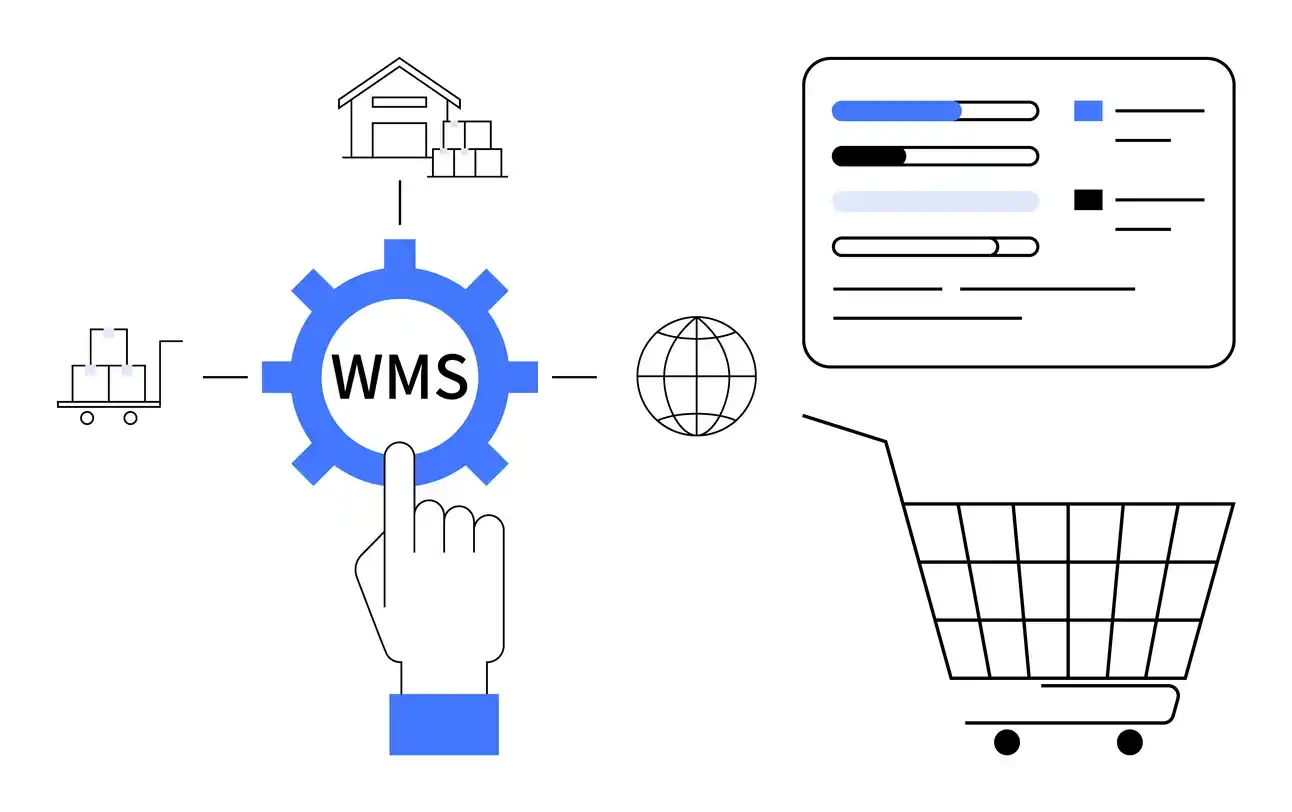
The right question is not whether to wait for a complete standstill. The right question is to identify the point at which friction becomes structural and a WMS brings more value than complexity.
Warning signs to watch out for
The right time to connect Prestashop to a WMS doesn’t necessarily come when the organization is already saturated. It often comes when certain weak signals become recurrent and start to cost time, margin and service quality.
- You still use paper, exports or multiple screens to prepare orders.
- Your picking slows down considerably when there are several lines or operators.
- Preparation errors are on the increase, even with an experienced team.
- You lack visibility of orders in progress, blocked or already shipped.
- Your flows become omnichannel, complex or multi-warehouse.
When several of these signals appear at the same time, the subject is no longer cosmetic. You don’t just need to improve the back office. You need real logistics software for Prestashop.
The most common business problems
In the field, the irritants are often the same. Teams search for information, arbitrate on the fly, re-enter data and discover anomalies too late. What appears to be a minor organizational flaw quickly becomes a recurring problem.
This friction is costly. A picking error is not limited to a poorly prepared parcel. It generates after-sales service, returns, re-shipments, sometimes negative feedback, and always wastes additional time.
The expected benefits of a WMS connected to Prestashop
The first expected benefit is fluidity. Preparers know what to do, in what order and with what level of control. Managers have a clearer picture of what’s going well, what’s stalling and what needs to be done.
The second benefit is structural. By connecting Prestashop to a WMS, you also prepare for better automation of Prestashop orders, improved inventory management and a more robust foundation for omnichannel. It’s a fundamental response, not just a Band-Aid.
Why the Prestashop + WMS combination is changing logistics performance
Associating Prestashop with a WMS doesn’t just add functionality. It changes the way teams prepare, control and manage flows on a day-to-day basis.
Faster preparation
The speed of preparation depends not only on team motivation. It depends above all on the level of organization of the flow. A well-designed Prestashop order preparation tool reduces unnecessary travel, avoids re-typing and simplifies order sequences.
With a WMS for Prestashop, orders can be grouped, filtered and launched according to relevant business rules. Teams spend less time searching and more time executing.
Reduce picking errors
The best way to reduce errors is not to ask for more attention. It’s to add control points at the right time. A structured picking check secures the conformity of orders before they leave the warehouse.
This is particularly useful when the catalog is expanding, certain references are similar, or volumes are increasing. In this context, barcode scanning becomes a simple but decisive lever for reliable preparation.
Streamline operations and absorb growth
A WMS isn’t just about going faster today. It’s about preventing every increase in volume from turning into an operational crisis. It’s what makes it possible to scale without multiplying files, manual handling and poorly managed exceptions.
This fluidity also improves coordination between teams. E-commerce, logistics and customer service work with more coherent information. Anomalies are reported more quickly, arbitration is simpler and the customer promise becomes more tenable.
Giving teams greater visibility
Operational visibility is a major benefit of a well-connected Prestashop OMS and Prestashop WMS stack. It enables you to see orders to be prepared, sessions in progress, potential shortages, blockages and pending shipments.
This visibility helps both the warehouse manager and the e-commerce manager. The former can better manage his business. The latter has a better understanding of the logistical reality that underpins the sales promise. It’s also what reinforces the relevance of a page dedicated toOMS e-commerce in your internal network.
Shippingbo, the solution for industrializing Prestashop order picking
Once the need has been identified, it’s time to look at the most coherent response. The challenge is not to pile up tools, but to connect Prestashop to a logistics layer designed for execution.
How Shippingbo completes Prestashop
Shippingbo does not replace the CMS. The logic is more interesting: Prestashop remains the commercial foundation, while Shippingbo provides the operational layer that centralizes, automates and makes logistics execution more reliable.
With Shippingbo‘s WMS for Prestashop, orders go up in real time, stocks are synchronized, preparation sessions are controlled and shipping follows in the same flow. This solution is precisely what is needed when Prestashop alone has to support more demanding logistics.
This is what makes the difference between a well-managed store and truly industrialized logistics. The Prestashop WMS Shippingbo stack makes it possible to move from correct operation to scalable operation.
Key features for order picking
For Prestashop merchants, Shippingbo is designed to make preparation easier, smoother and more reliable. The most useful features are grouped around a few operational bricks:
- preparation sessions to launch orders according to field logic
- picking pda to guide operators more effectively
- scanning and picking control to ensure the reliability of every order
- label printing and shipment in the same workflow
- location management and preparation rules according to your logistical constraints
- unified order and stock synchronization to avoid discrepancies between sales and fulfillment
- warehouse management and centralized tracking to maintain business visibility
For which merchants Prestashop Shippingbo is relevant
The solution is particularly relevant for Prestashop-based e-commerce SMEs that have already outgrown the artisanal stage. This often concerns structures that ship several hundred or several thousand orders per month, with peaks, several channels or a small, dedicated logistics team.
Relevance increases even more if you already have a fulfillment softwaresoftware, omnichannel warehousing, multiple carriers or multi-warehouse management. In this case, the question is no longer whether to structure logistics, but with what level of ambition.
Expected operational gains
The first expected benefit is a faster throughput. Teams spend less time searching, re-entering, manually checking or correcting errors. Preparation becomes smoother and more regular.
The second expected benefit is a reduction in the risk of error. Between picking, control and status management, a better-structured logic reduces disputes, avoidable returns and reshipments.
The third expected gain is a better ability to absorb growth. A Shippingbo-driven organization helps to keep up with the load during peaks, open up new channels and maintain visibility without burdening operations.
Prestashop alone manages orders, not the entire warehouse reality
Prestashop remains a good base for selling and tracking orders. But as soon as logistics become more important, the real issue is no longer just order management. It becomes a question of Prestashop order preparation, operational reliability and scalability.
This is precisely where a Prestashop WMS Shippingbo combination comes into its own. Shippingbo complements Prestashop with an OMS, WMS and transport layer capable of structuring picking, control, stock synchronization and logistics execution in a single interface.
Book a Shippingbo demo to assess whether your organization has reached the tipping point between Prestashop alone and truly industrialized logistics:

FAQ – Prestashop order picking software
Un logiciel préparation de commande Prestashop aide à exécuter les opérations logistiques liées aux commandes : picking Prestashop, contrôle, emballage, priorisation et synchronisation des statuts jusqu’à l’expédition.
La gestion commandes Prestashop organise le cycle de vie de la commande dans le back-office. La préparation de commande Prestashop concerne son exécution physique en entrepôt, jusqu’à l’expédition.
Prestashop couvre les bases du traitement de commande, mais montre vite ses limites dès qu’il faut structurer un vrai workflow logistique Prestashop, plusieurs opérateurs, du scan, du contrôle ou un fonctionnement multi-entrepôts.
Il faut connecter Prestashop à un WMS Prestashop dès que les volumes augmentent, que les erreurs de préparation se multiplient, que plusieurs opérateurs interviennent ou que la logistique devient omnicanale et plus difficile à piloter dans le natif.
Shippingbo Prestashop permet de garder Prestashop comme socle commercial tout en ajoutant une vraie couche OMS, WMS et transport pour industrialiser la préparation, la gestion stock Prestashop et l’expédition.
Glossary
WMS
A Warehouse Management System is warehouse management software. It is used to control picking, locations, operators and physical flows.
WHO
An Order Management System is order management software. It centralizes, distributes and orchestrates orders between the various channels and stocks available.
Picking
Picking is the action of taking the right products from the warehouse to prepare an order.
Picking control
This involves checking products before packing, to avoid errors in reference, quantity or order.
Picking PDA
The PDA is a mobile terminal used by pickers. It enables them to follow preparation instructions directly in the warehouse.
Logistics workflow
Logistics workflow refers to the sequence of steps that organize preparation, inspection, packaging and dispatch.
Fulfillment software
Fulfillment software helps manage the entire logistics execution chain, from order to shipment.