
Today, e-commerce growth depends on a balance between acquisition, profitability and operational execution. Omnichannel logistics is rapidly becoming a structuring factor: it determines the ability to deliver fast, error-free and without exploding costs.
For logistics and e-commerce managers, the challenge is no longer simply to sell more, but to deliver a consistent customer promise across all channels. Every stock shortage, preparation error or shipping delay has a direct impact on customer satisfaction, after-sales service and profitability.
This is where the OMS WMS question comes in. Understanding the OMS WMS difference is the key to structuring a logistics architecture capable of sustaining growth. OMS and WMS do not meet the same needs: one controls the order, the other the field execution. Their complementary nature is now a standard for omnichannel e-tailers.
- What is an OMS (Order Management System)?
- What is a WMS (Warehouse Management System)?
- OMS vs WMS: a match of features
- Why combining OMS and WMS is essential for your growth?
- How do you choose the right solution for your e-commerce business?
In short, the OMS WMS difference lies on the boundary between business decisions and operational execution. This article clearly explains these roles, their benefits and why combining them is essential for scalable logistics.
What is an OMS (Order Management System)?
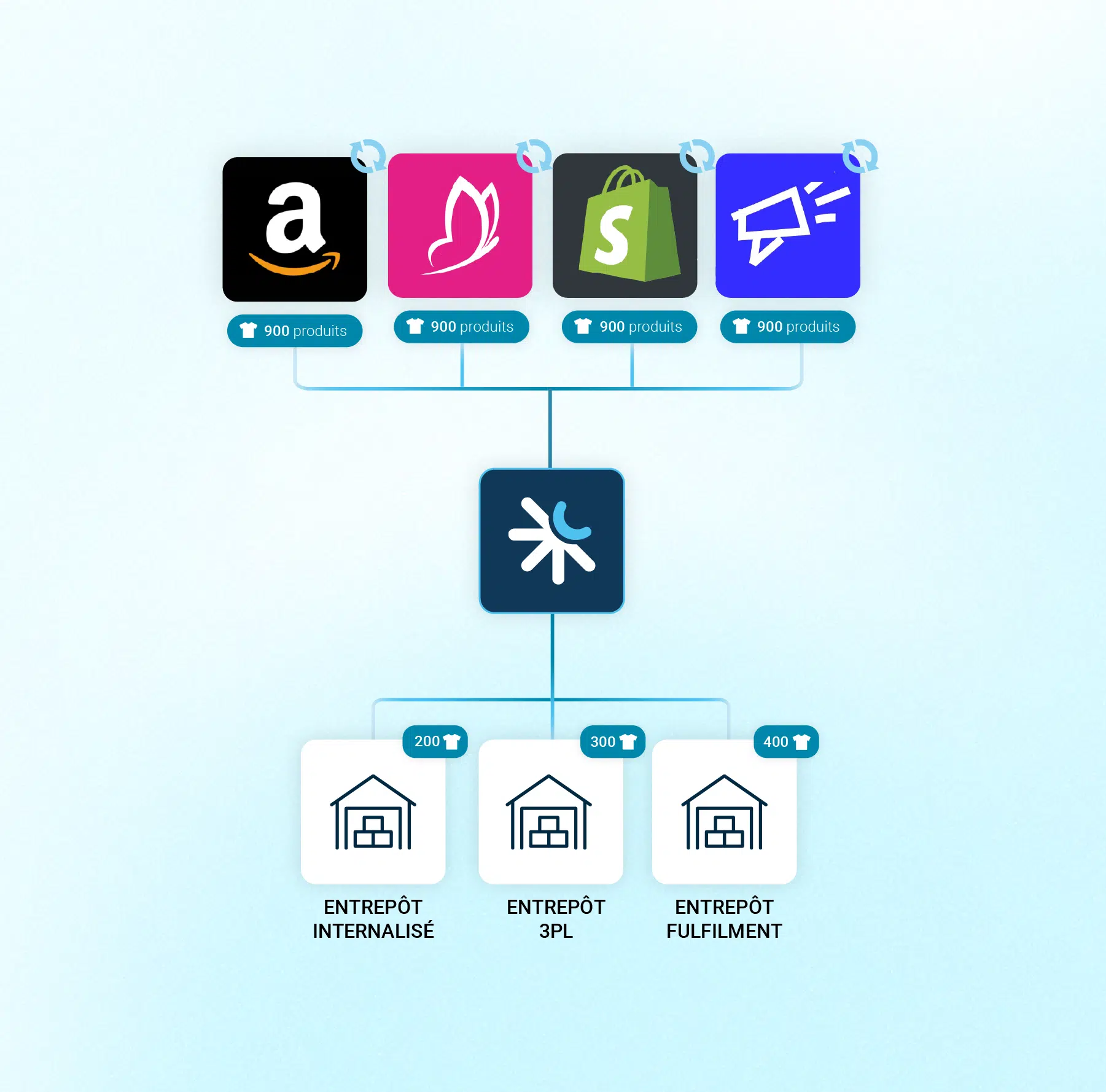
An OMS occupies a central position in the e-commerce ecosystem. It sits between the sales channels and the warehouse, with a decision-making role. It doesn’t prepare orders: it decides how they should be processed.
In other words, OMS is a software program that manages orders from creation to logistics routing. This capability makes it a strategic tool as soon as business becomes omnichannel.
Definition and role in command orchestration
An OMS, or order management system, is order management software designed to centralize all orders from all sales channels. E-commerce sites, marketplaces, stores or private sales: all flows are grouped together in a single interface.
The main objective of OMS is toorder orchestration. Each order is analyzed according to business rules: stock availability, warehouse location, shipment type or expected service level. This logic enables automated, consistent e-commerce flow management.
In practice, OMS eliminates silos and provides a global view of orders in progress. It becomes the essential decision-making layer for all structured omnichannel logistics.
Why WHO is the brain of your omnichannel strategy
In an omnichannel environment, OMS acts as a logistics brain. It guarantees real-time stock visibility and ensures inventory synchronization between all channels.
OMS consolidates information from the WMS and sales channels to produce reliable, saleable stock. This consolidation prevents overselling and secures the customer promise. It also enables multi-warehouse management. It automatically allocates orders according to performance criteria. This capability is essential as soon as business moves beyond a simple single-warehouse structure.
In short, OMS structures the logistics decision and guarantees consistency between sales and execution.
What is a WMS (Warehouse Management System)?

Whereas the OMS thinks in terms of orders, the WMS thinks in terms of physical operations. It comes into play when a decision has been taken and needs to be carried out efficiently in the field.
A WMS is software that physically organizes stock and warehouse operations. It becomes indispensable as soon as volumes increase or manual picking reaches its limits.
Definition and optimization of warehouse operations
A WMS, or warehouse management system, is warehouse software dedicated to managing inventory and physical movements. It precisely tracks the location, origin and destination of each product.
The WMS structures processes to improve warehouse productivity. It reduces unnecessary movements, makes operations more reliable and strengthens e-commerce inventory management.
Key features: from picking to dispatch
A high-performance WMS covers all aspects of order preparationfrom picking to packing and dispatch. It guides operators and secures each step.
By optimizing routes and automating repetitive tasks, the WMS significantly improves quality and speed of execution. Picking and packing management becomes standardized and measurable.
In short, the WMS guarantees field execution and operational reliability in logistics.
OMS vs WMS: a match of features
By comparing OMS and WMS, we can clarify their respective roles, and avoid a common mistake made by growing e-tailers: attempting to assign to a single tool responsibilities that in reality belong to two distinct logics. OMS and WMS do not address the same issues, nor do they address the same decision-making levels.
These two tools are therefore not in competition with each other, but rather complement each other. The OMS is positioned upstream, when the order is created, qualified and oriented. The WMS comes into play downstream, when the order must be physically executed in the warehouse. Replacing one with the other leads either to a loss of commercial control, or to a drop in operational performance.
Business vision (OMS) vs. operational vision (WMS)
Where OMS thinks in terms of orders, the WMS thinks in terms of locations.
This difference in perspective profoundly structures their role in the supply chain. The OMS works on commercial objects: an order, a customer, a sales channel, a promised lead time. The WMS, on the other hand, works on physical objects: a product, a location, a movement, an operation.
OMS adopts a sales and customer promise-oriented vision. It arbitrates, prioritizes and decides according to business rules: which warehouse should prepare the order, within what timeframe, with what level of service. The WMS adopts a field-oriented vision: it executes these decisions, checks that they have been carried out correctly, and continuously optimizes operations to improve reliability and productivity.
In short, the OMS drives the order, and the WMS drives logistics execution. It is the articulation of these three building blocks, and not their substitution, that enables us to build a high-performance, scalable supply chain.
Inventory management: the focal point
E-commerce inventory management is the natural point of convergence between OMS and WMS, as it lies precisely on the boundary between business decisions and operational execution.
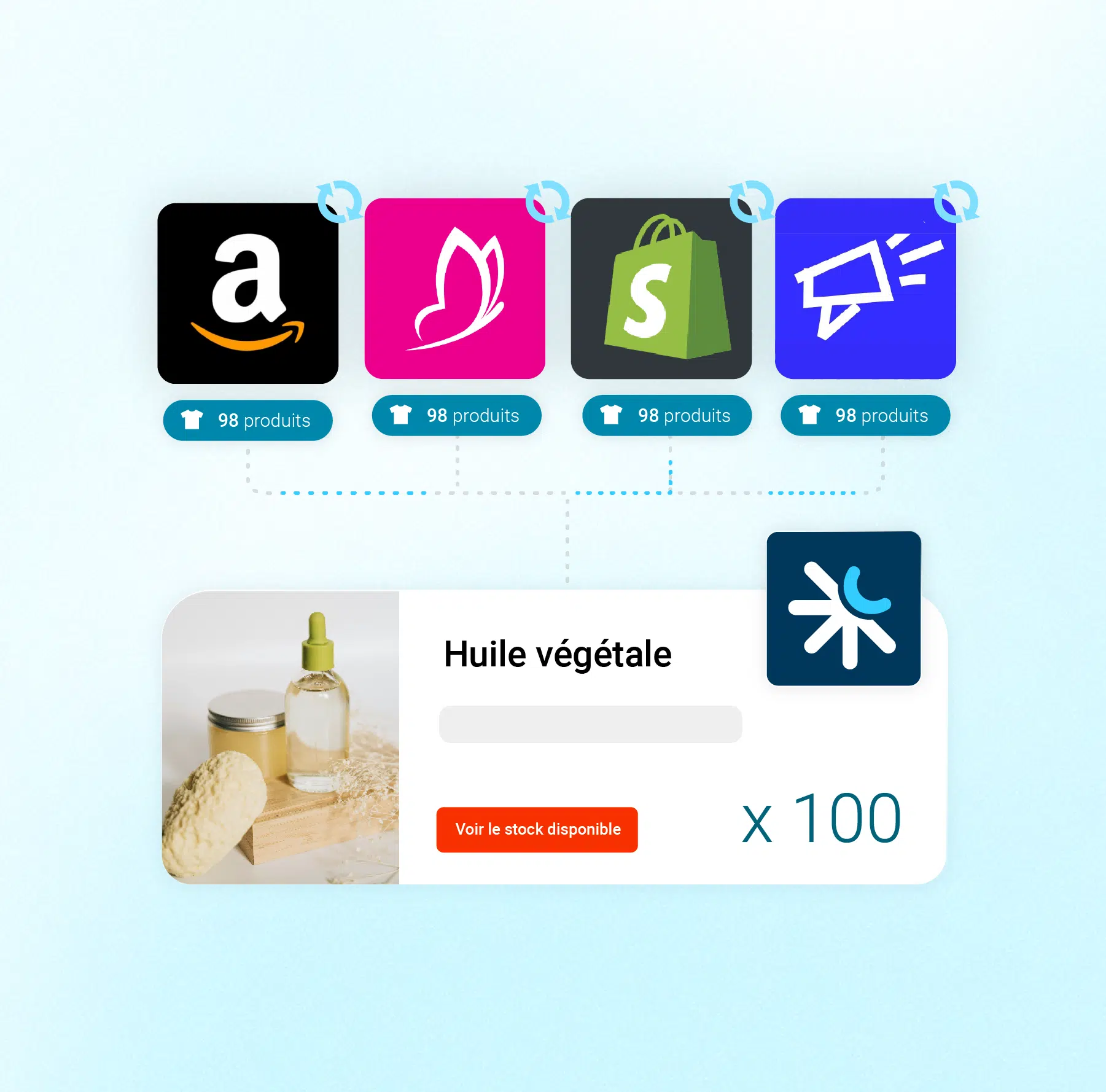
OMS displays stock available for sale, consistent for e-commerce teams and synchronized across all channels. The WMS, for its part, guarantees the reality of physical stock in the warehouse, with a precise view of quantities, locations and movements.
The WMS depends on the OMS to know which orders to prepare, in what order, and with what level of priority. Conversely, the OMS depends on the WMS to know what stock is actually available, taking into account reservations, preparations in progress and field adjustments.
In short, OMS WMS alignment transforms stock into reliable, actionable data, securing logistics flows and sustaining growth.
Here’s a table to help you understand:
| Criteria | OMS (Order Management System) | WMS (Warehouse Management System) |
| Main role | Order management and orchestration | Execution and optimization of warehouse operations |
| Vision | Commercial and omnichannel | Operational and in the field |
| Manipulated object | Orders, customers, channels, delivery promises | Products, locations, movements, preparations |
| Time of intervention | Upstream, as soon as the order is created | Downstream, during preparation and dispatch |
| Stock management | Sellable, synchronized inventory | Physical and localized stock |
| Key contribution | Securing the customer promise | Productivity and operational reliability |
| Main purpose | Decide where and how to process an order | How the order is prepared |
| Limit without the other | Decisions out of touch with the field | Execution without omnichannel vision |
Why combining OMS and WMS is essential for your growth?
E-commerce volumes and expectations in terms of speed and accuracy of deliveries will continue to grow in 2025: according to the E-Commerce Logistics 2024 Reportthe e-commerce logistics market continues to expand rapidly, with growing complexity due to the increase in orders and the need to automate fulfillment operations.
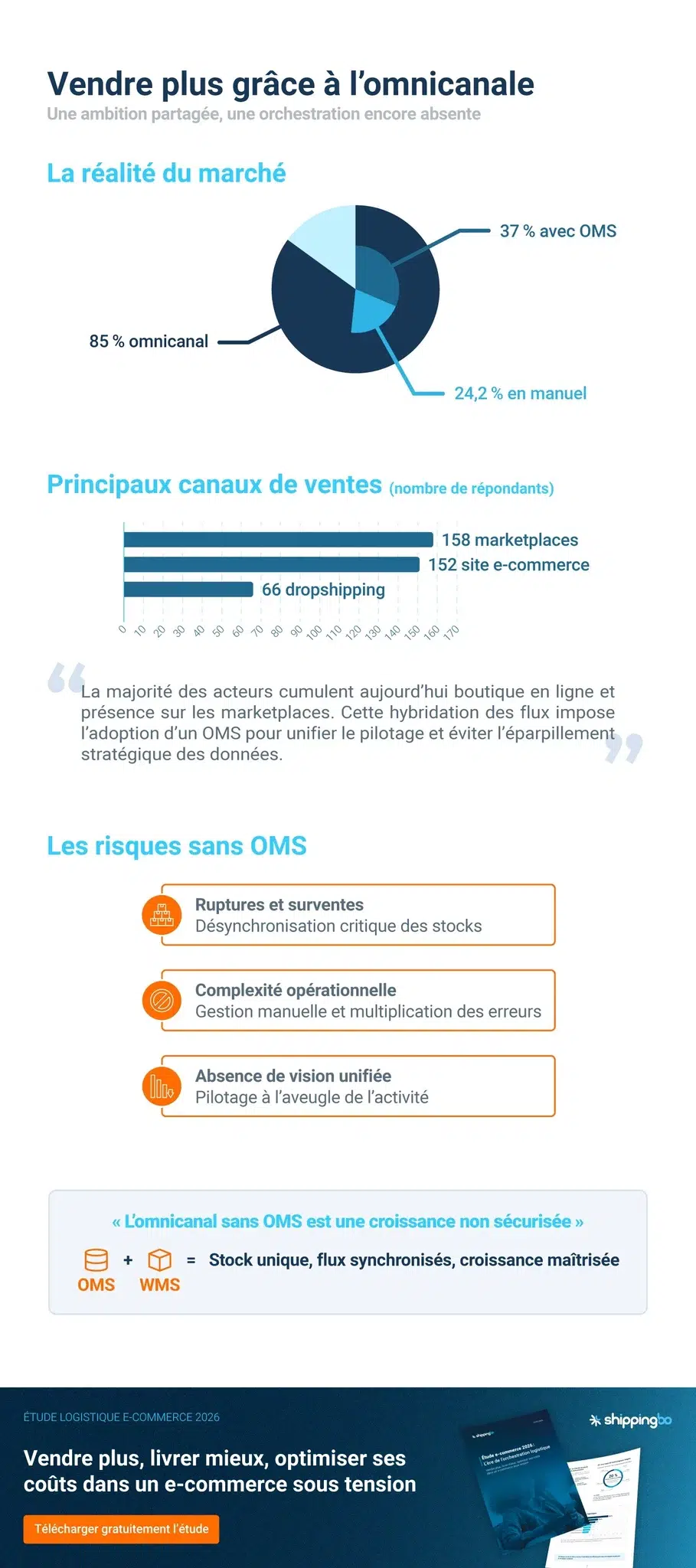
As e-commerce business grows, so does the complexity of logistics. Multiplying sales channels, increasing volumes, diversifying delivery methods, managing several warehouses: without the right tools, this complexity quickly becomes a brake on growth rather than a lever.
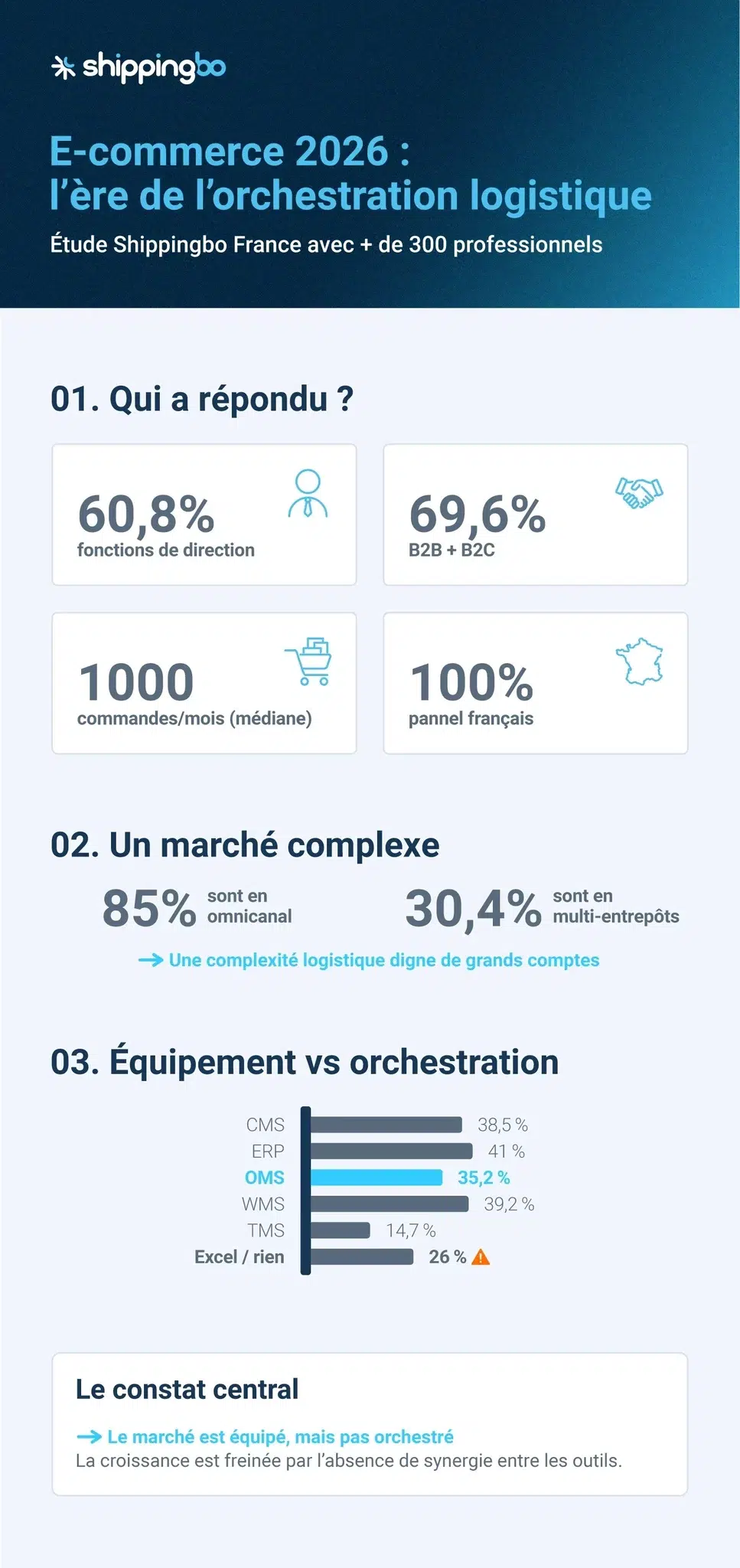
Combining an OMS and a WMS is precisely the way to regain control over this complexity. This is one of the findings of our e-commerce 2026 study.
The customer promise: sell what you really have in stock
In an omnichannel context, the customer promise depends above all on the reliability of stock information. Combining OMS and WMS ensures real-time stock visibility across all channels, by aligning saleable and physical stock.
This transparency greatly reduces out-of-stock sales, limits order cancellations and improves thepost-purchase customer experience. Customers receive reliable information, on-time delivery and consistent notifications.
Selling only what is actually available becomes a competitive advantage, as it builds trust and reduces the hidden costs of logistical errors.
Scalability: absorb peak loads without friction
The logistics scalability is based on the ability to automate decisions and standardize execution. The WMS intelligently distributes orders between warehouses according to predefined rules. The WMS industrializes warehouse execution to maintain a high level of productivity, even during periods of high activity.
In concrete terms, the OMS WMS duo makes it possible to :
- Reliable inventory synchronization across all channels
- Accelerate order picking without proportionally increasing staffing levels
- Reduce errors, disputes and returns, even with high volumes
In short, OMS and WMS make growth manageable, predictable and sustainable, by transforming logistics into a real driver of performance rather than a center of constraints.
How do you choose the right solution for your e-commerce business?
The choice of a logistics tool should never be guided solely by an immediate problem. If it meets a short-term need without anticipating growth, it quickly becomes a hindrance. A relevant logistics solution must keep pace with changes in volumes, channels and organization, without requiring a regular overhaul of the system.
Selection criteria for e-tailers
Choosing the right logistics software depends above all on its ability to handle the real complexity of e-commerce activity. The tool must be able to handle omnichannel, multi-warehouse multi-warehouse inventory management and increased volumes without loss of performance.
The question ofsoftware interoperability is also central. A logistics solution must not operate in a silo, but be easily integrated into the existing ecosystem: CMS, marketplaces, ERP, carriers or business tools. Siloed solutions generate friction, multiply data re-entry and limit overall performance.
Last but not least, ease of use and automation are decisive factors. The more standardized and automated processes are, the more teams can concentrate on high value-added tasks.
The benefits of a unified solution with Shippingbo
Shippingbo is a SaaS logistics solution that unifies OMS, WMS and TMS within a single platform. This unified approach avoids tool stacking and guarantees total consistency between decision, execution and dispatch.
Thanks to this architecture, e-tailers can centralize their decisions, run their operations efficiently and manage all their flows from a single interface. Shippingbo OMS WMS facilitates e-commerce flow management, improves global visibility and significantly reduces operational costs.
By providing an end-to-end vision, Shippingbo secures the customer promise while offering the flexibility needed to support sustainable business growth.
Transform your logistics into a sustainable performance driver
Understanding the OMS WMS difference allows us to move beyond a purely operational vision of logistics.OMS manages the order, WMS manages the location, and their synergy guarantees reliable execution.
At a certain level of maturity, OMS WMS architecture becomes essential to absorb growth without compromising service quality.
Shippingbo is a SaaS logistics solution designed to centralize, automate and scale your omnichannel logistics. It transforms logistics into a sustainable performance lever.
Discover how Shippingbo will revolutionize your logistics management. Request a free demo:

FAQ
No. The two tools complement each other. OMS orchestrates sales, centralizes orders and selects the best shipping point, while the WMS manages the warehouse’s internal physical execution, from picking to shipping.
It all depends on your logistics maturity. If you sell through several channels, the WMS is a priority for centralizing flows and synchronizing stocks. If your warehouse is saturated or suffers from too many picking errors, the WMS becomes indispensable.
Yes, Shippingbo natively integrates OMS, WMS and TMS into a single platform, enabling fluid, automated, omnichannel management, without relying on third-party connectors.
Glossary
OMS (Order Management System)
Software that centralizes and orchestrates e-commerce orders, from creation to logistics routing.
WMS (Warehouse Management System)
Software dedicated to inventory management and physical warehouse operations (reception, storage, preparation, dispatch).
TMS (Transport Management System)
Software for managing shipments, selecting carriers and tracking deliveries.
Omnichannel logistics
Logistics organization capable of managing and synchronizing multiple sales and delivery channels in a unified way.
Order orchestration
Ability to analyze and automatically direct orders according to business rules (stock, lead times, warehouses).