

Volumetric weight, or PV, is a calculation method that is becoming more and more present and in demand in carrier invoicing. The stakes involved in this model suggest that volumetric weight will develop rapidly in the not-too-distant future.
That’s why Shippingbo invites you in this article to discover what volumetric weight is, how it’s calculated, what’s at stake and how to adapt your logistics to this billing model.
What is volumetric weight billing?
Definition: Volumetric weight
Volumetric weight is the calculation that takes into account the volume of a parcel in comparison to its weight.
Since 1 kg of feather and 1 kg of lead have a completely different volume, carriers integrate the notion of volume when invoicing the cost of a shipment.
History
Air freight has always taken the volume and weight of the goods to be transported into account when calculating the cost of carriage.
Land carriers have been taking this notion into account for some years now, to rationalize the cost of their trucks.
Why is the weight/volume issue at the heart of today’s transport challenges?
An ecological reality
With global warming, more and more countries are taxing transport companies on the number of kilometers covered by trucks. So it’s a necessity for carriers to reduce the number of trucks on the road.
The challenges
In order to adapt to these new constraints (economic and ecological) and to continue to offer attractive rates that do not jeopardize their profitability, road haulage companies are switching from weight-based invoicing to weight/volume-based invoicing.
Who applies the volumetric weight?
Most international carriers introduced this billing method a few years ago for their domestic (France to France), European (France to EU countries) and international (France to the rest of the world) shipments.
The forerunners in the world of small parcel transport (BtoB and BtoC) are the Americans(FEDEX and UPS) and the Germans(DHL).
Transport operator TNT (acquired by FEDEX) has switched to weight/volume invoicing in 2020.
Now it’s the turn of French operators who have been lagging behind in this area to switch to this billing method. Groupe La Poste entities are the first with Chronopost and DPD (scheduled for January 2021).
Today, it is certain that the other transport operators will introduce invoicing by weight-volume in the years to come, as soon as their sorting centers are equipped with the facilities needed to acquire parcel volumes.

How to calculate volumetric weight?
The calculation method is the same for all road haulage operators. Only the ratio may vary from one operator to another.
Volumetric weight (in kg) = L x W x H (in cm) / conveyor ratio
Ratio = 4000, 5000, 6000 depending on carrier and contract
Once the weight/volume has been calculated, it is compared with the actual weight (PR) to determine which of these two weights will be used as the basis for invoicing. If PV (kg) > PR (kg) then PV will be used as the basis for calculating the carrier rate.
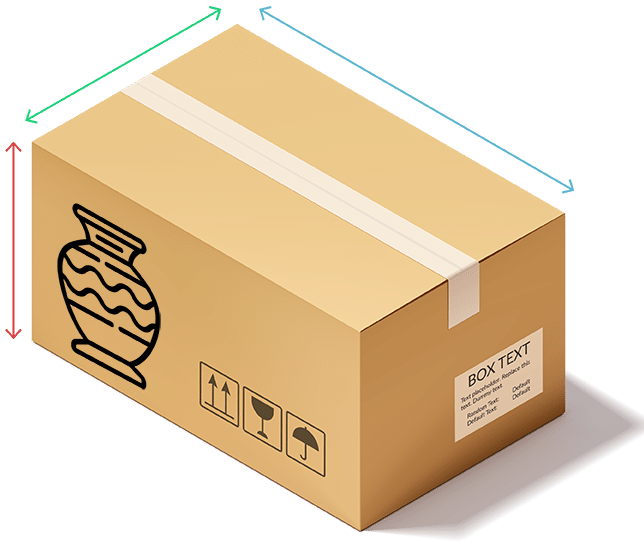
> Actual weight (PR) = 3kg
(40 x 30 x 30) / 5000
> Volumetric weight (PV) = 7.2kg
Volumetric weight > Actual weight
Invoiced weight : 7,2kg

> Actual weight (PR) = 3kg
(10 x 30 x 30) / 5000
> Volumetric weight (PV) = 1.8kg
Volumetric weight < Actual weight
Invoiced weight : 3kg
Source: ColisConsult.com
How can you adapt your logistics to weight-based invoicing?
The stated aim of invoicing by weight and volume is to reduce parcel size. So if you’re selling products that aren’t very heavy or bulky, or if the filling of your packages isn’t optimized, you need to review your packaging strategy.
What are the levers?
- Do my products need to be over-packaged?
Some products can be shipped without adding an extra layer of cardboard. This reduces the volume of cardboard and therefore the cost of transport, but above all packaging and payroll costs.
- Is my packaging appropriate? Do you have enough carton sizes to pack your orders?
It is important to determine your typical orders, i.e. the most recurrent orders in terms of volume, in order to find the right packaging.
Some cartons are adaptable in height.
- Review your carrier assignment rules?
Today, you entrust such and such an order to such and such a carrier. These rules are often determined by the total weight of the order. The new invoicing model will certainly change the rules for allocating your orders to carriers.
Some TMSs calculate the right carriers for you according to your criteria (product volume, parcel weight, etc.).
Get support from logistics experts
To optimize your packaging and adapt your logistics to weight-based invoicing, call on our logistics experts. Shippingbo offers you a complete logistics diagnosis. Our supply chain experts will visit your warehouse, analyze your processes, equipment and data, and deliver a clear, precise diagnosis of your logistics performance.
Conclusion
Volumetric weight is the calculation that takes into account the volume of a parcel in comparison to its weight. While this method of calculation has long been used in air freight transport, it is increasingly being used by ground carriers. The PV, or volumetric weight, is a major issue, both ecologically and economically. It is calculated as follows: (width x length x height in cm) / by the carrier’s ratio.
While volumetric weight is a major challenge for carriers, it’s also important for e-commerce professionals to master this calculation method and the logistics specificities that go with it.
Find out more about our white paper on parcel labels, essential for tracking and presenting parcel weight.
