In 2024, the second-hand market will be worth around 7 billion euros in France and 64 billion dollars internationally, with annual growth in excess of 15% according to a recent study (according to ENOV). Second-hand is no longer a marginal trend: it is now a strategic lever for e-tailers.
Driven by the rise of responsible consumption and the search for bargains, the recommerce market is as attractive as it is challenging. While the commercial opportunity is clear, the logistics issue remains complex. How can we efficiently manage unique products, ensure their traceability, and optimize their remarketing without increasing costs?
- Logistics challenges in the second-hand market
- Key stages in an efficient circular supply chain
- How can you adapt your warehouse to recommerce?
- The role of WMS and OMS in second-hand logistics
- Outsource or insource your second-hand logistics?
This article gives you the keys to structuring smooth, profitable second-hand logistics tailored to the specific needs of textiles, high-tech and furniture.
Logistics challenges in the second-hand market

In France, the average shopper spends around €102 a month on second-hand goods, and this figure is set to continue rising in 2025, according to ECommerce Nation.
Implementing a second-hand offer involves more than just accepting returns or reselling unsold goods. It requires a complete rethink of the logistics chain, since flows, storage methods and order preparation are very different from those of new goods. A process error can turn a sustainable initiative into an operational sinkhole. Understanding the specifics of these logistics is therefore an essential prerequisite.
Differences between new and used logistics
Unlike new products, second-hand items are highly variable: condition, wear, packaging… Each unit is unique. This particularity complicates traditional logistics operations, as it prevents management by standard reference. Second-hand logistics therefore require finer granularity in identification, tracking and storage.
This level of personalization requires adaptation of every link in the supply chain, from receipt to dispatch. Specific processes must be developed to identify, document and trace each item.
The challenge of operating profitability
Handling costs are generally higher in the second-hand sector, due to the sorting and inspection stage. To be profitable, you need to automate what you can, and rationalize information and processing flows. Second-hand profitability requires optimization at every link in the supply chain.
This also requires constant vigilance with regard to stock rotation: the longer a product remains in the warehouse, the more it costs. Logistics agility thus becomes a lever for economic performance.
Key stages in an efficient circular supply chain
The second-hand logistics process generally follows 5 key stages: collection, evaluation, classification, unit storage, and omnichannel publishing.
An efficient circular supply chain is based on a fluid, industrialized sequence of several specific stages. To prevent processing time from becoming a loss factor, it is essential to reduce the friction between receiving, repackaging and putting products back online.
Collection and Reverse Logistics
The first link is the return or collection of the product. This reverse logistics phase involves organizing an incoming flow: either from the customer (post-purchase return), or from a collection point (drop-off point, store, etc.). The efficiency of this flow determines everything else. It must be fast, traceable, and well coordinated with information systems.
Brands can also consider partnerships with collection operators (partner chains, associations, relay points) to improve territorial coverage and fluidify incoming flows.
Product logistics grading
Logistics grading, also known as product classification, involves assessing the condition of a used item in order to determine its price and commercial presentation.
Every product received goes through this stage: the operator inspects, cleans, tests if necessary, then classifies the product according to its condition (“as new”, “very good”, “good”, etc.). This stage is decisive not only for pricing, but also for the product sheet. It must be fast, standardized and recorded in the WMS.
Grading aids, such as digital checklists or AI modules for visual defect recognition, help to secure this stage without slowing down operations.
Here is an example of a classification grid generally used in the logistics of second-hand textiles or high-tech products:
| Grading level | Product status | Visible criteria | Adapted sales channel |
| Like new | No trace of use | Brand new, packaging possible | E-commerce site, Amazon |
| Very good condition | Slight marks | No functional defects | Specialized marketplaces |
| Good condition | Moderate brands | Visible use, works well | Vinted, reconditioned B |
| Correct condition | Visible defects | Functional, but worn | Batch sales, destocking |
How do you manage unique SKUs in the warehouse?
A unique SKU corresponds to a product reference specific to each second-hand part. Unlike new parts, it cannot be pooled.
Once classified, the product is repackaged and stored. It must be individually identified: one product = one unique SKU. This unique inventory management is the linchpin of a sustainable supply chain. It enables us to monitor availability in real time and avoid overselling, especially in multi-channel operations.
This unique SKU also feeds the product database, guaranteeing consistency between the declared condition, the visuals and the descriptions distributed via the various sales channels.
How can you adapt your warehouse to recommerce?
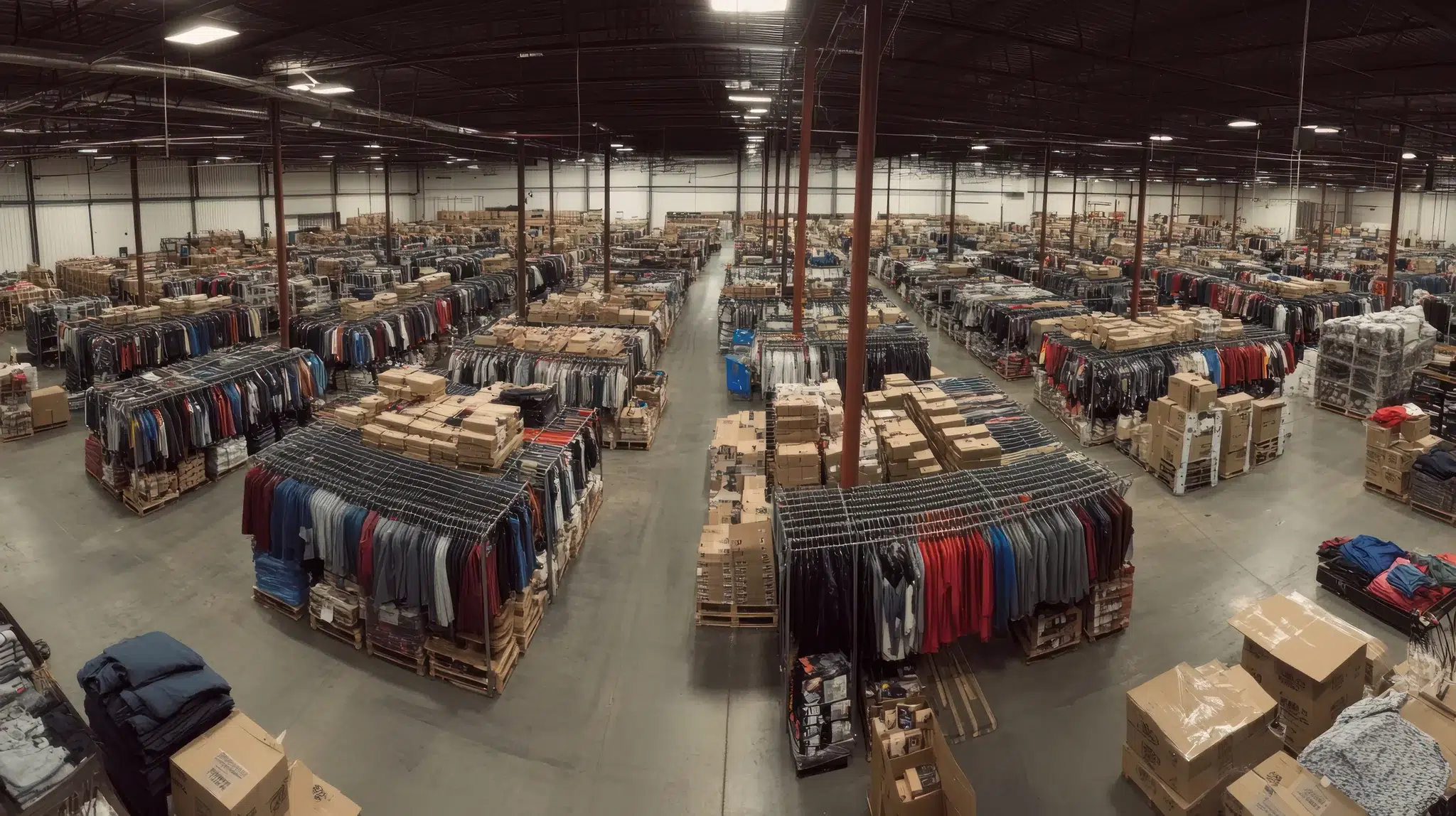
The physical organization of your second-hand warehouse has a direct impact on your logistics costs. Adapting areas, equipment and processes is therefore a lever for operational efficiency.
Optimizing the reception and photo shooting area
In the case of second-hand products, the product’s online presence is highly dependent on its presentation. A dedicated space for photo shoots is therefore essential, close to the reception area. The right layout ensures smooth, rapid processing – the key to second-hand profitability.
More and more merchants are installing semi-automated photo booths, to homogenize visuals and reduce processing time per item.
Example: A second-hand fashion brand can link a photo booth to its reception area to publish an article in less than 5 minutes.
Adapting storage
Used products can be stored in bulk or in defined locations. The challenge is to adopt a hybrid mode, depending on the volume and type of product. The WMS must be able to manage this adaptive logic to guarantee traceability.
Multi-level bin management, combined with good labeling, facilitates rapid access to items for order picking, and reduces picking errors.
Don’t: Don’t store bulk products without individual identifiers, as this can lead to errors and overselling.
Logistics tip: Store your “good condition” products close to fast-picking zones: they turn around faster.
The role of WMS and OMS in second-hand logistics
Second-hand logistics cannot be managed without robust technological tools. The WMS (Warehouse Management System) and OMS (Order Management System) are the pillars of smooth, automated, cost-effective operation.
Guarantee the traceability of each unique part
Each product must be identified, tracked and traced from end to end. The WMS plays an essential role here, managing condition, location, resale or reconditioning status. The sustainable supply chain relies on this ability to control at unit level. Thanks to a WMS each product is associated with a unique barcode as soon as it arrives, then placed in a defined or dynamic location according to its planned rotation.
In addition to WMS and OMS, a TMS (Transport Management System) to efficiently manage shipments, automate carrier selection according to cost and lead-time rules, and ensure post-delivery tracking, even for second-hand products.
This traceability also guarantees the quality of the customer experience, avoiding delivery errors and enabling efficient management of customer returns. A happy customer = better customer loyalty!
Distribute a single inventory across multiple channels
An item must be visible on all sales channels (Amazon, Vinted Pro, e-commerce site) but deactivated as soon as it is sold. It’s the role ofOMS to synchronize these flows. Unified stock management avoids errors, improves rotation, and increases second-hand profitability.
Here are the benefits of effective OMS + WMS synchronization:
- Lower oversold rate
- Acceleration of time-to-market after collection
- Simplified returns processing
- Reduce idle inventory with better global visibility
Outsource or insource your second-hand logistics?
Second-hand logistics can be handled in-house or by an external partner. The right choice depends on your logistics maturity, your volumes, and your need for branding control.
Internalization gives us greater control over logistics grading,used-product labeling and customer returns processing.
Outsourcing, through a specialized logistics partner, enables us to gain volume and access to expertise in reconditioned logistics and second-hand transport.
In both cases, using a solution like Shippingbo enables you to centralize operations, automate workflows and maintain a 360° view of your business. It also offers a scalableIt also offers a scalable architecture, capable of adapting to changing volumes, without compromising existing logistics processes.
Thanks to its WMS and OMS modules, Shippingbo helps merchants to achieve more agile logistics, even for the most heterogeneous products.
Cost-effective recommerce: it’s possible with the right logistics
Second-hand logistics is not a “cut-price” business. It requires rigor, adaptation, high-performance tools and a green logistics to meet environmental expectations without compromising performance. But with a well-structured circular supply chain, it becomes an engine for growth and profitability.
This logistic model is based on :
- Control of product uniqueness (single SKU, precise grading)
- Dynamic, synchronized inventory management
- Tools capable of managing each flow (WMS, OMS)
- Fine-tuning processes and warehouses to this product-by-product logic
By centralizing operations, automating flows, and ensuring real-time visibility of each unique SKU, merchants are adopting the standards of a logistics 4.0Connected, agile and data-driven, solutions such as Shippingbo enable e-merchants to embark on new business with complete peace of mind.
With Shippingbo, e-commerce merchants can industrialize their second-hand logistics, without sacrificing productivity or margins.
You’ve figured out how to structure profitable second-hand logistics, but the real difficulty begins when you sell your unique products on several platforms at once: discover in our white paper how to orchestrate high-performance omnichannelity and guarantee D+1 shipments, even with unified inventory and complex flows:

FAQ – Second-hand logistics
Management of unique SKUs. Unlike new goods, each item has a specific condition and must be processed, stored and tracked individually, making order preparation and inventory more complex.
The right WMS allows you to create product sheets on the fly at the receiving stage,assign a unique barcode to each item, and manage dynamic storage locations to optimize space.
Grading is the incoming product qualification stage. Operators assess the item’s aesthetic and functional condition, and assign it a grade (A, B, C) to determine its resale price.
Glossary
SKU (Stock Keeping Unit)
A unique code assigned to a product, enabling it to be identified, tracked and managed in a logistics system.
Grading
Method of classifying a used product according to its general condition (like new, very good condition, good condition, etc.).
WMS (Warehouse Management System)
Warehouse management software to organize logistics flows, storage locations, order picking and inventories.
OMS (Order Management System)
Order management system that centralizes multi-channel flows, synchronizes inventories in real time and orchestrates shipments.
TMS (Transport Management System)
Transport management tool that automatically selects the right carrier, issues labels, tracks packages and manages returns.
Reverse Logistics
All operations related to the return, sorting, repackaging or resale of goods.
Logistics 4.0
Connected and automated logistics, based on data, intelligent software and interconnection between all links in the chain.
Green logistics
All logistics practices designed to reduce environmental impact, such as optimizing transport or using eco-responsible packaging.