
Faced with rapidly changing customer expectations and increasingly complex purchasing paths, more and more merchants are turning to headless e-commerce. This technical approach, based on the separation of front-end and back-end, offers greater flexibility, performance and omnichannel agility. But how do you adopt it in practice? And, above all, how do you connect this structure with high-performance, fluid and automated logistics?
Headless e-commerce is increasingly attracting merchants looking to reconcile performance, technological flexibility and logistical excellence. This architecture, based on the separation of front-end and back-end, is particularly attractive to growing e-tailers who want to accelerate their time-to-market while adapting to an omnichannel ecosystem.
- What is headless e-commerce?
- What are the advantages of headless architecture?
- What are the disadvantages of headlessness?
- For whom is headless relevant?
But what exactly is headless e-commerce? Is it for every company? And above all, how do you connect this technical structure to your logistics to avoid silos? Answers in this article.
What is headless e-commerce?

Headless e-commerce is based on a simple yet powerful principle: the separation of the front-end (the shop window) from the back-end (the internal mechanics). Unlike traditional architectures, this approach gives e-tailers greater flexibility, speed and freedom of customization. To fully understand its benefits, however, it’s important to grasp the technical basics and practical issues involved. Here’s how it works.
Simple definition and analogy
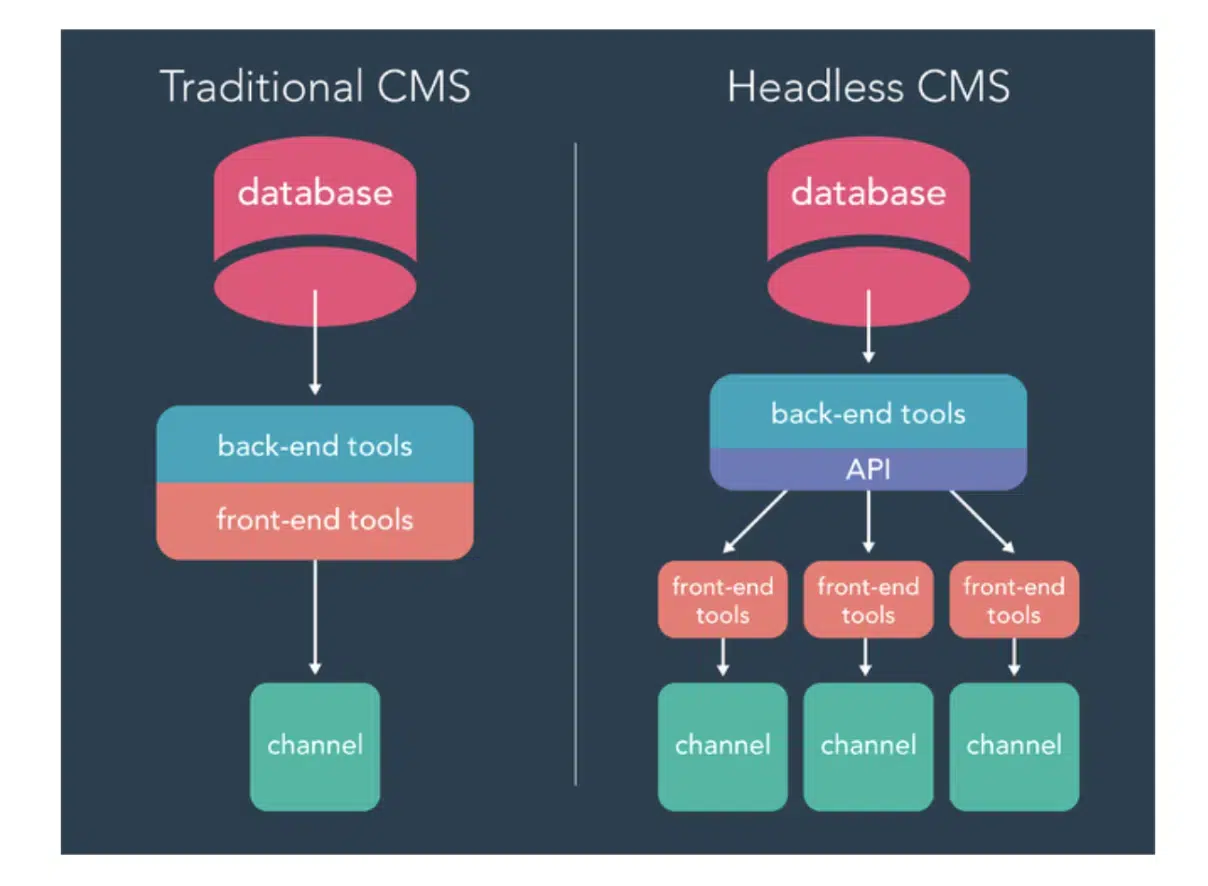
Headless e-commerce consists in dissociating the site’s visible interface (the front-end) from its operational engine (the back-end), while connecting them via APIs. Each component becomes autonomous, but perfectly synchronized thanks to automated workflows.
Let’s take a simple analogy: imagine a restaurant where the kitchen and dining room are separated by a hatch. The menu (the front) can be changed at will, without ever disrupting the operation of the kitchen (the back). You can serve at the table, deliver or offer click & collect, without changing your recipe.
This logic enables merchants to deploy a variety of interfaces (website, app, kiosk, marketplace) while maintaining a centralized system for managing products, orders and inventory.
Front-end vs. back-end: the decoupled approach
In a traditional architecture, the CMS is monolithic: the front-end is directly dependent on the back-end. Any visual or functional change can impact the technical structure, slowing deployment and blocking innovation.
Conversely, headless development is based on a decoupled model, in which the front-end (developed using modern frameworks such as React, Next.js or Vue.js) is totally independent. It consumes data via API without having to interact directly with the business base. This offers several advantages:
- each team (tech, product, logistics) works independently,
- the front end can be optimized for each channel,
- data remains unified, consistent and up-to-date in real time.
This structure paves the way for a fluid omnichannel experience, advanced personalization of the customer journey, and native interoperability with tools such as OMS or modern WMS (like Shippingbo).
What are the advantages of headless architecture?
Adopting a headless architecture means opting for a more flexible, faster and more connected system. The benefits go far beyond simple front/back separation: they concern thecustomer experience as much as technical performance and business scalability. Here are the three main benefits to bear in mind.
Front-end flexibility and customization
The main advantage of headless design is the creative freedom offered to the front-end. Gone are the limitations of templates imposed by traditional CMS: developers can design customized interfaces, optimized for each medium (desktop, mobile, PWA, kiosk, etc.).
This makes it possible to create differentiated buying paths, adapted to the specific buying behaviors of a persona or segment. A DNVB, for example, will be able to test a new immersive product experience without touching its back-end.
This agility is also invaluable for marketing teams, who can test, iterate and personalize without depending on back-end developers, with measurable results in terms of conversion rates and retention.
Omnichannel and scalability
With a headless architecture, each sales channel becomes an independent point of entry, but all synchronize on the same data base. Products, prices, stock and promotions are automatically pushed to the website, app, marketplaces or in-store screens.
This is the key to truly omnichannel e-commerce, capable of adapting to consumer habits without creating a rupture between platforms. And above all, this structure is scalable: it’s easy to add new channels or markets without overhauling the whole system.
Combined with a connected OMS like Shippingbo, this enables centralized management of logistics flows, even as sales outlets, warehouses and marketplaces multiply. A major lever for rapid growth, without operational friction.
Performance and technical agility
Headless also optimizes overall site performance. By offloading the front-end to a CDN (Content Delivery Network), pages load faster, which improves the user experience… and search engine optimization (SEO).
On the technical side, each system component is isolated: if a front-end needs to evolve, it can do so without disrupting the back-end, and vice versa. This reduces the risk of production bugs, and accelerates development cycles.
Finally, this architecture is ideal for modern DevOps environments, with CI/CD pipelines, automated testing and robust API governance. In short: more stability, more responsiveness, more innovation.
What are the disadvantages of headlessness?
Although headlessness is seductive because of its flexibility, it is not without its constraints. It requires technological maturity, a clear vision of the architecture to be put in place, and appropriate resources. Here are the main obstacles to consider before taking the plunge.
Dependence on tech teams
The power of headlessness lies in APIs, JavaScript frameworks and data flow orchestration. This requires a technical team capable of managing these components, from front-end development to connector integration.
In other words, an SME without a structured dev team is likely to find itself dependent on external service providers for every modification or addition of functionality. This can slow down the company’s responsiveness and lengthen time-to-market. Even if low-code headless platforms are emerging, the level of expertise required remains higher than for a monolithic turnkey CMS.
Integration costs and complexity
Adopting a headless approach also means accumulating specialized software bricks: CMS, PIM, ERP, OMS, WMS, TMS… Each component must be integrated via APIs, configured, secured and maintained over time. These integrations can result in :
- significant initial development costs,
- maintenance costs if orchestration is poorly thought out,
- risks of disconnection between tools if APIs change or are not aligned.
Support from a partner like Shippingbo – which offers a 100% API-compatible suite – helps to alleviate this complexity by centralizing logistics flows, while securing exchanges between systems.
For whom is headless relevant?
A well-thought-out headless architecture only works if each brick is connected seamlessly and automatically. That’s where Shippingbo comes in. Its OMS, WMS and TMS suite is based on 100% API-ready logic, perfectly compatible with decoupled environments.
OMS, WMS, TMS 100% API-ready
Shippingbo has been designed to integrate into the heart of modern e-commerce workflows. Thanks to its API-driven infrastructure, every interaction – from order to shipment – can be triggered automatically, without manual intervention. Whether retrieving an order, updating stock or sending a tracking number, data flows in real time.
This logic enables e-tailers to connect Shippingbo to their headless front-end without any flow interruption. Interfaces are decoupled, but operations remain centralized, reliable and industrialized.
Interconnection with headless CMS, PIM, ERP
One of Shippingbo’s great strengths lies in its ability to interface with existing tools, whether a headless CMS such as Contentful, a PIM such as Akeneo, or an ERP such asOdoo or Sage. Our connectors enable rapid, secure, long-term integration.
In a headless environment, this fluid interconnection avoids re-entries, reduces errors and ensures total consistency between the e-commerce site, the product database, stock and logistics. In this way, the company maintains a modular yet perfectly synchronized architecture.
Use cases: decoupled order management, omnichannel logistics, automated shipping
Let’s take a case in point: an SME using Shopify in headless mode, enhanced by a PIM, and wishing to streamline its logistics management. Thanks to Shippingbo, orders are automatically transferred to OMS as soon as they are validated. Stock is updated in real time, including on marketplaces, thus avoiding stock-outs.
In the warehouse, the WMS optimizes order preparation using intelligent scenarios. Once the parcel is ready, the TMS automatically selects the most suitable carrier according to defined rules. Customers receive their tracking number without delay, enhancing the post-purchase experience.
This scenario perfectly illustrates the value of a connected logistics base, indispensable in a high-performance headless strategy.
Headless e-commerce: what you need to know
Headless e-commerce is not just for web giants. It offers a powerful, scalable alternative for organizations wishing to grow rapidly, while retaining control of their customer experience, front-end and logistics.
By decoupling interfaces, companies gain in flexibility, deployment speed and omnichannel consistency. However, for this approach to work to its full potential, it must be underpinned by connected, reliable and automated logistics.
Shippingbo does just that, integrating seamlessly with CMS, ERP and PIM systems used in headless architectures. Thanks to its 100% API-ready OMS, WMS and TMS, you can synchronize your flows, automate your operations and guarantee your customers a seamless shopping experience.
Unify your tools for greater efficiency. Watch this webinar to find out how to unify logistics and customer relations in a fluid and efficient system:
