
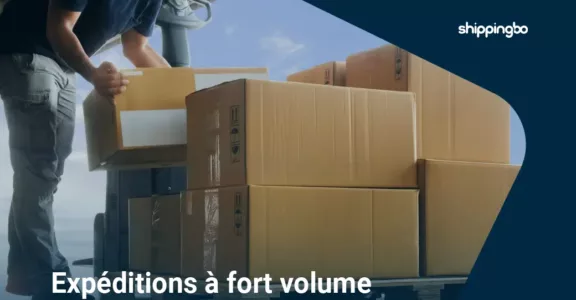
It’s possible to ship hundreds or even thousands of orders every day, without stress or errors. But you still need the right tools and the right reflexes! Whether you’re growing or in a rush, this article will guide you step by step to successful high-volume e-commerce shipping.
Managing high-volume e-commerce shipments is no longer a luxury reserved for large organizations with unlimited resources. Today, even small and medium-sized businesses are faced with ever-increasing order volumes, particularly with the rise of marketplaces, the diversification of sales channels, and the explosion of peak periods. Black Friday, sales, flash sales, influencer campaigns… the opportunities to see orders double or even triple in the space of a few days are multiplying.
- Why high-volume shipping is becoming a major challenge for e-tailers
- The logistical challenges of large-scale shipping
- 5 levers for successful high-volume shipping
- Why does a solution like Shippingbo make all the difference?
At the same time, consumer expectations have changed radically. They want fast delivery, real-time tracking and the guarantee of receiving exactly what they ordered. A simple delay or preparation error can be enough to tarnish customer relations and damage your reputation on review platforms or marketplaces. For e-tailers, logistics is no longer a secondary expense: it’s a vector for differentiation and a lever for growth.
But meeting this requirement while preserving margins requires a structured approach. Centralizing orders, automating logistics tasks, optimizing transport costs, real-time management… these are all key success factors. Without rigorous organization and appropriate tools, even the most dynamic structures can quickly find themselves overwhelmed.
Why high-volume shipping is becoming a major challenge for e-tailers

Large-scale shipping is no longer the preserve of e-commerce giants. Today, many small and medium-sized businesses are faced with large order volumes, sometimes even comparable to those of major retailers, particularly during peak periods. To remain competitive, merchants need to adapt their logistics and tools to this new reality.
Rising orders and customer expectations
The boom in e-commerce, the rise of marketplaces, the multiplication of promotional campaigns and new consumer habits have radically changed the situation. SMEs can now reach several hundred orders a day, particularly during sales periods, Black Friday or product launches.
But this growth is accompanied by ever-increasing demands: fast delivery, real-time tracking, irreproachable customer experience. Consumers expect the same quality of service, whether they order from a small brand or an international platform. Successful high-volume shipments are now a prerequisite for the survival of any company that wants to build customer loyalty.
Limits of manual or non-specialized systems
Despite increasing volumes, many merchants continue to manage their logistics with unsuitable tools: Excel files, aging ERP systems or poorly integrated e-commerce platforms. These solutions quickly show their limitations when it comes to handling mass orders.
The consequences are numerous and can put a lasting brake on growth:
- Frequent shipping errors due to manual entry
- Delivery delays due to lack of coordination between stages
- Poorly synchronized inventory between sales channels
- Increased mental workload for teams under constant pressure
- Lack of real-time visibility on the status of orders or returns
Without high-performance e-commerce logistics software, it’s hard to keep pace and guarantee fast, reliable shipping, especially when sales are soaring. Adopting a specialized solution is therefore essential for securing and scaling your e-commerce business effectively.
The logistical challenges of large-scale shipping

When order volumes explode, logistics become a strategic lever… or a bottleneck. Without the right tools and optimized processes, every shipment can become a source of stress, delays and cost overruns. To meet the challenge of large-scale e-commerce logistics, it’s essential to identify the main sticking points and provide concrete solutions.
Team productivity
Increasing order volumes, especially during peak periods, put growing pressure on logistics teams. Without the appropriate tools, each stage of the process – from order preparation to theprinting of carrier labels – relies on repetitive manual tasks. With little automation, these actions quickly become bottlenecks that slow down warehouse productivity. What’s more, the punctual arrival of reinforcements (temporary or seasonal workers) requires rapid training, which mobilizes internal resources that are already under strain.
In this context, a lack of logistical structure leads to fatigue, mental overload and reduced quality. To keep pace, it becomes essential to standardize processes and equip yourself with an e-commerce WMS capable of industrializing tasks: optimized picking, automated stock tracking, intelligent preparation rules… The result: better organization, fewer errors, and a team focused on high value-added tasks.
Error rates and delays
As the volume of shipments increases, the likelihood of logistical errors explodes: reversed references, forgotten products, incomplete addresses or incorrect carrier selections. Each incident is costly for the company: return costs, after-sales service, customer refunds, loss of sales… not to mention the negative impact on brand image.
On marketplaces, these errors can have direct consequences: loss of the buy box, delisting or contractual penalties. A single poorly dispatched parcel can jeopardize a customer’s trust, or even generate a poor public rating. To counter this, it is imperative to rely on solutions such as automated picking, coupled with good e-commerce logistics software, to ensure reliable flows and fast, compliant dispatch.
Rising logistics costs
Logistics costs are not limited to delivery costs: they encompass the entire order processing cycle, from receipt to final delivery. Overly long preparation times, unsuitable packaging, stock errors, poorly managed returns… these are all friction points which, when accumulated, considerably reduce the unit margin, especially when the customer expects free or express delivery.
On a large scale, without management tools, it becomes difficult to know where and how to optimize. Poor flow management leads to duplication, poorly distributed shipments and additional warehouse costs. Integrating an e-commerce TMS into your logistics ecosystem makes it possible to automate the choice of the most cost-effective carrier, pool shipments and control logistics costs, while meeting delivery commitments. This type of solution provides companies with real-time visibility of their performance and potential savings levers.
5 levers for successful high-volume shipping

Coping with a steady increase in orders without compromising service quality requires much more than just additional staff. To ensure the success of high-volume e-commerce shipments, it’s essential to rely on tried-and-tested methods and high-performance tools. Here are the 5 key levers to activate to maintain control and maximize the efficiency of your logistics flows.
Structuring your order management (OMS)
An OMS e-commerce (Order Management System) is the first link in a controlled logistics chain. It centralizes all orders from your different sales channels: website, marketplaces, B2B sales, etc.
Thanks to real-time stock synchronization, OMS prevents out-of-stock sales and enablesorders to be intelligently routed to the most appropriate warehouse. By reducing data entry errors and duplicate orders, OMS helps you ensure reliable order processing, even during peak periods. OMS also enables you to automate processing rules according to product type or location, considerably reducing manual tasks.
Automate preparation (WMS)
Order picking is one of the most time-consuming processes in logistics. With an e-commerce WMS (Warehouse Management System), you can structure all flows within your warehouse.
This type of software enables you to manage picking locations, reserve zones, stock movements and picking strategies adapted to your volumes (pick and pack, beehive burst, PDA, etc.). It’s ideal for setting up automated or semi-automated picking, depending on the size of your warehouse. By automating these steps, you can drastically reduce picking errors, boost warehouse productivity and make your teams more autonomous, even during peak periods.
Optimize shipping (TMS)
Manually selecting a carrier or printing labels one by one is not viable on a large scale. A good e-commerce TMS (Transport Management System) automates the entire fast shipping process.
This system automatically selects the most suitable carrier according to customizable rules: weight, cost, lead time, geographical zone… It also manages label printing, tracking, returns management and the sending of tracking information to the customer. With a TMS, you can ensure same-day shipping while keeping your logistics costs under control, a decisive advantage in maintaining your competitiveness on marketplaces.
Adapting to peaks in activity
Periods of high demand can put a strain on an unprepared logistics organization. With the right tools, it’s possible toabsorb a peak in orders without losing service quality.
For example, by automating low value-added tasks, your teams can focus on priorities. The system can also generate specific rules during peaks in activity: routing to secondary warehouses, prioritizing urgent orders, temporary management of new carriers.
You can also train temps more easily, thanks to simple interfaces and software-guided processes, reducing errors and integration times.
Gain visibility on flows
Efficiently managing high-volume e-commerce logistics also means having clear indicators and a real-time overview of all your operations. Integrated software suites (such as those offered by Shippingbo) give you access to comprehensive dashboards to monitor your performance: dispatch rates, processing times, errors, delays, volume per channel…
This visibility enables you toanticipate bottlenecks, identify areas for improvement and optimize your resources. By centralizing data, you also reduce manual exchanges between logistics teams, customer support and management.
Why does a solution like Shippingbo make all the difference?
When the volume of orders becomes substantial, manual logistics quickly reach their limits. This is where a solution like Shippingbo comes into its own. Designed for growing e-tailers, Shippingbo combines the three pillars of operational efficiency in a single platform: an OMS to centralize and orchestrate orders, a WMS to optimize preparation and inventory, and a TMS to streamline shipping and control transport costs. This integrated approach provides lasting process structure, reduces human error and saves precious time, especially during peak periods.
In addition to the tools, Shippingbo offers a unified vision of logistics: teams have real-time access to all the information they need to make the right decisions, prioritize tasks and guarantee a smooth, reliable customer experience. Thanks to over 200 plug-and-play integrations, the solution adapts easily to existing CMS, marketplaces, carriers and business tools, without the need for complex developments. Shippingbo thus becomes not only a logistics performance lever, but also a growth gas pedal, capable of supporting the ambitions of the most dynamic SMEs.
Reaching a critical shipping volume? It’s time to automate.
Request a free demo of Shippingbo and discover how to simplify and accelerate your logistics today.
