
According to recent FEVAD data, 68% of the French population will have purchased at least one parapharmaceutical product online by 2024, reflecting the significant adoption of digital channels for the purchase of health and well-being products (source: Atrium).
However, e-commerce health logistics demand much higher standards than traditional e-commerce. Parapharmacy, nutraceuticals, food supplements and lightweight medical devices are all subject to strict constraints: expiration dates, batch traceability, hygiene standards and health safety. In this context, logistics performance is measured not just in terms of speed, but above all in terms of reliability and regulatory compliance.
- Health e-commerce logistics: specific constraints in the health and well-being sector
- E-commerce health logistics: the role of the WMS in order picking
- Healthcare e-commerce logistics: secure transport and delivery
- Omnichannel e-commerce health logistics: towards unified logistics
Unlike hospital logistics, which focus on internal B2B flows, healthcare e-commerce logistics are aimed directly at the end consumer. It must therefore combine health safety, customer experience and omnichannel promise. For DNVBs and specialized e-tailers, controlling constrained inventories is becoming a strategic lever for sustainable growth.
Health e-commerce logistics: specific constraints in the health and well-being sector

E-commerce health logistics are based on an inescapable reality: health, wellness and parapharmacy products are subject to much stricter regulatory, sanitary and quality constraints than other e-commerce categories. The slightest logistics failure can result in risks for the consumer, regulatory sanctions and an immediate loss of confidence.
For players in the parapharmaceutical, nutraceutical and active cosmetics sectors, logistics has become a strategic pillar. It is no longer limited to preparing and dispatching orders, but must guarantee permanent compliance throughout the entire healthcare supply chain, from supplier reception to delivery to the end customer’s home.
Critical SLED management and the FEFO method
Managing best-before dates is one of the main challenges facing parapharmacy and dietary supplement logistics. Poor management of expiration dates not only leads to direct financial losses, but also to major regulatory risks.
In this context, the FEFO (First Expired, First Out) method has become the reference standard. Unlike FIFO, which dispatches the product entered into stock first, FEFO systematically prioritizes the product with the nearest expiration date. This logic is essential to guarantee consumer safety and limit the management of out-of-date products.
Efficient FEFO stock rotation relies on reliable, real-time information. Each batch must be identified as soon as it is received, with its associated expiry date, so that the logistics system can automatically direct order picking. This approach is particularly critical in just-in-time healthcare environments, where volumes are high and lead times short.
| Criteria | FIFO | FEFO |
| Output logic | Older entry | Closer to expiry |
| Obsolete risks | High | Very low |
| Health compliance | Insufficient | Adapted to sanitary requirements |
| Management complexity | Low | Requires WMS |
| Suitable for Parapharmacy | No | Yes |
Total traceability: management of batch numbers and recalls
Batch number traceability is a key regulatory requirement in healthcare e-commerce logistics. Each product must be traceable individually, with a clear link between the manufacturer’s batch, the order and the end customer.
In the event of non-compliance or a health alert, product recall management must be immediate. A high-performance system can instantly identify which customers have received the batch concerned, which orders are still in stock, and which flows need to be blocked.
Health traceability is not just a compliance tool. It is becoming a lever of trust for brands, particularly in sensitive sectors such as dietary supplements, light medical devices and dermo-cosmetics.
Warehouse health and safety standards
Medical warehousing is structured around compliance with health logistics standards. Warehouses must be organized to guarantee strict hygiene conditions, adapted to the storage of pharmaceutical and nutraceutical products.
Logistics hygiene rules include the separation of zones, control of traffic flows, operator training and traceability of operations. These requirements are aimed at preventing any risk of contamination and reinforcing logistical health safety.
In an e-commerce context, these standards need to be applied on a large scale, without slowing down operations. This is where process structuring and the support of an appropriate logistics system become essential.
E-commerce health logistics: the role of the WMS in order picking
In e-commerce health logistics, the WMS plays a central role. It is no longer just an operational optimization tool, but a true guarantor of flow conformity and safety, capable of automatically applying sanitary rules (FEFO, batches, quarantine) to each stock movement, without depending on human intervention.
Avoiding picking errors: a health imperative
In parapharmacy order preparation, picking errors are unacceptable. A batch inversion, a wrong DLUO or an incorrect reference can have health and regulatory consequences.
The WMS secures every step: scanning of locations, batch validation, automatic date control and strict compliance with the FEFO method. These mechanisms reduce human risks and guarantee reliable, compliant e-commerce health logistics.
In concrete terms, when the same product is stocked in several batches with different BBDs, the logistics system needs to be able to automatically prioritize the right batch for dispatch, even at times of peak omnichannel activity.
Isolate high-risk products and manage quarantine
Quarantine management is one of the pillars of logistics sanitary safety. Certain products need to be temporarily isolated: suspected non-compliance, supplier disputes or quality alerts.
A high-performance WMS enables these references to be unambiguously identified, blocked and traced. This capability is essential for preserving stock integrity and securing the entire healthcare supply chain.
Automate the production of regulatory documents
Healthcare e-commerce logistics requires precise, traceable documentation. Regulatory labeling, CN23 customs documents, specific certificates: any administrative error can block a flow.
Automating these documents via the WMS makes operations more reliable, speeds up shipments and secures international flows, particularly for the transport of healthcare products.
In conclusion, in an e-commerce health logistics context, the WMS does more than just orchestrate flows. It must apply strict, reproducible sanitary rules to each operation. In concrete terms, an adapted WMS must enable :
- Automatically apply the FEFO method to ensure priority shipment of products with the earliest expiry date
- Ensure unit traceability by batch number, from receipt to delivery to the end customer
- Isolate and block products in quarantine in the event of a quality or non-conformity alert
- Secure order picking thanks to systematic controls to limit picking errors
- Maintain omnichannel compliance by applying the same sanitary rules across all sales channels
Coupled with a OMS (Order Management System), the WMS centralizes orders and synchronizes inventory in real time across all omnichannel channels, guaranteeing consistent application of FEFO and sanitary traceability rules, whatever the sales channel.
Healthcare e-commerce logistics: secure transport and delivery
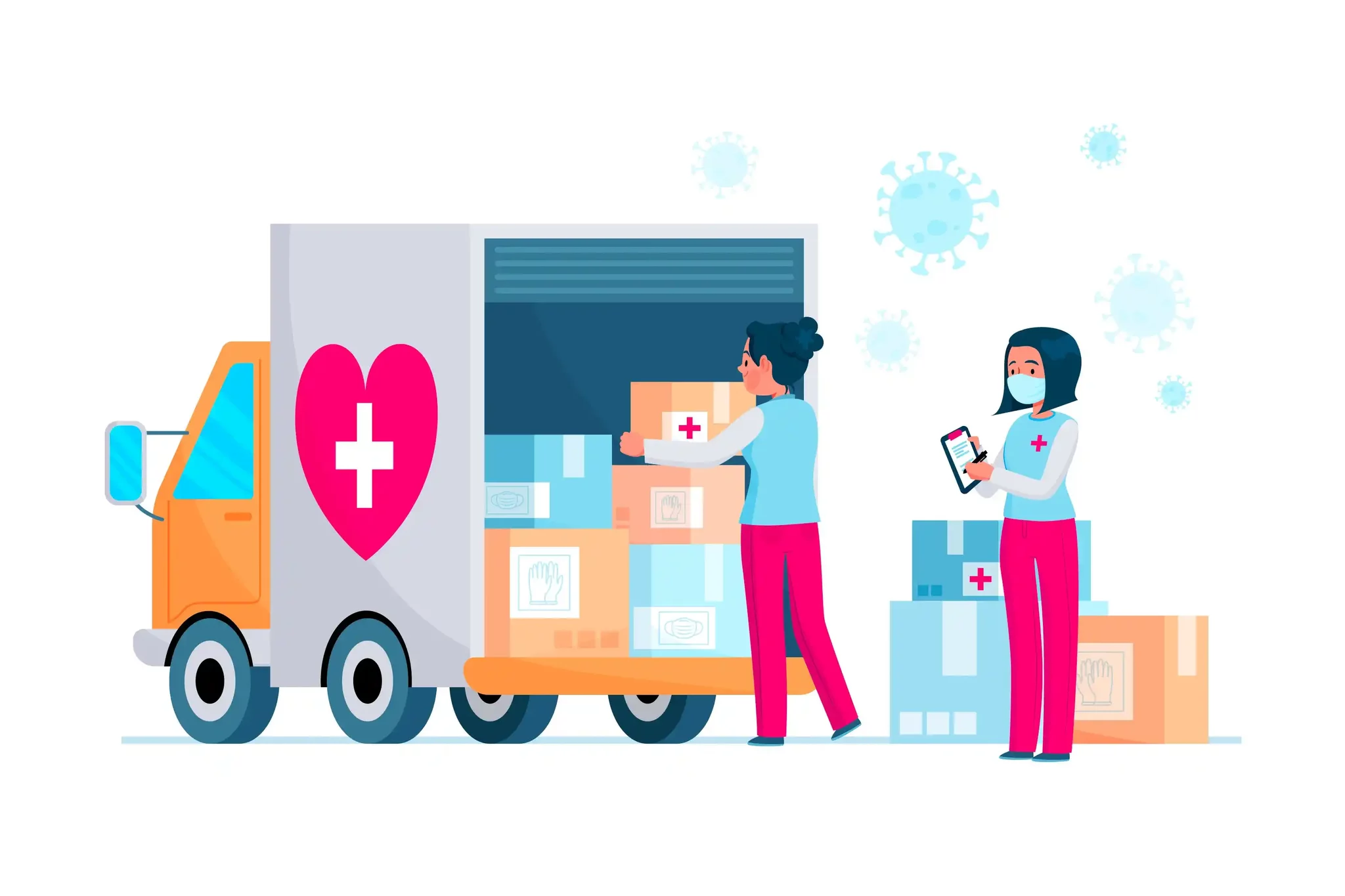
Transport is a critical link in e-commerce healthcare logistics. It extends compliance requirements beyond the warehouse, all the way to the end customer’s home, guaranteeing compliance with handling, temperature and discretion conditions throughout the last mile.
Ensuring package integrity
Healthcare products require specially adapted solutions: isothermal packaging, reinforced cushioning and compliance with handling constraints, in order to guarantee safe shipping of fragile products. shipment of fragile products health and regulatory requirements. For certain products, discretion is also essential, with neutral, unidentifiable packaging.
This is particularly true for home delivery of medicines and sensitive products, where confidentiality is an integral part of the customer experience.
Package tracking as a reassurance tool
Tracking is a major confidence-building factor. In healthcare messaging, transport temperature monitoring and real-time notifications reassure customers that transport conditions are being respected.
Accurate tracking also reduces customer service calls and strengthens brand credibility in a world where trust is crucial, while contributing directly to customer satisfactiona key loyalty factor in e-commerce healthcare logistics.
This security also relies on the use of a TMS (Transport Management System), capable of selecting carriers adapted to healthcare products, automating label printing and ensuring accurate tracking of shipments right through to the end customer.
Omnichannel e-commerce healthcare logistics: towards unified logistics
Omnichannel has become a standard in the healthcare and parapharmacy sectors. Consumers expect a seamless experience between e-commerce, marketplaces and physical points of sale, with total continuity of stock, FEFO rules and health traceability whatever the ordering or collection channel.
Connecting web stores and physical pharmacies
Omnichannel healthcare logistics rely on perfect stock synchronization. Web, marketplaces and physical pharmacies must share a single, reliable vision.
This unification makes it possible to comply with FEFO and batch constraints throughout the network, while supporting high-performance just-in-time health management. It is a strategic lever for brands wishing to grow without compromising compliance.
Secure your healthcare e-commerce growth today
E-commerce healthcare logistics is based on three inseparable pillars:
- regulatory compliance,
- total traceability
- and constrained inventory control.
Shelf-life management, the FEFO method, batch number traceability and compliance with health logistics standards structure the entire chain, from storage to delivery.
In an omnichannel context, these requirements can no longer be handled manually or via generalist tools. They require a WMS capable of orchestrating sanitary rules, automating controls and securing every flow, even on a large scale.
Choosing a logistics tool that is ill-suited to health constraints exposes e-tailers to regulatory, financial and reputational risks that are hard to make up for.
With Shippingbo, you can rely on a solution designed for healthcare e-commerce logistics, capable of managing FEFO, batch traceability, product quarantine and omnichannel flows from a single platform.
Do you want to make your operations more reliable, strengthen your compliance and support your growth without health risks? Find out how Shippingbo structures efficient, sustainable healthcare logistics:

FAQ
FEFO stands for First Expired, First Out. In contrast to FIFO, it prioritizes the shipment of products with the closest use-by or minimum durability date (DLUO). This approach is essential in e-commerce health logistics to reduce waste, limit expired product management and guarantee logistical health safety.
Batch management enables complete upward and downward traceability. In the event of a health alert on a production batch, the logistician must be able to identify in a matter of seconds all the customers who have received this batch, block any remaining stocks and trigger product recall management in compliance with regulatory requirements.
Transport security relies on several levers: the use ofsuitable packaging (wedging, thermal protection or isothermal packaging if necessary), the choice of reliable carriers via a TMS and the provision of accurate parcel tracking. These elements guarantee product integrity and reinforce end-customer confidence.
Glossary
DLUO
Best Before Date. Indicates the period during which a product retains all its properties, particularly critical in parapharmacy and nutraceuticals.
FEFO (First Expired, First Out)
An inventory management method that prioritizes the dispatch of products with the earliest expiration date, a benchmark in healthcare logistics.
WMS (Warehouse Management System)
Warehouse management software for inventory control, order picking, FEFO rules, batch traceability and quarantine management.
TMS (Transport Management System)
Shipping management tool for selecting carriers, editing labels and tracking deliveries of healthcare products.
Logistics quarantine
An area or status of stock where suspect or non-conforming products can be temporarily isolated to prevent accidental shipment.