

As volumes increase, sales channels multiply and customer requirements become ever more stringent (speed, traceability, reliability), the question is no longer whether you should structure your tools, but how to build an architecture capable of absorbing growth without generating inventory errors.
- OMS ERP WMS architecture: why it’s confusing (and why it should be)
- OMS ERP WMS architecture: the role of ERP (and its limits)
- ERP WMS OMS architecture: OMS, WMS, TMS… what’s the use of each brick?
- ERP WMS OMS architecture: case study of Semic Distribution (Sage + Shippingbo + Atoo Next)
- OMS ERP WMS architecture: 5 best practices for scaling without stock errors
During this webinar on February 26, 2026, Michel Donat (Atoo Next), Pierre-Olivier Demailly (Shippingbo) and Arthur Pehau (Semic Distribution) shared a clear vision: ERP, OMS and WMS have complementary roles, and it’s their articulation that conditions your logistics performance.
OMS ERP WMS architecture: why it’s confusing (and why it should be)

Many teams mix up scopes: the ERP is asked to “do the warehouse”, the WMS to “become the global source of truth”, or the OMS is placed in the wrong place. The result: stock stalls, slow synchronization, cobbled-together processes, and teams compensating by hand.
The central idea reiterated during the webinar was simple: it’s not the tool that makes the performance, it’s thearchitecture.
OMS ERP WMS architecture: the role of ERP (and its limits)
According to Michel Donat,ERP is first and foremost software that centralizes a company’s activities. It includes accounting, sales, purchasing, repositories (items, customers, suppliers) and pricing policy.
The major benefit: everyone works with the same data, in the same place. A product created by purchasing becomes immediately saleable by sales, and usable for invoicing.
But the webinar emphasizes one point: many legacy ERPs are less “open” or less adapted to modern logistics uses (real-time, e-commerce connectors, carriers, terminals, fine warehouse management). Hence the importance of relying on more specialized and connected components.
What ERP does very well
An ERP is above all a structuring tool. It centralizes all the company’s data repositories: product catalogs, customer and supplier databases, pricing conditions and sales documents. This centralization ensures that each department works with a single, consistent set of data, thus reducing errors and re-entries.
It also excels at managing pricing rules, discounts, specific B2B conditions and regulatory compliance. Mechanisms for invoicing, VAT, credit notes and multi-company management are natively designed to meet legal and accounting requirements.
Finally, the ERP is responsible for accounting traceability and inventory valuation. It is the guarantor of financial entries linked to sales, purchases and inventory movements. It ensures consistency between physical and financial flows, a critical point for steering and closing the accounts.
Where ERP reaches its limits
While ERP is robust when it comes to structuring and compliance, it is often less effective when it comes to e-commerce and carrier connectivity. Many legacy solutions were not designed to manage real-time flows with marketplaces, CMS or multiple APIs.
Similarly, reactivity can become an obstacle. File synchronization or batch processing are no longer sufficient when volumes are increasing and stock needs to be updated in near-real time to avoid overselling. In these contexts, a specialized component such as OMS or WMS complements the ERP to ensure operational execution and the speed expected in e-commerce.
OMS ERP WMS architecture: what’s the use of each brick?
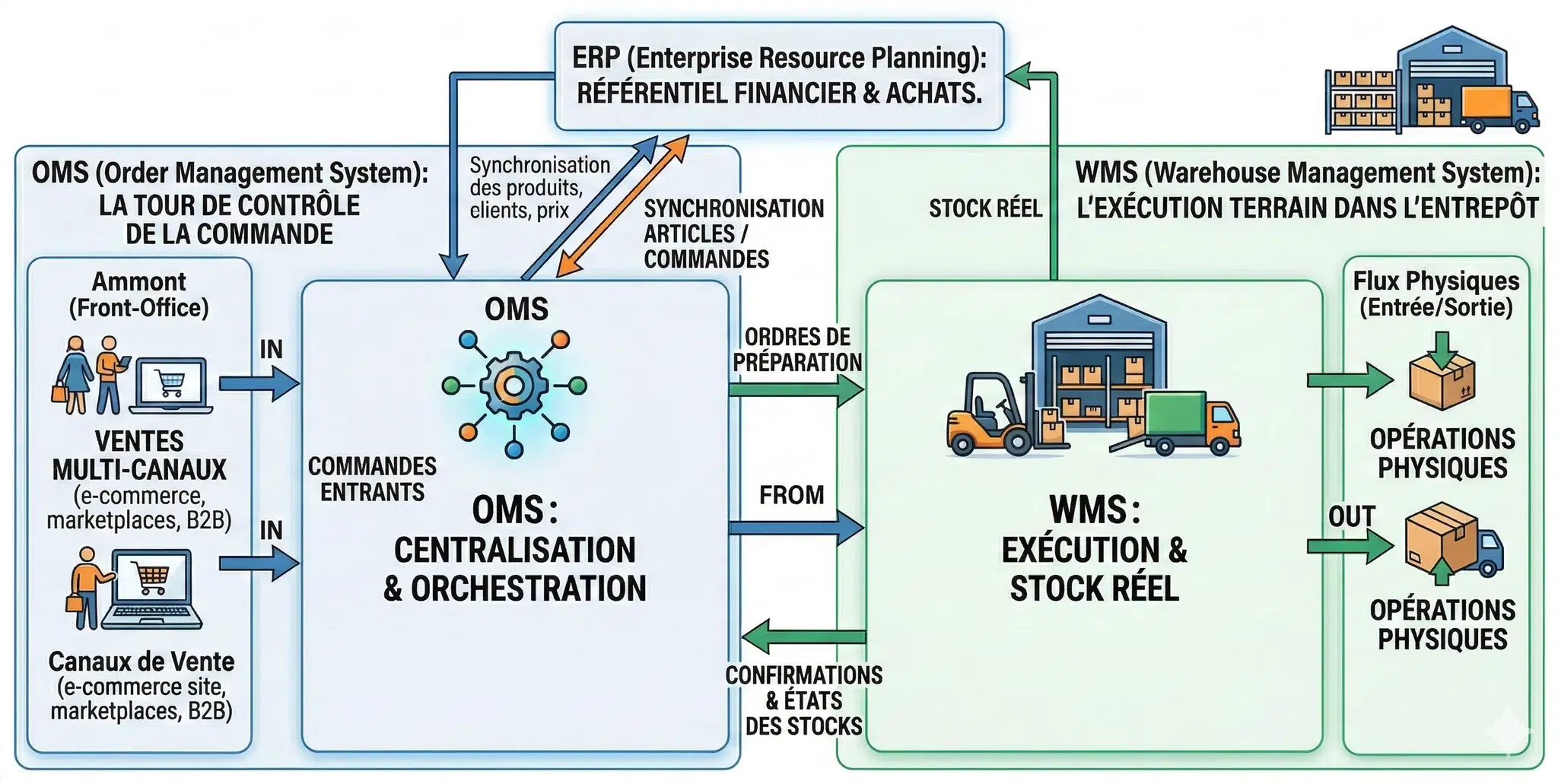
To clarify roles and avoid frequent confusion, Pierre-Olivier Demailly proposes a resolutely operational approach: start with real flows (order, stock, preparation, dispatch) then position each brick (ERP, OMS, WMS) where it brings the most value. The aim is not to pile up tools, but to orchestrate clear responsibilities in order to guarantee data reliability and rapid execution.
WHO as a control tower
OMS centralizes orders and orchestrates flows between sales channels, available stocks and the various preparation points (internal warehouse, 3PL, stores). It acts as a true orchestration layer between the front-office (e-commerce sites, marketplaces, B2B) and logistics execution.
In concrete terms, OMS aggregates all orders, whatever their channel of origin, then applies business rules: prioritization, B2B/B2C separation, stock allocation, choice of shipping site, status management. It constantly recalculates available stock, taking into account orders in progress, scheduled deliveries and reservations.
Its role is also to ensure the consistency of data transmitted to sales channels. By redistributing reliable, synchronized stock, it limits the risk of overselling and improves the customer experience. OMS thus becomes the control tower that guarantees smooth flows and real-time visibility of activity.
WMS for field operations
The WMS lives “in” the warehouse: receiving, warehouse management, picking, packing, inventories. Its role is toexecute and optimize logistics operations.
At receiving, he physically registers products, checks quantities and updates actual stock levels. It then organizes storage according to addressing and location optimization rules. During order preparation, it guides operators along optimized picking paths to reduce movements and errors.
The WMS also controls packaging,label printing, parcel consolidation and rotating inventory management. It is responsible for the reliability of the physical stock, i.e. what is actually present in the warehouse. It is this field data which then feeds the OMS and, by synchronization, the ERP.
ERP WMS OMS architecture: case study of Semic Distribution (Sage + Shippingbo + Atoo Next)
Semic Distribution distributes Studio Ghibli derivative products in Europe, with both B2B and B2C activities. Faced with growing volumes and increasingly complex flows, the company decided to outsource its logistics, while retaining Sage as the central foundation of its information system.
The challenge was not to replace the existing system, but to structure an architecture capable of absorbing the increased workload without generating stock errors or breaks in the accounting chain.
Background and issues prior to the project
The first challenge was to avoid double flows. Without clear orchestration, the same order could be sent twice, or be poorly synchronized between systems.
A clear distinction also had to be made between B2B and B2C flows. Lifecycles, commercial documents and accounting requirements are different, so the separation of sources in OMS made it possible toapply rules adapted to each type of order. Inventory reliability was another major challenge. Inventories carried out by the logistician had to be correctly fed back into the ERP system to ensure consistency between physical and theoretical stock levels.
Backorder management also needed to be clarified, both on the purchasing side and on the customer order side, to avoid misunderstandings and discrepancies in follow-up.
Finally, Semic wanted to finely control thedispatch of orders to the warehouse according to defined statuses, and enrich its product database with precise logistical data (weight, dimensions, packaging rules) to improve preparation and transport.
The choice of architecture
The B2C channel, with its simpler cycle, is connected directly to OMS via a web service. Orders are quickly transferred to the logistics system without complex intermediate accounting steps.
B2B, on the other hand, continues to be handled by Sage. Orders are created in the ERP so as to correctly manage sales documents, invoicing and constraints specific to professional customers. They are then transferred to OMS via the connector developed by Atoo Next.
Once centralized in OMS, orders are transmitted to the logistician’s WMS for execution. Preparation and dispatch statuses, as well as tracking numbers, are then fed back into the system, ensuring complete and consistent visibility of the entire order cycle.
Results observed at Semic
Thanks to this new architecture, Semic has reduced its average dispatch time from 60 hours to 26.4 hours, significantly improving its responsiveness and ability to absorb peaks in activity. At the same time, near real-time stock synchronization (up to 5 times per hour, with adjustable frequency) has reinforced the reliability of available stock, reducing both out-of-stocks and oversales.
If, like Semic, you want to take your logistics management to the next level, request a free demo:

OMS ERP WMS architecture: 5 best practices for scaling without stock errors
- Clarify the responsibilities of each application
- Mapping the exchanges required prior to the technique
- Favoring real time (API/webhooks)
- Anticipate the repository (packs, batches, nomenclatures)
- Resolve the rules governing leftovers (who does what)
Conclusion: secure your stocks, speed up your shipments
When your volumes increase, the challenge is not to pile up tools, but to build a clear, scalable architecture: ERP software to structure the business base and guarantee compliance, OMS to orchestrate and synchronize flows, and WMS to run the warehouse with precision. It is this intelligent distribution of roles that enables us to absorb growth without creating disruptions in the supply chain.
A well thought-out architecture brings you three major benefits: better control of available stock, reduced operational errors and the ability to scale up to new channels or warehouses without overhauling your entire information system.
With Shippingbo, you combine OMS, WMS and TMS in a unified solution to centralize your orders, increase inventory reliability and automate shipping, while maintaining complete visibility of your logistics performance. Our approach is based on clear responsibilities, real-time synchronization and openness via API to integrate with your existing ecosystem.
To find out more about Semic Distribution’s workflows, architecture choices and experience feedback, watch the full replay of the webinar to discover all the discussions and advice shared by our experts:

FAQ
L’ERP couvre la gestion métier (référentiels, achats, ventes, comptabilité). L’OMS orchestre les commandes et le stock disponible entre vos canaux et vos sites logistiques. Le WMS exécute les opérations d’entrepôt (réception, picking, packing) et garantit la fiabilité du stock physique.
Le WMS est maître du stock physique car il reflète la réalité terrain. L’ERP reste essentiel pour la valorisation et la traçabilité comptable. L’important est une synchronisation claire des mouvements et des responsabilités.
En combinant un calcul de stock disponible fiable (via l’OMS) et des synchronisations rapides (API/webhooks). Plus les mises à jour sont fréquentes et cohérentes, plus le risque de survente diminue, notamment en période de pic.
Oui, si l’architecture est évolutive. L’ERP reste le socle métier, tandis que l’OMS/WMS/TMS apportent connectivité, rapidité et exécution logistique adaptées à la croissance e-commerce.
Glossary
API
An interface that enables software programs to exchange data automatically (orders, inventory, status) in real or near-real time.
Webhook
A “push” alert mechanism: instead of waiting for a synchronization, a system sends a notification as soon as an event occurs (order created, stock modified).
Physical stock
The quantity actually present in the warehouse. This is the field reference used for preparation and dispatch.
Available stock
The saleable quantity after taking into account reservations, open orders and business rules. This is the commercial stock to be displayed on your channels.
Stock allocation
The decision to assign an order to a stock and a dispatch site (warehouse, store, 3PL) according toorchestration rules.
Remainder
A missing or partially delivered quantity on a receipt or order. Its management has a direct impact on stock reliability.
3PL
A logistics provider (Third-Party Logistics) who prepares and dispatches your orders. They can use your WMS or their own, with a connection to OMS.
On-premise
Software hosted on the company’s servers, often withintegration constraints that differ from those of a cloud solution.
Batch
Scheduled processing (e.g. hourly) that synchronizes data in batches. Useful, but less responsive than a real-time approach.