
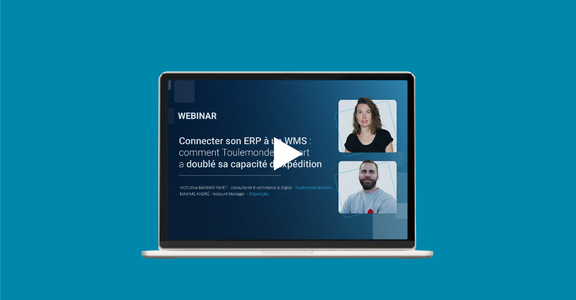
When growth accelerates, an ERP-centric logistics architecture can quickly become an obstacle. In this webinar, discover why connecting ERP and WMS can help your logistics organization evolve, through the testimony of Toulemonde Bochart, which has gained in visibility, reliability and shipping capacity.
When a brand is growing, its ERP is often the foundation on which it is built. But in logistics, there comes a time when this foundation is no longer sufficient to keep up with the real pace of operations. Orders increase, flows become more complex, channels multiply, and teams spend more time compensating than serenely executing.
- Why ERP-centric architecture can block execution
- What you will learn during this webinar
- A case study in knowing when to upgrade your architecture
This is precisely the subject of Shippingbo’s webinar on Thursday, May 28, 2026. In 30 minutes, Toulemonde Bochart will share concrete feedback on a question that concerns many brands that are already structured: when should you connect your ERP to a WMS to regain reliability, visibility and shipping capacity?
Why ERP-centric architecture can block execution

An ERP structures the business, centralizes data and helps to steer the company. But in the field, logistics requires a level of precision and responsiveness that ERP alone cannot always cover. When teams have to manage stock, preparation, movements or shipments with manual workarounds, the problem is no longer a one-off. It becomes organizational.
Signals that your logistics are reaching saturation point
The first signal is the loss of visibility. Stock exists, but it’s not sufficiently reliable or usable in real time. Teams doubt what’s available, juggle several interfaces and secure operations by hand.
The second signal is wear and tear on the teams. Logistics managers spend their time correcting, re-launching and checking. E-commerce managers no longer have a clear picture of what can actually be sold and shipped. Every spike in activity adds to the tension, instead of being absorbed naturally.
The third signal is the difficulty of growing the business without degrading quality. When an architecture is tooERP-centric, it can end up slowing down execution rather than supporting it. Logistics no longer follows growth, it suffers it.
What an ERP-connected WMS means in concrete terms
Connecter un ERP à un WMS, ce n’est pas empiler un outil de plus. C’est clarifier les rôles. L’ERP garde sa fonction de pilotage métier. Le WMS prend en charge l’exécution opérationnelle : gestion des stocks, préparation, contrôle, traçabilité et expédition. C’est cette séparation qui redonne de la lisibilité à l’organisation.
In concrete terms, this makes stock more reliable, operations more fluid and execution capacity more efficient, without the need for a lot of tinkering. We’re no longer asking the same system to do everything. We’re putting each brick in its right place to support growth with greater robustness.
This is exactly the approach taken by Toulemonde Bochart. Historically, the brand relied on inventory management via an ERP extension. To simplify its logistics operations and regain execution capacity, it has upgraded its architecture by connecting its ERP to Shippingbo’s WMS.
What you will learn during this webinar
This webinar has a simple appeal: it doesn’t start from a theoretical promise, but from a real-life case. You’ll see why transformation became necessary, how it was framed and what it has already changed in operations.
Concrete feedback, from diagnosis to first results
Lors de cette session, vous découvrirez d’abord les enseignements de l’audit logistique mené chez Toulemonde Bochart. Vous comprendrez ensuite les limites d’une architecture trop centrée sur l’ERP et la manière dont la marque a structuré une organisation plus adaptée à ses enjeux.
The strong point of this feedback is that it shows benefits that are already visible. The first shared result is clear: shipping capacity has doubled, from around 50 to 100 possible orders per day. For a growing brand, this immediately changes the way volumes are absorbed.
Who will benefit most from this webinar
This webinar is aimed at e-merchants, growing brands and structured accounts already equipped with an ERP, faced with limitations in stock visibility, operational reliability or shipping capacity. It is particularly useful for logistics managers, e-commerce managers and operations directors who need to upgrade their architecture without undermining the existing system.
The webinar will feature Victoria Barbier Payet, E-commerce & Digital Consultant at Toulemonde Bochart, and Maxime André, Customer Development Manager at Shippingbo. Together, they will review the diagnosis, the choices made and the concrete benefits of a successful ERP – WMS integration.
A case study in knowing when to upgrade your architecture
When logistics start to slow down execution, waiting doesn’t simplify anything. As flows become more complex, the need to distinguish between the role of theERP and that of the WMS becomes increasingly important.
In this webinar, we’ll use a real-life case study to show how one brand has developed its architecture to improve capacity, readability and operational reliability.
Register for the webinar to find out how Toulemonde Bochart doubled its shipping capacity and what this approach can change in your own operations:

FAQ
Because an ERPstructuresthe business, but isn’t always enough to manage day-to-day logistics operations. A WMS allows you tobetter manage stock, preparation and dispatch in the field.
Growing brands, structured e-tailers, logistics managers, e-commerce managers and operations directors already equipped with an ERP system.
You’ll find out why Toulemonde Bochart changed its logistics architecture, how the project was carried out, and what concrete benefits have already been observed.
Glossary
ERP
software that centralizes a company’s overall management, such as purchasing, sales management, finance or product data.
WMS
warehouse management software. It is used to control concrete logistics operations such as stock, order picking, movements and dispatch.
Logistics architecture
organization of tools and flows that enable orders, stocks and information to circulate correctly.