
Traditional retail, online sales or omnichannel strategy? Today’s merchants no longer have a choice: they need to master all the levers to stay competitive. This article helps you to understand the fundamentals of retail and e-commerce, their practical differences and the best practices for deploying an effective omnichannel approach, step by step.
For a long time, retail and e-commerce were perceived as two distinct worlds. Today, they form a complementary whole, with one focusing on the customer experience at the point of sale, and the other on online purchasing performance. For SMEs, retailers and e-tailers, the real challenge is no longer choosing a channel, but connecting them intelligently.
- Definition: retail, e-commerce and e-retail
- Retail vs. e-commerce: the differences that matter
- When to choose one, the other… or both?
- Omnichannel to reconcile retail and e-commerce
- Taking action: the toolbox
- 7-step start-up checklist
- FAQ: the keys to a successful omnichannel approach
In the face of increasingly hybrid buying patterns,omnichannel sales are becoming an essential growth lever. But it’s important to understand the specifics of each model. This guide will help you to distinguish between retail, e-commerce and e-retail, identify the key indicators to monitor and explore the right logistics solutions to take action, with concrete case studies.
This omnichannel model is also part of a D2C (Direct-to-Consumer) logic, where brands seek to sell directly to the end consumer, whether via an e-commerce site, a marketplace or a physical point of sale. This approach enables greater control over customer relations and data management, while reducing the number of intermediaries.
Definition: retail, e-commerce and e-retail

Before developing an omnichannel strategy, it’s crucial to get the basics right. Retail, e-commerce and e-retail may seem similar, but each refers to a specific business logic. Understanding them enables you to better structure your sales channels and lay the foundations for efficient logistics management.
Retail in brief
Retail refers to the sale of products directly to the consumer in a physical outlet. It relies on a tangible customer experience: product viewing, testing, immediate purchase. This model requires local management of inventory, staff and cash registers.
Although effective for building human relationships and strengthening brand awareness, retail is still constrained by fixed hours and on-site logistics.
E-commerce: key features
E-commerce refers to any commercial transaction carried out online, via a website, marketplace or application. The user places an order remotely, with delivery at home or at a relay point.
This model offers significant advantages: 24/7 accessibility, national or international reach, low operating costs. However, it requires a solid supply chain, from inventory management to shipping, as well as reliable digital tools.
For D2C brands, e-commerce is often the main channel. It enables them to control the entire purchasing process, personalize the customer experience and collect valuable data. However, this model requires a robust logistics infrastructure and perfect stock synchronization to maintain the promise of speed and reliability.
E-retail: what’s the difference?
E-retail combines physical commerce with online sales. These are traditional retailers who have integrated digital channels into their strategy. This is also known as the phygital model.
This hybrid operation is based on an omnichannel logic where stocks, orders and points of sale are interconnected. It requires a technological infrastructure capable of synchronizing all data in real time, to enhance the customer experience.
Retail vs. e-commerce: the differences that matter
While the two models may seem similar in that they have the same objective (to sell), their operational logic, costs and tools differ significantly. This section will help you to better understand the strengths and constraints of each…
Costs, margins and operating complexity
Retail involves high fixed costs: rent, personnel, energy. In e-commerce, these costs are lower, but others appear: traffic acquisition, delivery costs, customer service.
The e-commerce model often allows for a more flexible margin, but involves greater logistical complexity. The choice between retail and e-commerce therefore depends on your ability to absorb these constraints.
Supply chain, inventory and delivery
A physical store manages its stock locally. In e-commerce, you need to centralize, forecast volumes and avoid out-of-stock sales. Then there’s last-mile delivery, e-commerce returns and dropshipping.
For hybrid companies, unified inventory management (in the warehouse and in-store) is essential. Here again, omnichannel offers an effective alternative.
Customer experience and data
Retail relies on the human touch and in-store advice. E-commerce, on the other hand, enables advanced personalization thanks to customer data: purchase history, average basket, online behavior.
But beware: without a coherent strategy, this data is difficult to exploit. That’s why it’s so important to centralize data flows, so you can maintain control over the experience, whatever the channel.
| Criteria | Retail (Physical store) | E-commerce (online sales) |
| Main costs | Rent, salaries, fixed costs (energy), local inventories. | Traffic acquisition (digital marketing), delivery costs, customer service, site maintenance. |
| Supply chain | Localized inventory management, point-of-sale logistics. | Centralized inventory management, order preparation, last-mile delivery, e-commerce returns management. |
| Customer experience | Human contact, direct advice, sensory experience. | Data-driven personalization, 24/7 accessibility, fast checkout. |
| Complexity | Operational (personnel management, scheduling). | Technical and logistical (stock synchronization, order orchestration). |
When to choose one, the other… or both?
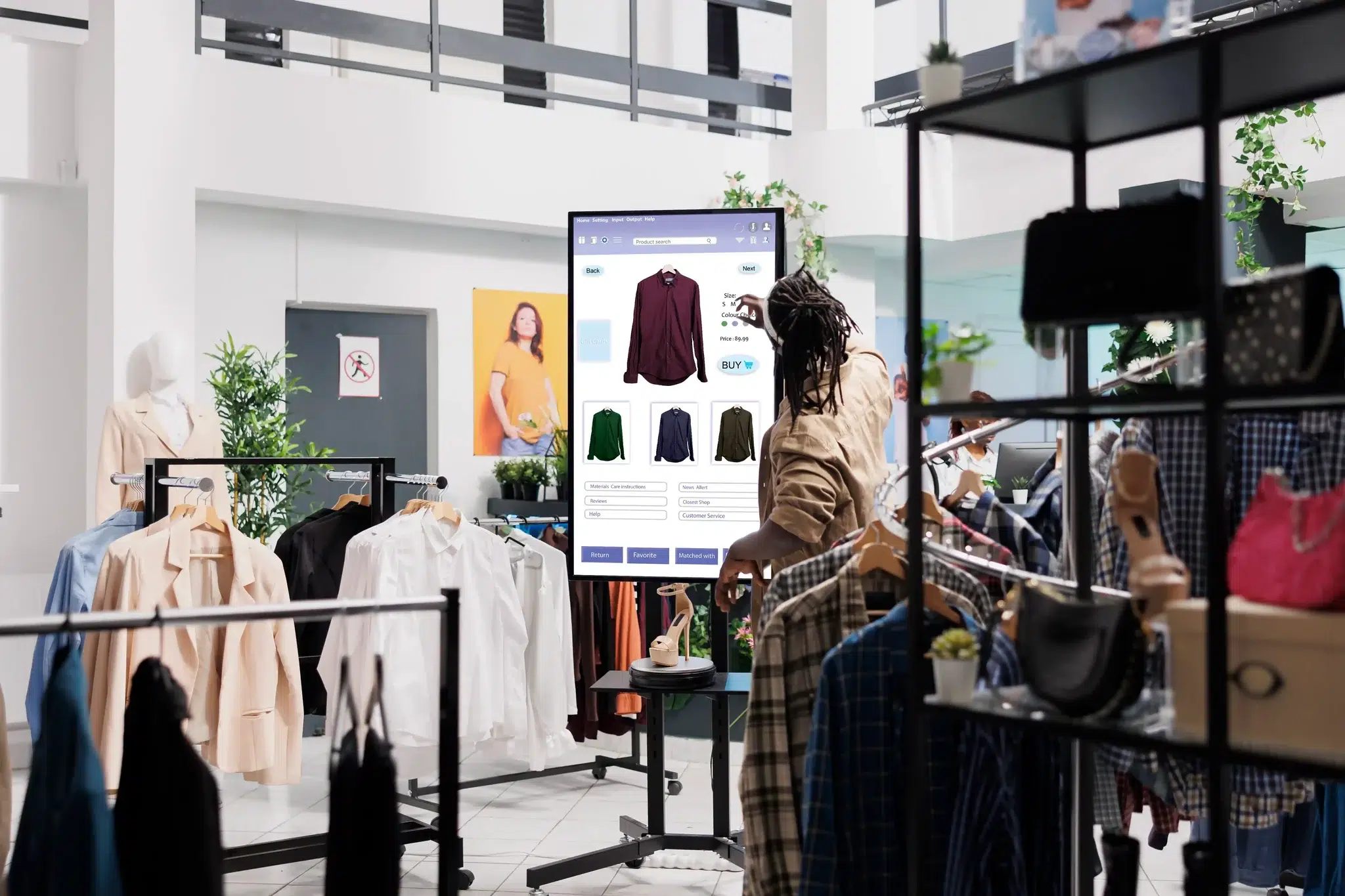
Not all merchants start from the same point, nor with the same resources. Depending on your digital maturity, type of customer or growth ambitions, the ideal model will not be the same. Here are three typical scenarios.
3 typical scenarios for e-tailers
- Pure retail: for local brands with a strong in-store presence.
- E-commerce only: for DNVB or dropshipping companies.
- Hybrid model: the most common today, combining store and website, with Click & Collect or Ship-from-Store.
Each scenario requires different logistics management and adapted tools.
Indicators to monitor (conversion, basket, OTIF)
Before deciding, analyze your KPIs:
- Conversion rates (by channel)
- Medium basket
- OTIF (on-time, in-full)
- Lead time (time between order and delivery)
These indicators guide your strategic choices, showing you where to optimize your logistics or your customer journey.
Omnichannel to reconcile retail and e-commerce
To benefit from the best of both worlds, a well-executed omnichannel strategy enables your sales channels to converge, while improving customer experience and logistics performance.
Use cases: click & collect, ship-from-store, BOPIS
With Click & Collect, the customer orders online and collects the product from the store. The same logic applies to BOPIS (Buy Online, Pick-up In Store).
Ship-from-Store, on the other hand, enables in-store stocks to be used as mini-warehouses for local shipping. These models reduce transport times and costs, while improving product availability.
Prevent out-of-stock situations: centralize inventories
Omnichannelity demands a unified view of inventory. Thanks to connected systems, you know in real time where every item is.
This helps limit stock-outs, optimize restocking, and route orders according to stock availability or location.
Taking action: the toolbox
The success of an omnichannel strategy depends on solid tools capable of connecting your flows, making your stocks more reliable and optimizing your deliveries. These are the three pillars of your logistics system.
OMS: orchestrating orders and promises of delivery
An Order Management System (OMS) centralizes orders, synchronizes stocks and automates routing to the right warehouse or point of sale.
With OMS like Shippingbo, you can keep your delivery promise, improve your OTIF, and make your customer commitments more reliable.
WMS: making preparation and inventory more reliable
The Warehouse Management System (WMS ) enables efficient organization of warehouse flows: receiving, picking, shipping.
It optimizes preparation costs, avoids errors and keeps your inventory up to date. A high-performance WMS is crucial to meeting your deadlines.
TMS: optimizing transport costs and lead times
The Transport Management System (TMS) automates carrier management, choosing the most cost-effective carrier according to your rules (volume, weight, destination).
A good TMS can improve your delivery SLAs, reduce costs, and automatically send tracking numbers to the customer.
7-step start-up checklist
For a successful omnichannel strategy, it’s crucial to take things one step at a time, with a structured approach. Here’s a checklist to make sure you don’t forget anything.
- Map your channels (POS, web, marketplaces)
- Auditing your inventory: centralized or decentralized?
- Identify your logistics flows (store > customer, warehouse > store, etc.).
- Measure your key indicators (OTIF, lead time, return rate)
- Select your tools: OMS, WMS, CMS/ERP-compatible TMS
- Plan technical integration and team training
- Deploy gradually: first one channel, then another, testing logistical resilience
Transform your logistics into an omnichannel performance lever
Retail or e-commerce? Why choose whenomnichannel can optimize both? By connecting your points of sale, your warehouses and your digital channels, you gain in responsiveness and customer satisfaction.
Shippingbo helps you automate your operations, synchronize your inventory and make the transition to efficient omnichannel logistics.
👉 Try Shippingbo today and boost your e-commerce performance

FAQ: the keys to a successful omnichannel approach
Retail refers to sales in physical stores, with a direct customer experience. E-commerce refers to sales made online, often via a website or marketplace. E-retail combines both models. It enables retailers to sell in-store while maintaining a digital presence, synchronizing their activity across multiple channels.
A physical boutique offers strong human contact and a close relationship with customers. However, it is often limited by its geographical area and opening hours. E-commerce enables you to broaden your customer base and sell 24 hours a day, but requires good logistical organization. E-retail represents an opportunity for growth, provided that operations are well coordinated between the physical and digital worlds.
First and foremost, you need to analyze the sales channels already in place. Next, it’s essential tounify inventory management to guarantee availability at all points of contact. Connecting tools (store, website, marketplaces) then ensures smooth sales.Automated order preparation via OMS facilitates ramp-up. Finally,analysis of logistics performance enables us to adjust our strategy over time. This type of approach is particularly useful for companies adopting a D2C model, in order to centralize their flows, avoid stock-outs and unify experiences across all points of contact.
An OMS, or Order Management System, plays a central role in an omnichannel strategy. It consolidates all orders, regardless of the channel used by the customer. Stocks are updated in real time, and orders are automatically directed to the right warehouse or point of sale. OMS simplifies day-to-day management and contributes to a smooth, consistent customer experience.
The first mistake is to anticipate demand incorrectly, which can lead to stock-outs or unnecessary overstocking. Another frequent difficulty is manual stock updating, which leads to errors and missed sales. It’s also common for sales channels not to be synchronized, leading to duplication or discrepancies in availability. These problems can be avoided with the right tools right from the start.
Logistics performance can be measured by a number of indicators. The out-of-stock rate shows whether supply is under control. The error rate in order preparation reveals the quality of execution. Average processing time gives an idea of responsiveness. The logistics cost per order indicates overall efficiency, while the customer return rate provides information on satisfaction. These data enable precise logistics management and continuous optimization.