

Choosing between marketplace and e-commerce is not simply a matter of selecting a sales channel. For an e-tailer or e-commerce manager, this choice affects growth, profitability, customer relations and logistics organization.
Today, e-commerce plays a central role in distribution strategies. In France, this dynamic is confirmed: according to Fevad, e-commerce sales reached 196.4 billion euros in 2025, representing year-on-year growth of 7%, proof that digital channels continue to gain in importance for businesses.
For a long time, marketplaces and e-commerce sites were presented as two opposing models. In reality, the most mature players know that they meet different objectives. The marketplace accelerates acquisition and visibility. The proprietary e-commerce site gives greater control over brand, data and margin. Today, the real issue is not just marketplace or e-commerce site, but how to combine these channels in a coherent logic.
- Marketplace vs. e-commerce site: definitions and comparisons
- Marketplace or e-commerce site: how to choose?
- Why e-tailers combine marketplace and e-commerce site
- Case study: Audilo, an example of a successful marketplace strategy
This article explains the difference between marketplace and e-commerce, compares their strengths and limitations, and explains why many merchants are adopting a mixed approach. Because performance depends not only on the channel chosen, but also on the ability to manage operations, centralize orders and synchronize inventory.
Marketplace vs. e-commerce site: definitions and comparisons

Before deciding between the two models, we need to clarify how they work. While both allow you to sell online, they are based on very different economic and commercial logics.
Understanding this distinction is all the more important given that online sales now concern a very significant proportion of the population. In France, there are over 42 million online shoppers, confirming the central role of e-commerce in companies’ distribution strategies.
The marketplace model
A marketplace is a platform that brings buyers and sellers together in a shared environment. Amazon, Cdiscount, Fnac and ManoMano are among the leading examples of marketplaces. In a B2C marketplace, sellers address consumers directly. In a B2B marketplace, the platform facilitates exchanges between professionals.
The main advantage of selling on the marketplace is immediate access to existing traffic. Merchants benefit from an existing audience, and can quickly list their products without having to build up their reputation alone. This is why many brands use this channel to test an offer, open up a new market or accelerate sales.
But this speed comes at a price. On a marketplace platform, the seller has no control over the overall environment, nor over the rules imposed by the operator. Commissions, competitive pressure, dependence on algorithms and service quality constraints reduce the seller’s room for manoeuvre. The Amazon marketplace operation illustrates this well: performance depends as much on price, availability and service as on the product itself.
The marketplace is therefore a powerful sales lever, but also a more dependent channel, where control of the brand and customer relations remains limited.
The e-commerce site model
The proprietary e-commerce site works in the opposite way. The brand sells in its own digital universe, with its own content, identity, business rules and purchasing path. It controls the user experience, its promotional policy, its customer relations and its image.
However, selling on an e-commerce site requires a greater effort in terms of acquisition. Traffic must be built up via SEO, SEA, social networks, emailing or CRM. Start-up is often more gradual than on a marketplace, but the company builds a more durable asset.
The advantages of an e-commerce site are clear on several dimensions. First, brand control. Second, full access to customer data. Finally, a better ability to manage margins, provided marketing costs are kept under control. The site is not just a sales channel: it’s also a tool for building loyalty, differentiation and profitability.
Advantages and disadvantages of each
Comparing marketplace and e-commerce sites comes down to a trade-off between speed to market and level of control. The main marketplace advantages are :
- existing traffic on platforms such as Amazon and Cdiscount
- rapid time-to-market for catalog testing
- easier access to new customers
- potential forsales acceleration in the short term
But the limitations are real. Commissions reduce margins, access to customer data is restricted, dependence on the platform is high and differentiation remains weak. In some cases, growth can even become fragile if the company relies too heavily on a single channel.
The advantages of an e-commerce site lie more in its strategic autonomy. A brand that sells on its own site retains control over its universe, its sales tunnel, its promotions and its customer experience. It can also better work on loyalty, average basket and customer lifetime value. On the other hand, acquisition takes longer to build.
The table below summarizes the main differences between a marketplace and an online store:
| Criteria | Marketplace | E-commerce website |
| Traffic | Existing traffic (Amazon, Cdiscount…) | Traffic to be built |
| Costs | Sales commissions | Marketing costs/Management costs |
| Brand | Limited control | Total control |
| Customer data | Limited access | Full access |
| Margin | Weaker | Higher |
| Acquisition | Fast | Progressive |
| Dependency | Strong | Low |
| Logistics | Platform constraints | Flexible |
This comparison shows that the question of selling on a marketplace or e-commerce site is not just about sales. It also involves the company’s cost structure, branding strategy and level of autonomy.
Marketplace or e-commerce site: how to choose?
There is no universal answer to the question of which marketplace or e-commerce to choose. The right choice depends above all on the company’s maturity, its business priorities and its ability to manage operations across multiple channels.
Depending on your e-commerce maturity
A young brand or a merchant just starting out online can rely on the marketplace to quickly generate its first sales. The visibility offered by the major platforms reduces the time needed to reach the market, and makes it possible to validate the attractiveness of an offer more quickly.
Conversely, a more mature company will often benefit from strengthening its e-commerce site. When a brand already has a reputation, a structured catalog and marketing resources, it can better exploit the benefits of a proprietary environment: better margins, better control and richer customer relationships.
Thinking about a marketplace or e-commerce site must evolve with the level of development of the business. What’s right for launching a brand is not necessarily right for consolidating its profitability.
Depending on your growth strategy
The choice also depends on the objective being pursued. If the priority is to get volume quickly, a marketplace strategy is often the right choice. It offers rapid access to demand and enables certain markets to be opened up more quickly.
On the other hand, if the aim is to build a strong brand, develop loyalty and improve profitability, the e-commerce strategy makes more sense. The proprietary site then becomes the foundation of the customer experience and value management.
This is where the marketplace vs. e-commerce comparison comes into its own. The marketplace often favors speed of acquisition. The e-commerce site favors control and long-term value. The choice therefore depends less on the channel itself than on the nature of the growth sought.
Depending on your logistics organization
Another decisive criterion is operational capacity. As soon as a company sells through several channels, the complexity increases rapidly. he main operational challenges include :
- marketplace order management on multiple platforms
- e-commerce order management from the proprietary site
- stock synchronization between different sales channels
- management of carriers and delivery options
- customer returns management
Without the right organization, multi-channel growth generates preparation errors, out-of-stock situations, delays and a degraded customer experience. This is why sales performance cannot be dissociated from logistics execution.
In this context, a OMS plays a central role in this context. It centralizes orders, improves omnichannel inventory management and streamlines multi-channel e-commerce management. Combined with a WMS for the warehouse and a TMS for transport management, it helps the company to absorb the complexity associated with growth.
Why e-tailers combine marketplace and e-commerce site

As they become more structured, the most successful merchants stop pitting the two models against each other. They understand that each channel has its function. The marketplace brings visibility and volume. The e-commerce site builds brand, loyalty and profitability. Combining the two is a logical way to diversify and secure revenues.
Marketplace: a powerful acquisition lever
The marketplace is an excellent lever for attracting new customers. It enables you to capture existing demand, accelerate time-to-market and increase your visibility in highly competitive markets. In a marketplace strategy, this channel often plays a conquest role.
But you have to manage it well. The quality of product descriptions, stock availability, logistical responsiveness and pricing control quickly become decisive factors. As volume increases, marketplaces management becomes a strategic challenge.
E-commerce site: building your brand and profitability
The e-commerce site completes this acquisition logic. It’s on this channel that the brand can deepen its customer relationships, work on its image, tell its story and develop its profitability. Mastery of the purchasing process enhances conversion, loyalty and basket value.
From this point of view, the website is not just another sales channel. It becomes the center of gravity of the customer relationship and the business model. Where the marketplace helps to recruit, the site helps to capitalize.
An omnichannel strategy to diversify revenues
That’s why more and more companies are adopting an omnichannel strategy. The aim is not to sell everywhere without consistency, but to exploit the strengths of each channel while limiting dependencies.E-commerce omnichannel allows you to spread out opportunities, better secure growth and avoid basing the entire business on a single source of traffic.
But this diversification is only viable if the execution follows. We need to ensure inventory synchronization, the fluidity of marketplace logistics as well as e-commerce logistics. e-commerce logisticslogistics, and consistent management of carriers and returns. This is precisely what distinguishes a simple multi-channel presence from a truly effective strategy.
Case study: Audilo, an example of a successful marketplace strategy
The Audilo case study is a concrete example of how a well-orchestrated multi-channel strategy can support growth. Specializing in hearing-related products, the company has integrated marketplaces into its sales dynamic in order to strengthen its presence and expand its outlets.
As with many merchants, the challenge was not just commercial. We also had to absorb the increase in flows and limit the operational complexity linked to the multiplication of channels.
Boosting sales through marketplaces
With Shippingbo, Audilo has centralized and optimized order and stock management across all its platforms. This organization has reduced human error, improved service quality and shortened preparation times. At the same time, this improved operational control has helped to sustain sales growth on marketplaces.
This example illustrates an essential reality: the success of a marketplace sale, like that of an e-commerce site, also depends on robust logistics. Without unified management, multi-channel growth can quickly become a source of friction. With the right tools, on the contrary, it becomes a performance lever.
Marketplace vs e-commerce: making the right choice for sustainable growth
The marketplace vs. e-commerce debate should no longer be seen as a rigid opposition. The marketplace is a gas pedal of acquisition and volume. The proprietary e-commerce site is a lever for control, loyalty and profitability. Each responds to different challenges, depending on the company’s maturity and strategic priorities.
For the most advanced players, the best approach is often to combine the two. The marketplace enables you to reach new customers quickly. The e-commerce site consolidates the brand, makes better use of data and improves margins. Between the two, everything hinges on the ability to orchestrate flows and maintain a high level of service quality.
This is where Shippingbo really comes into its own. By centralizing orders, streamlining omnichannel omnichannel inventory management and helping merchants to manage their operations across multiple channels, Shippingbo transforms the complexity of multi-channel operations into a lever for growth. For companies that want to develop their sales without choosing between speed, control and operational efficiency, this approach is a decisive advantage. And now is precisely the right time to structure a strategy that enables marketplaces, e-commerce sites and high-performance logistics to work together.
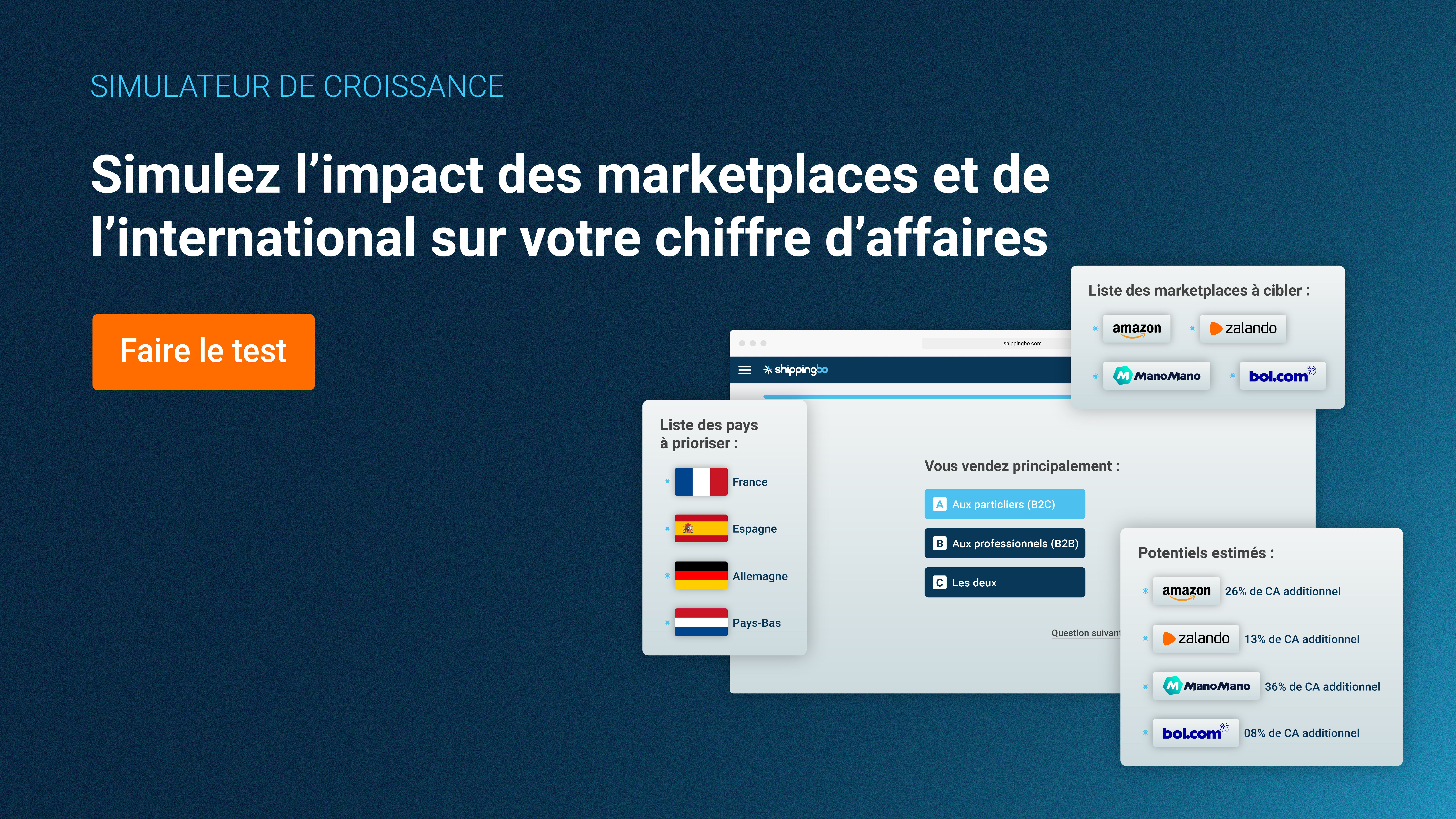
To take things a step further, Shippingbo offers an e-commerce development simulator for marketplaces and international markets. Discover your potential now and prepare for the next stage in your e-commerce development.
FAQ
A marketplace is a platform that brings together several sellers and buyers on a single site. Platforms such as Amazon or Cdiscount enable different brands to sell their products in the same environment.
A marketplace brings together several sellers on a single platform. Conversely, an e-commerce site belongs to a single brand, which sells its products directly and controls the entire customer experience.
Yes, many merchants combine both models in an omnichannel strategy to increase their visibility, diversify their revenue streams and reach more customers.
Marketplaces provide rapid access to a large audience and generate sales more quickly. On the other hand, they generally involve commissions on each transaction, which can reduce margins.
By centralizing orders via OMS e-commerce, you can consolidate flows from marketplaces and the e-commerce site, synchronize inventories and automate part of your logistics operations.
Glossary
Marketplace
Online sales platform that enables several sellers to offer their products to buyers on a single site.
Proprietary e-commerce site
Online store belonging to a brand or company that sells its products directly.
OMS (Order Management System)
Software for centralizing and orchestrating orders from multiple sales channels.
WMS (Warehouse Management System)
System used to manage warehouse operations, including stock preparation and management.
TMS (Transport Management System)
Tool to manage parcel shipping and relations with carriers.
Omnichannel strategy
An approach that involves selling across multiple channels (e-commerce site, marketplaces, stores, etc.) while offering a consistent customer experience.
Stock synchronization
A process that automatically updates stock levels across all sales channels to avoid shortages or overselling.