

Selling on international marketplaces opens up new avenues for growth, without having to immediately launch a local site in each country. But international expansion is only profitable if sales strategy, catalog management, order management and e-commerce logistics all work together.
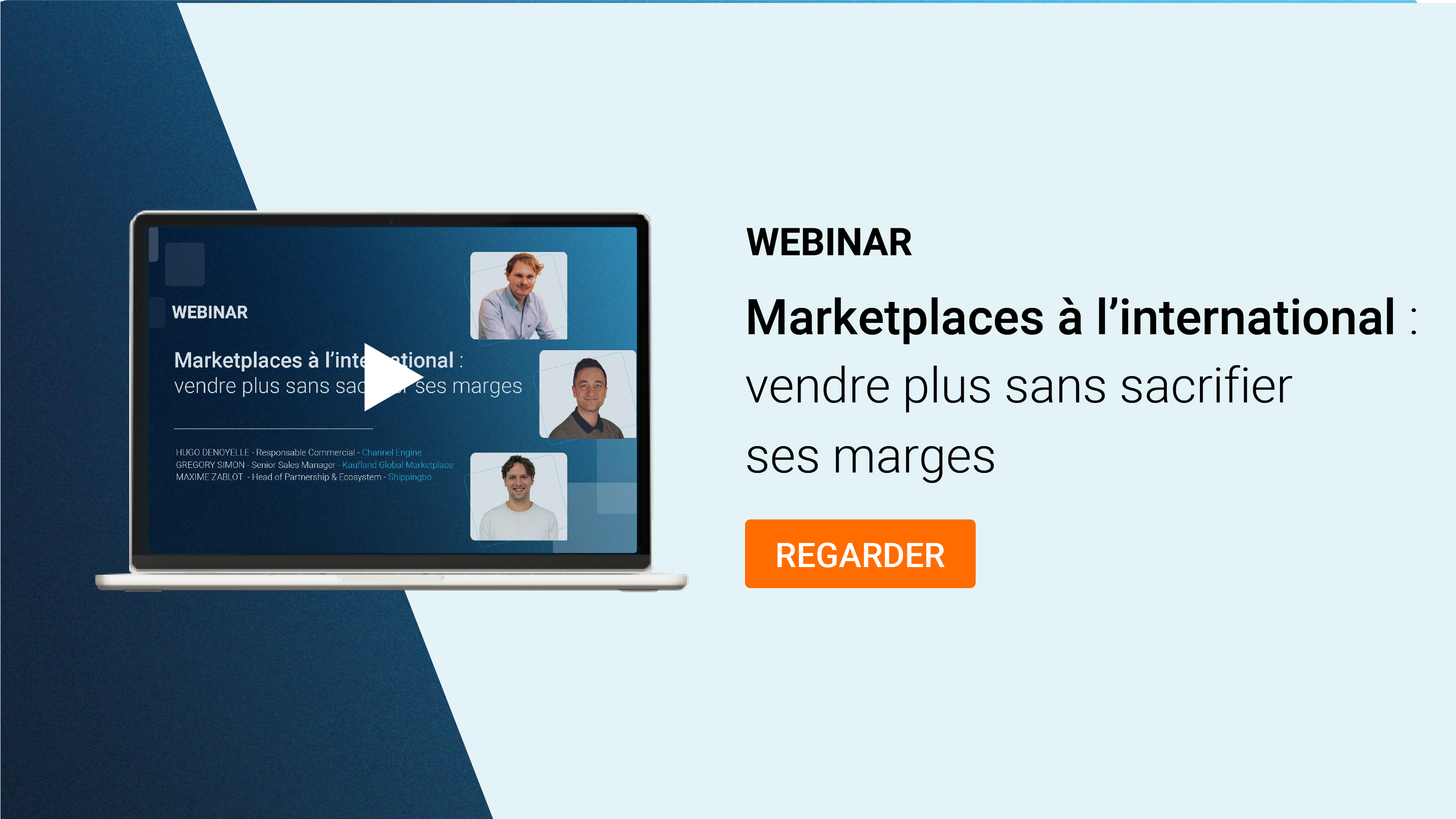
This is the message shared during this webinar with Hugo Denoyelle from ChannelEngine, Gregory Simon from Kaufland Global Marketplace and Maxime Zablot from Shippingbo. What they had in common was to show that it is possible to develop cross-border business without damaging margins, provided you structure your flows from the outset.
- Why international marketplaces are a credible growth driver
- How to preserve margins when volumes increase
The advantage of marketplaces is simple: they enable you to test a market quickly, with an existing audience and lower entry costs than a full e-commerce launch. On the other hand, the more countries you open up, the more critical the issues of translation, pricing, inventory, transport and customer service become.
Why international marketplaces are a credible growth driver

Before opening up new countries, a brand needs to validate two points: the real commercial potential of the market and the level of complexity it is ready to absorb. The first step is to identify the right growth drivers, without dispersing resources.
Why starting with nearby countries reduces risk
For Hugo Denoyelle, many French brands are coming to the same conclusion: growth is slowing down in their domestic markets. Moving towards marketplaces marketplaces can open up new outlets without having to rebuild an entire sales organization.
The key idea of this webinar is not to confuse internationalization with dispersion. Starting with Belgium, Germany, the Netherlands or Italy is often more appropriate than an over-ambitious roll-out in distant markets. Geographical proximity simplifies e-commerce logisticslogistics, reduces lead times and enables faster testing.
Marketplaces play anaccelerating role here. Instead of launching a local site, recruiting traffic and building brand awareness country by country, the brand can rely on a platform that is already familiar to consumers. Time to market is shorter, and learning is quicker.
The importance of cross-border sales in Europe is well established. The volumes are already there, and a significant proportion of transactions take place via marketplaces. For a brand, the question is no longer whether this channel is relevant, but how to use it without losing control of profitability.
How to choose the right marketplaces without adding unnecessary complexity
Choosing a marketplace isn’t just a matter of looking at its size. Above all, you need to ask yourself where the brand will be credible, which country corresponds to its offer, and what operational constraints it will be able to absorb. A good marketplace strategy strategy always starts with this business reading.
Kaufland is a good example of this logic. The platform provides access to several European countries via a single account. This is an important advantage, as it reduces initial friction and facilitates an initial test phase.
The webinar showed that some of the barriers to entry can be absorbed by the ecosystem itself: translating product data sheets, providing support in the merchant’s language, managing payments according to local customs and adapting customer support. These issues are often underestimated, even though they have a direct impact on conversion.
Another useful point: payment and delivery habits vary greatly from one country to another. What works in France is not always what German, Polish or Czech buyers expect. Relying on a marketplace that’s already established locally helps to meet these standards more quickly.
How to preserve margins when volumes increase
Once marketplaces have been chosen, it’s not just a question of selling more, but selling better. To protect profitability, we need to structure flows, automate key operations and adapt logistics organization to the realities of each country.
Why centralizing catalogs and orders is a must
Opening several marketplaces is relatively simple. Managing them over time is much more demanding. As the number of countries, catalogs and orders increases, the slightest manual re-entry undermines performance.
This is precisely the role of a tool like ChannelEngine in the webinar: centralize catalog management, automate product distribution, adapt prices, synchronize information and streamline order management. Without this foundation, scaling quickly becomes synonymous with errors, delays and operational overload.
The real challenge is not to open 10 or 20 marketplaces, but to maintain a stable quality of execution when volumes rise. On marketplaces, service standards are high. A poorly synchronized stock or a deadline that is not met can quickly cost sales.
The case of Calicosy provides a concrete illustration of what a structured organization can achieve. The brand has extended its presence from 4 to 9 countries, opened some 30 marketplaces and increased the proportion of its international sales from 20% to 40%. This result is based not only on greater visibility, but also on better control of flows.
Another key lesson is that the best products in France are not necessarily the best abroad. International marketplaces also serve to identify new growth products, new customer expectations and sometimes better margin opportunities.
Which logistics organization enables you to sell more without sacrificing profitability?
Profitability then comes down to execution. Successful international expansion means absorbing more orders without compromising the customer promise. When volumes increase by 20% or 30%, the warehouse must keep pace.
This is where the complementarity between WHO, WMS and TMS becomes strategic. The WMS centralizes flows and directs orders to the right warehouse. The WMS structures preparation, reduces errors and improves productivity. The TMS helps you choose the right carrier according to country, weight, product and expected level of service.
The webinar reminded us that there is no single right logistical scheme. A brand selling furniture, bulky products or light references will not have the same trade-offs. The right approach depends on the product, the volume, the destination country, the cost of transport and the rate of return.
It may also be appropriate to adopt a hybrid logic. Some of the best references can be stored locally by a logistics provider or in a second warehouse, while the long tail is shipped from France. This approach improves international fulfillment without tying up too much stock.
Finally, the question of price must not be forgotten. Shipping costs, marketplace commissions, local customs and purchasing power vary from country to country. A uniform pricing policy often weakens margins. A pricing strategy adapted to each market better protects profitability.
Watch the full webinar replay
The underlying message is clear: success on international marketplaces depends on more than just opening up new channels. It depends on the ability to align marketplace strategy, catalog management, order management and e-commerce logistics in a single system.
This is exactly where Shippingbo brings value: centralizing flows, orchestrating inventories, making shipments more reliable, and helping brands to support their growth without losing operational control. To review all the feedback, concrete examples and advice shared during the exchange, access the full webinar replay:
FAQ
International marketplaces make it possible to test a country more quickly, with an already active audience and trust already established. For many brands, this is a faster, less risky way of validating a market before investing further.
The key is to manage costs by country: commissions, transport, returns, taxation, service levels and sales prices. Profitable expansion depends on an organization capable of adjusting pricing, flows and logistics to each market.
Yes, because a localized product sheet improves understanding, conversion and brand credibility. Translation shouldn’t just be about language, but also about local customs, payment methods and customer expectations.
You need to anticipate this from the very first launches. Even with low volumes, structured e-commerce logistics avoid stock errors, shipping delays and the extra costs that ultimately slow growth.
Glossary
Cross border
Cross-border refers to the sale of products from one country to another. In e-commerce, this means, for example, a French brand selling in Germany, Italy or Poland.
OMS (Order Management System)
An OMS, for Order Management System, is a tool that centralizes orders from several sales channels. It helps to distribute orders to the right warehouse and maintain a unified view of the business.
WMS (Warehouse Management System)
A WMS, for Warehouse Management System, is warehouse management software. It is used to organize order picking, inventories, locations and day-to-day logistics operations.
TMS (Transport Management System)
A TMS, for Transport Management System, manages shipments and the choice of carriers. It helps to apply the right rules according to country, product, service level or transport cost.
Fulfillment
Fulfillment covers all logistics operations after the order has been placed: storage, preparation, dispatch and, in some cases, returns management. It’s a key element in keeping the customer promise while protecting profitability.
Repricing
Repricing consists in automatically adjusting a selling price according to pre-defined rules. The aim is to remain competitive on a marketplace without selling at a loss.